Facts
The Plaintiff (Appellant) filed a suit for declaration of title over 1.691 hectares of land, seeking to declare four sale deeds executed between 1981 and 1983 in favor of Defendant Nos. 1 and 2 as null and void, and for a permanent injunction.
Source reference: para. 4The Plaintiff claimed the land was purchased via self-earned income and the sale of his wife's ornaments, asserting that his brothers’ names were included in the deeds by mistake.
Source reference: para. 6Defendant No. 4 (Plaintiff’s wife) filed a counter-claim asserting title over 1.205 hectares as stridhan.
Source reference: para. 5, 8Defendant No. 1 contended the property was joint family property acquired from joint income.
Source reference: para. 7The Trial Court dismissed both the suit and the counter-claim on 27.01.2012, holding the land to be joint family property.
Source reference: para. 9The First Appellate Court dismissed the subsequent appeals on 02.05.2016, affirming the Trial Court’s findings.
Source reference: para. 3, 13Issues
1. Whether the suit property was the self-acquired property of the Plaintiff or joint family property.
Source reference: para. 9, 122. Whether the impugned sale deeds were nominal transactions liable to be declared null and void.
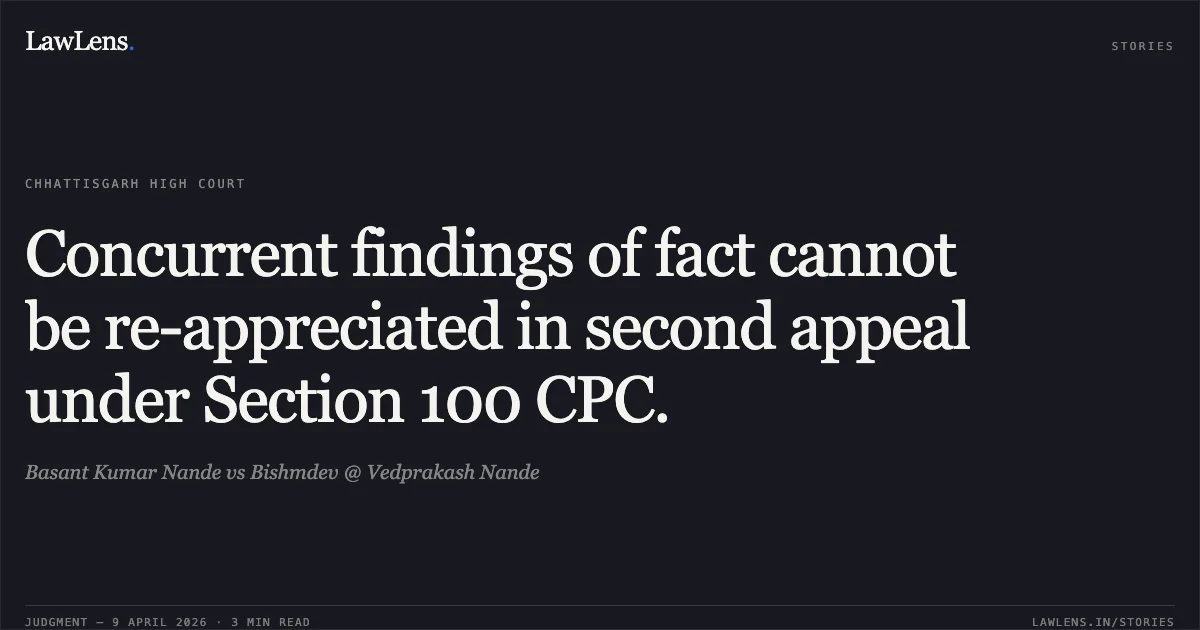
Source reference: para. 10, 123. Whether the concurrent findings of fact by the lower courts warrant interference under Section 100 of the CPC.
Source reference: para. 13, 144. Whether the appeal involves any substantial question of law.
Source reference: para. 14, 9 (second series)Law Applied
The court primarily applied Section 100 of the Code of Civil Procedure (CPC), which restricts the scope of a Second Appeal to cases involving a "substantial question of law".
Source reference: para. 1, 14It relied on the principle that concurrent findings of fact are binding unless shown to be perverse, based on no evidence, or contrary to settled legal principles.
Source reference: para. 7 (second series), 10 (second series)The court further cited State of Rajasthan and others v. Shiv Dayal and another (2019) 8 SCC 637, which establishes that interference with concurrent findings is only permissible if they are recorded de hors the pleadings, based on misreading of evidence, or are judicial decisions no reasonable judge could reach.
Source reference: para. 11 (second series)Reasoning
The High Court observed that the Trial Court had meticulously evaluated the evidence, correctly identifying that the Plaintiff failed to prove exclusive ownership.
Source reference: para. 12Specifically, a key certificate (Ex. P-7) remained unproved as the author was not examined, and another document (Ex. P-8) indicated the land was recorded in the name of a temple rather than being inherited by the Plaintiff.
Source reference: para. 12The court noted that the Plaintiff failed to establish that the 1981–1983 sale deeds were nominal or that any prior partition had occurred; thus, the property was rightly classified as joint family property where the Plaintiff’s possession was merely that of a co-owner.
Source reference: para. 9, 12In exercising its jurisdiction under Section 100 CPC, the High Court determined that the Appellant's challenges related entirely to the re-appreciation of evidence and questions of fact.
Source reference: para. 9 (second series), 12 (second series)Since no perversity or misapplication of law was demonstrated in the concurrent findings of the lower courts, the High Court held that no substantial question of law existed.
Source reference: para. 13, 14Holding
The High Court dismissed the appeal at the motion stage, affirming the judgments of the Trial Court and the First Appellate Court.
The Court held that the concurrent findings of fact—stating the property was joint family property and that the Plaintiff failed to prove the sale deeds were void—did not give rise to any substantial question of law under Section 100 CPC.
Source reference: para. 14, 12 (second series)Relief was denied to the Appellant.
Source reference: no citationActs & Sections Cited
1 provisions across 1 statute referred to in this judgment. Each provision opens on LawLens.
Code of Civil Procedure, 19081
Original Court PDF
Basant Kumar NandevsBishmdev @ Vedprakash Nande
Click to open original judgment
Original judgment, available to read, download and summarize on LawLens.in