Facts
The Appellant (plaintiff) filed a civil suit seeking a declaration of title over land in Khasra No. 164/29, recovery of possession, and a declaration that a revenue order dated 15.06.1996 was null and void
Source reference: para 2The Appellant claimed the land was ancestral property mutated in his name in 1975, but during 1992-93 settlement proceedings, it was renumbered as Khasra No. 164/28 and allotted to Respondent Nos. 2 and 3 without notice
Source reference: para 2The Trial Court dismissed the suit on 27.02.2008, finding a lack of documentary evidence of title and holding that the land was a public pond vested in the State
Source reference: para 4The First Appellate Court affirmed this dismissal on 15.10.2014
Source reference: para 5Issues
1. Whether the findings of the lower courts were perverse or based on a misappreciation of evidence regarding the ancestral nature of the suit land
Source reference: para 6 / para 112. Whether the Civil Court’s jurisdiction was barred under Sections 251 and 257 of the Chhattisgarh Land Revenue Code regarding the challenge to revenue settlements
Source reference: para 4 / para 93. Whether the second appeal involves a substantial question of law under Section 100 of the CPC
Source reference: para 10 / para 16Law Applied
The Court applied Section 100 of the Code of Civil Procedure, 1908, which restricts the High Court’s jurisdiction in second appeals to "substantial questions of law" rather than pure questions of fact
Source reference: para 10It applied Sections 251 and 257 of the Chhattisgarh Land Revenue Code, which bar civil court jurisdiction over matters vested in revenue authorities
Source reference: para 4, 9The Court relied on State of Rajasthan v. Shiv Dayal (2019) to define the limited scope of interference in concurrent findings of fact
Source reference: para 14Russi Fisheries Pvt. Ltd. v. Bhavna Seth & Ors. (2026) to reiterate that even erroneous findings of fact do not warrant interference unless vitiated by perversity
Source reference: para 15Reasoning
The Court observed that the Appellant failed to produce cogent documentary evidence, such as partition deeds or reliable revenue entries, to prove the land was ancestral property
Source reference: para 4, 9The Court noted that if the identity or boundaries of the land were disputed, the Appellant should have sought official demarcation, which he failed to do
Source reference: para 8Furthermore, the Assistant Settlement Officer’s 1996 order—declaring the land a public pond vested in the State—had attained finality as it was never challenged before a higher revenue forum
Source reference: para 4, 9Applying Section 100 CPC, the Court reasoned that the Appellant’s arguments essentially sought a re-appreciation of evidence rather than addressing a legal principle, and since the lower courts’ findings were supported by the record, no perversity existed
Source reference: para 11-12The court emphasized that concurrent findings of fact are binding unless shown to be reached de hors the pleadings or against provisions of law
Source reference: para 14-15Holding
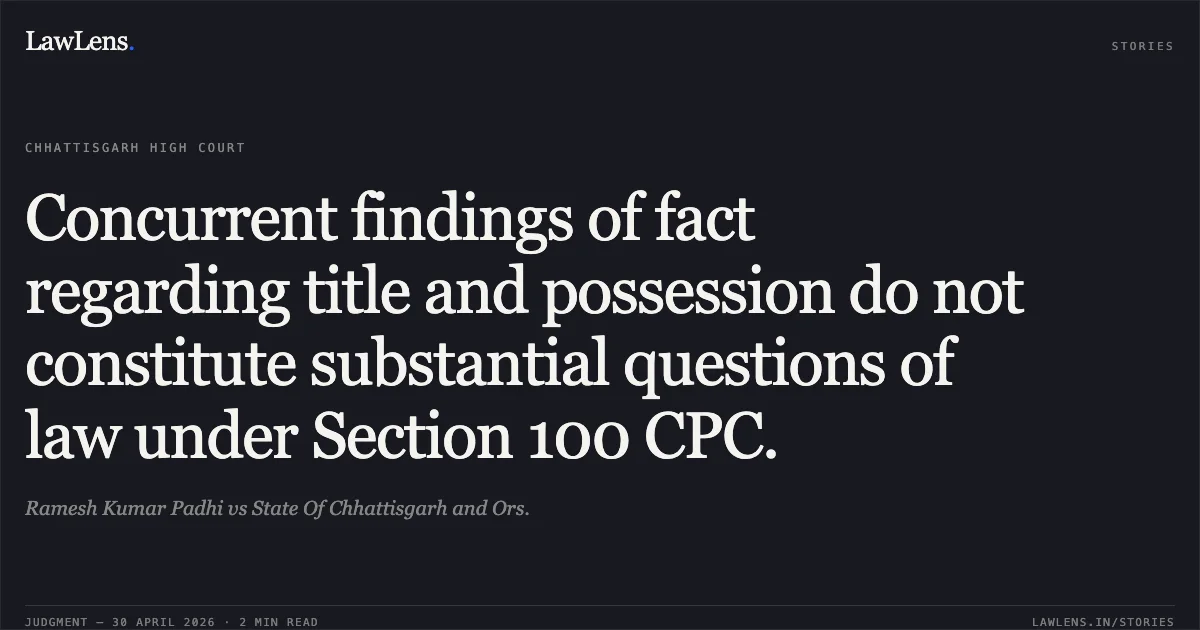
The High Court held that the appeal failed to raise any substantial question of law as required under Section 100 of the CPC
The Court answered the issues by affirming that the lower courts historically and legally correctly identified the land as State property and that the civil suit was barred by the Land Revenue Code
Source reference: para 9, 17The second appeal was dismissed, and the judgments and decrees of the Trial Court and First Appellate Court were upheld
Source reference: para 18Acts & Sections Cited
2 provisions across 1 statute referred to in this judgment. Each provision opens on LawLens.
Code of Civil Procedure, 19082
Original Court PDF
Ramesh Kumar PadhivsState Of Chhattisgarh and Ors.
Click to open original judgment
Original judgment, available to read, download and summarize on LawLens.in


