Facts
The plaintiffs’ son, Hareshbhai, aged approximately 22 years, died of electrocution on 6 April 2016 while working as a farm labourer. He allegedly came into contact with a live earthing wire near the defendant electricity company’s transformer pole, which the plaintiffs attributed to the defendant’s failure to properly maintain the electrical installation.
Source reference: p.2; para. 4The plaintiffs claimed ₹5,90,000 as compensation. The Trial Court held the defendant negligent, awarded ₹5,40,000 with interest at 6% per annum, and decreed the suit.
Source reference: p.2; para. 4.2The First Appellate Court dismissed the defendant’s appeal and confirmed the decree dated 7 February 2025.
Source reference: p.2; para. 4.3The defendant thereafter filed the present second appeal under Section 100 of the Code of Civil Procedure, 1908, challenging the findings on negligence and the quantum of compensation.
Source reference: pp. 2–4; paras. 4.4–5.2Issues
Whether the concurrent findings that the defendant’s negligence in maintaining the transformer pole and earthing wire caused Hareshbhai’s death were perverse, unsupported by evidence, or otherwise raised a substantial question of law under Section 100 CPC?
Source reference: pp. 4–8; paras. 6–9Whether the defendant could rely upon an allegation that the deceased’s own negligence caused the accident when that defence had not been pleaded in the written statement?
Source reference: pp. 4–5; para. 7Whether the compensation of ₹5,40,000 with 6% interest was excessive or legally unsustainable?
Source reference: p. 8; para. 10Law Applied
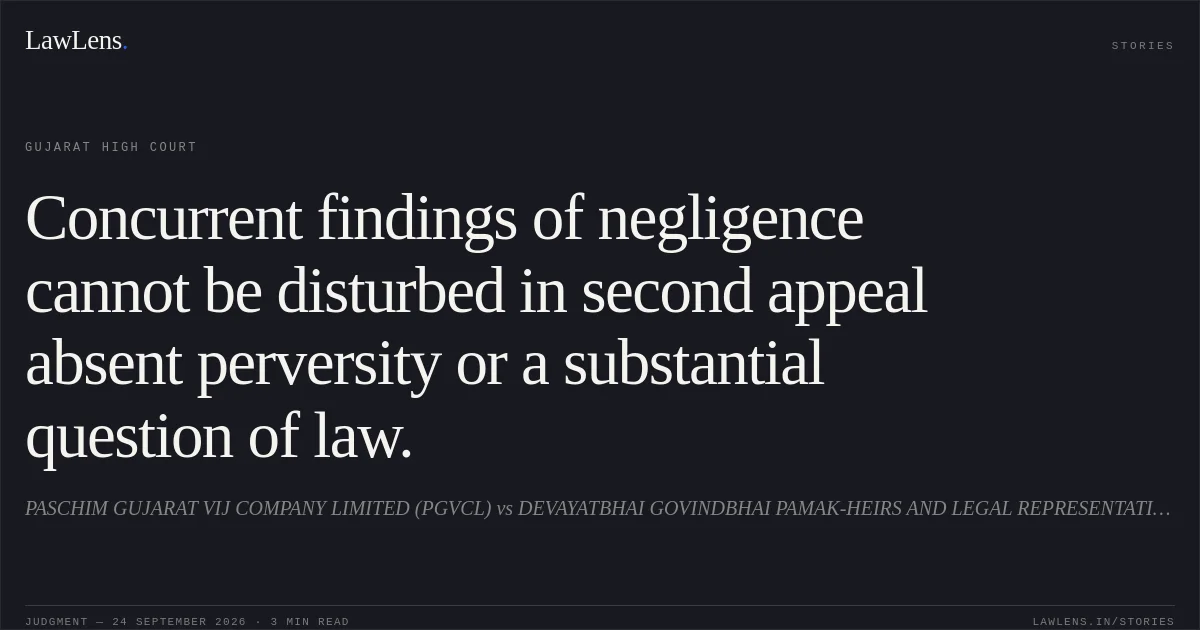
The Court applied Section 100 of the Code of Civil Procedure, 1908, under which a second appeal lies only where a substantial question of law arises; the High Court cannot reassess concurrent findings of fact unless they are perverse, based on inadmissible or no evidence, or contrary to mandatory legal principles.
Source reference: pp. 6–8; paras. 8–9Relying on Jaichand (Dead) through LRs v. Sahnulal , 2024 SCC OnLine SC 3864, and Russi Fisheries (P) Ltd. v. Bhavna Seth , 2026 SCC OnLine SC 555, the Court reiterated that factual findings of the First Appellate Court cannot be disturbed merely because another view is possible.
Source reference: pp. 6–8; paras. 8–8.1The Court also applied the principle that a party cannot lead evidence beyond or contrary to its pleadings.
Source reference: pp. 4–5; para. 7The electricity company, being responsible for maintenance of the transformer pole, was required to produce material showing that the pole and earthing system were maintained in safe and effective condition.
Source reference: p. 5; para. 7.1Reasoning
The Trial Court and the First Appellate Court had concurrently found, on the basis of oral and documentary evidence, that Hareshbhai died after receiving an electric shock from the live earthing wire near the defendant’s transformer pole.
Source reference: pp. 4–5; paras. 6–7.1The farm owner’s testimony supported the plaintiffs’ account, while the defendant produced no sufficient evidence showing that the pole was properly maintained or that the earthing wire could not have carried current at the time of the accident.
Source reference: p. 5; para. 7.1The defendant’s attempt to attribute the accident to the deceased’s negligence was also rejected because that defence was not pleaded in the written statement and was unsupported by an independent eyewitness.
Source reference: p. 5; para. 7Since the defendant failed to demonstrate perversity, absence of evidence, or any error of law in the concurrent findings, no substantial question of law arose under Section 100 CPC.
Source reference: pp. 6–8; paras. 8–9The Court further held that ₹5,40,000 for the death of a 22-year-old able-bodied person, with 6% interest, could not be considered excessive.
Source reference: p. 8; para. 10Holding
The High Court held that the appeal raised no substantial question of law and that the concurrent findings regarding the defendant’s negligence were neither perverse nor legally unsustainable.
The second appeal was dismissed in limine, and the judgment and decree of the First Appellate Court confirming the award of ₹5,40,000 with 6% interest were upheld.
Source reference: p. 9; para. 11The defendant was directed to deposit the compensation before the Trial Court, which was directed to disburse the amount to the plaintiffs after due verification.
Source reference: p. 9; para. 12The connected Civil Application for stay was disposed of accordingly.
Source reference: p. 9; para. 13Acts & Sections Cited
1 provisions across 1 statute referred to in this judgment. Each provision opens on LawLens.
Code of Civil Procedure, 19081
Original Court PDF
PASCHIM GUJARAT VIJ COMPANY LIMITED (PGVCL)vsDEVAYATBHAI GOVINDBHAI PAMAK-HEIRS AND LEGAL REPRESENTATIVES OF DECD HARESHBHAI DEVAYATBHAI PAMAK
Click to open original judgment
Original judgment, available to read, download and summarize on LawLens.in