Facts
The complainant alleged that the petitioner borrowed ₹2,00,000 on 27 September 2010 and issued a post-dated cheque to repay it.
Source reference: para. 2The cheque was dishonoured for insufficient funds; the demand notice was returned with an endorsement that the addressee had refused to accept it, and no payment followed
Source reference: para. 26–29The Trial Court convicted the petitioner under Section 138 of the Negotiable Instruments Act, 1881 (NI Act), and sentenced him to six months’ simple imprisonment and a fine of ₹2,20,000, payable as compensation
Source reference: para. 6The Sessions Court upheld the conviction and sentence
Source reference: para. 7In revision, the petitioner challenged the complainant’s financial capacity and maintained that he had lost his cheque book and that the cheque had been misused
Source reference: para. 8, 10Issues
1. Whether the concurrent findings of guilt under Section 138 of the NI Act disclosed an error warranting interference in revision, particularly in light of the petitioner’s lost-cheque-book defence and challenge to the complainant’s financial capacity.
Source reference: para. 13, 15, 17–252. Whether the statutory requirements of dishonour, service of demand notice and failure to pay were established.
Source reference: para. 26–293. Whether the sentence imposed by the Trial Court warranted interference.
Source reference: para. 30–33Law Applied
Section 138 of the NI Act criminalises dishonour of a cheque drawn for discharge of a legally enforceable debt or liability, provided the statutory requirements—including presentation, written demand notice and failure to pay within the prescribed period—are met.
Source reference: para. 14Once execution of the cheque is proved or admitted, presumptions under Sections 118 and 139 arise that it was issued for consideration and towards a debt or liability; the accused may rebut them on a preponderance of probabilities, but a bare denial is insufficient.
Source reference: para. 23Under Tedhi Singh v. Narayan Dass Mahant, the complainant need not initially establish financial capacity unless the issue is raised by the accused; the accused may challenge capacity through evidence or effective cross-examination.
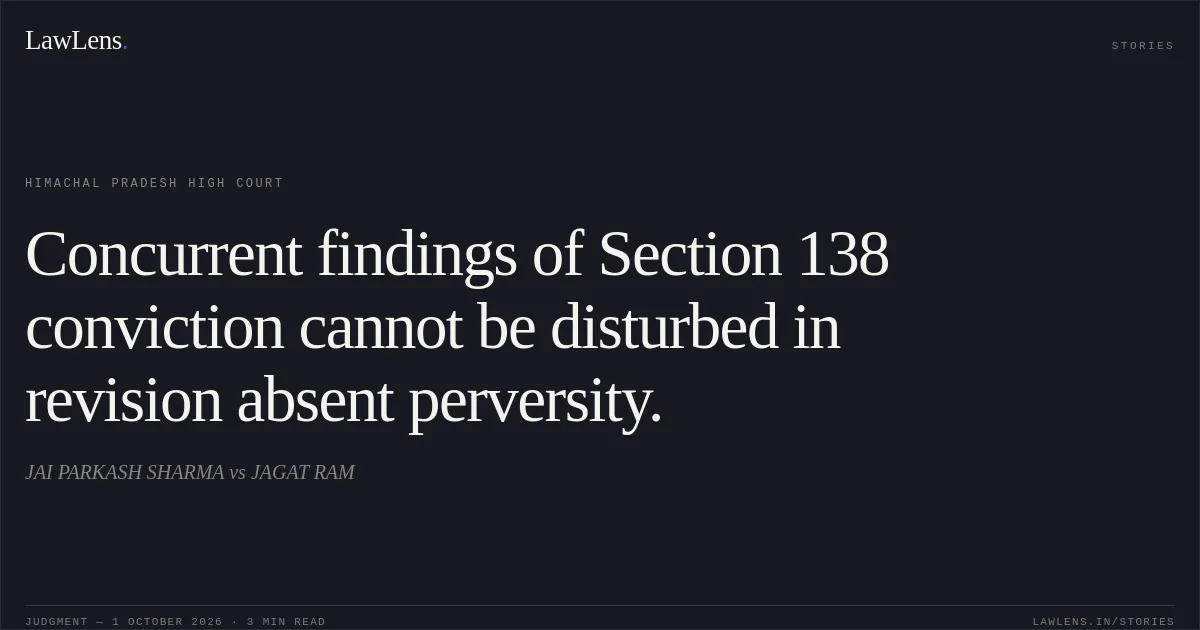
Source reference: para. 18Revisional jurisdiction is supervisory, not appellate: concurrent findings should not be re-evaluated absent perversity, material error, or miscarriage of justice.
Source reference: para. 13A notice returned “refused” may be presumed served.
Source reference: para. 27Section 138 is deterrent and compensatory; Kalamani Tex v. P. Balasubramanian states that, absent special circumstances, courts should generally consider a fine up to twice the cheque amount with interest.
Source reference: para. 30, 32Reasoning
The Court found no basis to disturb the concurrent factual findings in revision.
Source reference: para. 16–20The complainant testified that he had funds from selling crops and earned approximately ₹2–2.5 lakh annually; the cross-examination disclosed no reason to disbelieve him, and the petitioner had not challenged his capacity in a reply to the demand notice.
Source reference: para. 16–20The police entry relied upon to support the lost-cheque defence identified cheque-book numbers 10568 and 10565, but no evidence connected the dishonoured cheque to either book; that evidence therefore did not rebut the statutory presumptions.
Source reference: para. 21–25The cheque-return memo and the petitioner’s admission supported the finding of dishonour for insufficient funds, while the postal endorsement of refusal supported deemed service; there was no evidence of subsequent payment.
Source reference: para. 26–29The Court also held that the six-month sentence was not excessive and that the fine was not a ground for interference, noting that no appeal seeking enhancement had been filed.
Source reference: para. 30–33Holding
The Court held that the ingredients of Section 138 were established and that the petitioner had not rebutted the presumptions attached to the cheque.
Finding no revisional ground to interfere with the conviction or sentence, it dismissed the revision and disposed of any pending applications.
Source reference: para. 35Acts & Sections Cited
7 provisions across 3 statutes referred to in this judgment. Each provision opens on LawLens.
Negotiable Instruments Act, 18813
Code of Criminal Procedure, 19732
Bharatiya Nagarik Suraksha Sanhita, 20232
Original Court PDF
JAI PARKASH SHARMAvsJAGAT RAM
Click to open original judgment
Original judgment, available to read, download and summarize on LawLens.in