Facts
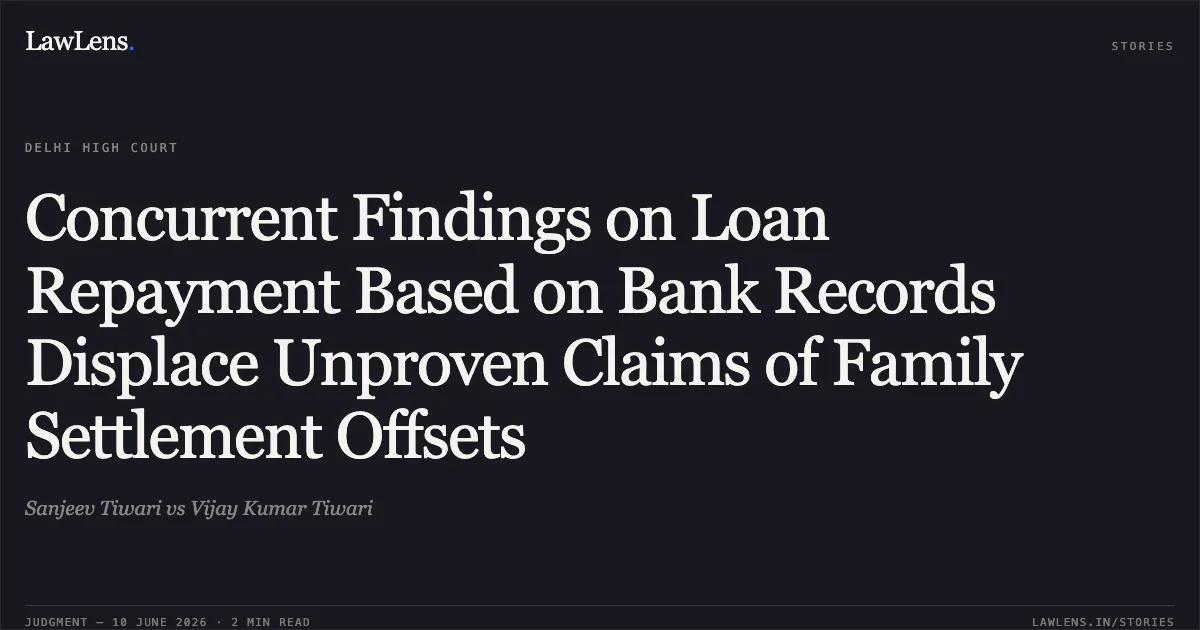
The Plaintiff (Respondent) filed a suit for recovery of a friendly loan of ₹2,00,000/- advanced to the Defendant (Appellant) via two cheques in May 2009.
Source reference: para 2-3The cheques were encashed, but the amount was not repaid despite a legal notice.
Source reference: para 3The Defendant contended the amount was not a loan but a partial reimbursement for litigation expenses (approx. ₹5,02,000/-) incurred by their late father regarding an ancestral property in Bhatinda.
Source reference: para 4-5The Trial Court decreed the suit in favor of the Plaintiff, a decision upheld by the First Appellate Court.
Source reference: para 1, 15-16The Defendant then filed this Regular Second Appeal.
Source reference: para 17Issues
1. Whether the First Appellate Court erred in law by not adjudicating upon the application filed under Order 41 Rule 27 of the CPC for additional evidence?
Source reference: para 182. Whether the Trial Court erred in closing the evidence of the Appellant’s remaining witnesses?
Source reference: para 183. Whether the lower courts erred in law by shifting the onus of proof regarding the nature of the transaction from the Plaintiff to the Defendant?
Source reference: para 184. Whether the present appeal raises any substantial question of law under Section 100 of the CPC?
Source reference: para 1, 38Law Applied
The court applied Section 100 of the Code of Civil Procedure, 1908, which restricts a second appeal to cases involving a "substantial question of law".
Source reference: para 1, 38Order 41 Rule 27 of the CPC regarding the admission of additional evidence in the appellate court, which is generally disallowed if intended to fill lacunae in the original evidence.
Source reference: para 35Indian Evidence Act principles regarding the burden of proof, noting that once a transaction (receipt of money) is admitted, the burden shifts to the party asserting a specific character of that transaction (e.g., reimbursement vs. loan) to prove the same.
Source reference: para 13-15, 26Reasoning
The Court observed that the receipt of ₹2,00,000/- was admitted by the Defendant and corroborated by the Plaintiff’s ITR Verification form (Ex. PW-1/D1), which listed the sum as a loan asset.
Source reference: para 13-15, 26The Defendant’s claim that this was litigation reimbursement was found to be factually inconsistent; the Sale Deed (Ex. DW1/1) of the Bhatinda property showed the father was not a party (having died earlier) and that buyers bore the registration expenses.
Source reference: para 28-29The Court noted that the Defendant closed his own evidence after two witnesses and could not later claim "inadvertence" to seek additional evidence under Order 41 Rule 27, as this was a blatant attempt to fill gaps in a failed defense.
Source reference: para 35The testimony of PW2 (the family lawyer) further demolished the defense by clarifying that the actual litigation expenses were minimal (₹15,000-₹20,000) and were paid by the Plaintiff.
Source reference: para 33Holding
The Court held that no substantial question of law arose as the challenge was purely factual and both lower courts had cogently appreciated the evidence.
The application for additional evidence was rejected as an attempt to fill lacunae.
Source reference: para 35The appeal was dismissed, and the decree for ₹2,20,000/- with 8% interest was upheld.
Source reference: para 1, 39Acts & Sections Cited
2 provisions across 1 statute referred to in this judgment. Each provision opens on LawLens.
Code of Civil Procedure, 19082
Original Court PDF
Sanjeev TiwarivsVijay Kumar Tiwari
Click to open original judgment
Original judgment, available to read, download and summarize on LawLens.in