01Facts
The petitioner and respondents are co-sharers of Survey No. 237 (0.379 hectare).
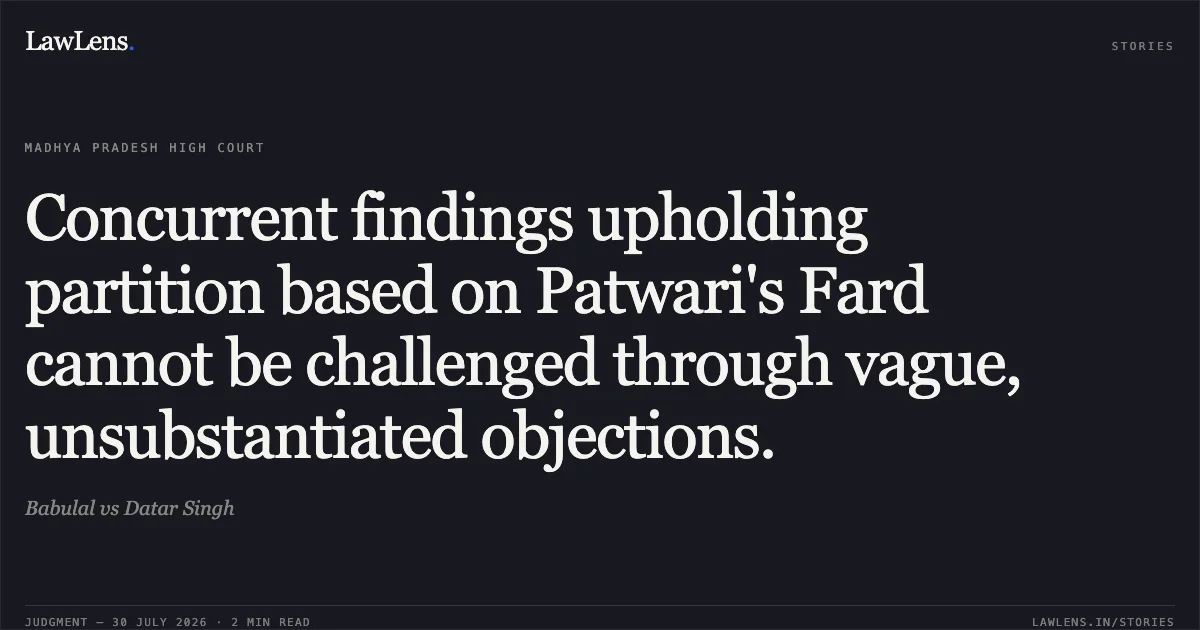
¶ 2Partition proceedings were initiated under Section 178 of the M.P. Land Revenue Code (MPLRC) before the Additional Tehsildar, who finalized the partition based on a Fard (report) prepared by the Halka Patwari.
¶ 2The petitioner challenged this order, asserting that his objections regarding actual possession and physical situation on the spot were dismissed mechanically.
¶ 2Both the Sub Divisional Officer (10.08.2023) and the Additional Commissioner (04.04.2024) dismissed subsequent appeals, affirming the Tehsildar’s order.
¶ 1The petitioner approached the High Court under Article 227 of the Constitution of India.
¶ 102Issues
i.1. Whether the revenue authorities failed to properly adjudicate the petitioner’s objections regarding the Fard and actual possession during the partition proceedings.
¶ 2/5ii.2. Whether the observation of the Additional Commissioner regarding an easementary dispute necessitated a remand for fresh adjudication of the partition.
¶ 2/603Law Applied
Section 178 of the Madhya Pradesh Land Revenue Code, which governs the partition of joint holdings.
¶ 2/5The principle that concurrent findings of fact by revenue authorities warrant no interference under Article 227 of the Constitution unless there is manifest perversity, jurisdictional error, or procedural irregularity.
¶ 7The distinction between partition proceedings (proprietary shares) and easementary rights (independent remedies).
¶ 6Provisions in the judgment · 1 · Linked ones open on LawLens
MP Land Revenue Code 1959 Section 178
04Reasoning
The High Court observed that the Tehsildar did not overlook the petitioner’s objections but found them devoid of merit as they were vague and unsupported by documentary evidence.
¶ 3/5The court noted that the petitioner failed to demonstrate any specific violation of mandatory legal provisions or factual errors in the Patwari’s Fard.
¶ 6Regarding the Additional Commissioner’s remarks on the pathway dispute, the court reasoned that such observations were intended to preserve the parties' liberty to seek separate remedies under easement law and did not invalidate the underlying partition.
¶ 6Since the revenue authorities followed due procedure—including issuing public notice and providing opportunities for hearing—the court found the concurrent findings of fact to be based on a proper appreciation of the record.
¶ 705Holding
The court answered the issues in the negative, holding that the petitioner failed to prove any procedural impropriety or jurisdictional error.
¶ 7The High Court affirmed the concurrent orders of the Additional Tehsildar, SDO, and Additional Commissioner; the Writ Petition was dismissed, and no order as to costs was made.
¶ 7-8Original Court PDF
BabulalvsDatar Singh
Click to open original judgment
Original judgment, available to read, download and summarize on LawLens.in