Facts
The appellant-plaintiff, a company engaged in securities broking, applied for membership of the respondent Ahmedabad Stock Exchange pursuant to a public notice inviting applications for 100 new members. It deposited earnest money of ₹3,00,000.
Source reference: pp. 2, 10–11; paras. 3.2, 10.1The Exchange subsequently accepted the application “in principle”, subject to fulfilment of the prescribed eligibility conditions, written test, personal interview, payment of the membership price, and approval by the competent authorities.
Source reference: pp. 2, 10–11; paras. 3.2, 10.1The plaintiff’s nominated Director did not appear for the written test or interview, and the plaintiff did not deposit the demanded balance membership amount.
Source reference: pp. 2–3, 11–12; paras. 3.2–3.3, 10.1Although the Exchange granted further opportunities, the requirements remained unfulfilled and the Exchange forfeited the earnest money.
Source reference: pp. 2–3, 11–12; paras. 3.2–3.3, 10.1The plaintiff sued for refund of the ₹3,00,000 deposit, contending that no concluded membership contract had arisen and that the Exchange had no authority to forfeit the amount.
Source reference: pp. 4–6; paras. 4.1, 5.1The City Civil Court dismissed the suit and held that the Exchange was entitled to forfeit the deposit.
Source reference: pp. 4–6; paras. 4.1, 5.1Issues
Whether the plaintiff had fulfilled the eligibility and other contractual conditions necessary for obtaining membership of the Ahmedabad Stock Exchange.
Source reference: p. 9; para. 9Whether the Exchange was legally entitled to forfeit the plaintiff’s earnest-money deposit of ₹3,00,000.
Source reference: p. 9; para. 9Law Applied
The Court applied the contractual terms contained in the public notice, the application form, and Annexure-III governing membership applications.
Source reference: no citationUnder clause 5 of the public notice, the ₹3,00,000 earnest money was non-interest-bearing but refundable where the applicant was not admitted as a member.
Source reference: p. 12; para. 10.3Annexure-III clause 4 provided for refund of the earnest money of an unsuccessful applicant, while clause 5 permitted forfeiture where an applicant whose application had been accepted failed to deposit the membership offer amount within the prescribed period.
Source reference: p. 13; para. 11The Court further held that an acceptance “in principle”, expressly made subject to fulfilment of further conditions and approval under the Exchange’s rules and regulations, did not amount to admission as a member or formation of an unconditional concluded membership contract.
Source reference: p. 14; para. 13No specific judicial precedent or statutory provision was relied upon in the judgment as the decisive basis for the holding.
Source reference: no citationReasoning
The Court found that membership required fulfilment of cumulative conditions, including satisfaction of the eligibility criteria, success in the written test, appearance before the screening committee for interview, and payment of the prescribed membership price.
Source reference: pp. 10–12; paras. 10.1–10.2The plaintiff had not completed any of these material requirements: its Director did not appear for the test or interview, and the plaintiff did not pay the balance amount demanded by the Exchange.
Source reference: pp. 11–12; para. 10.4The letter accepting the application “in principle” was conditional and therefore did not establish that the plaintiff had been admitted as a member.
Source reference: p. 14; para. 13Since the plaintiff was never admitted and remained an unsuccessful applicant, clause 4 of Annexure-III and clause 5 of the public notice required refund of the earnest money.
Source reference: pp. 13–14; paras. 12–14The Trial Court consequently erred in treating the conditional acceptance as sufficient justification for forfeiture and in overlooking the refund provisions.
Source reference: pp. 13–14; paras. 12–14Holding
The High Court answered both issues in favour of the plaintiff.
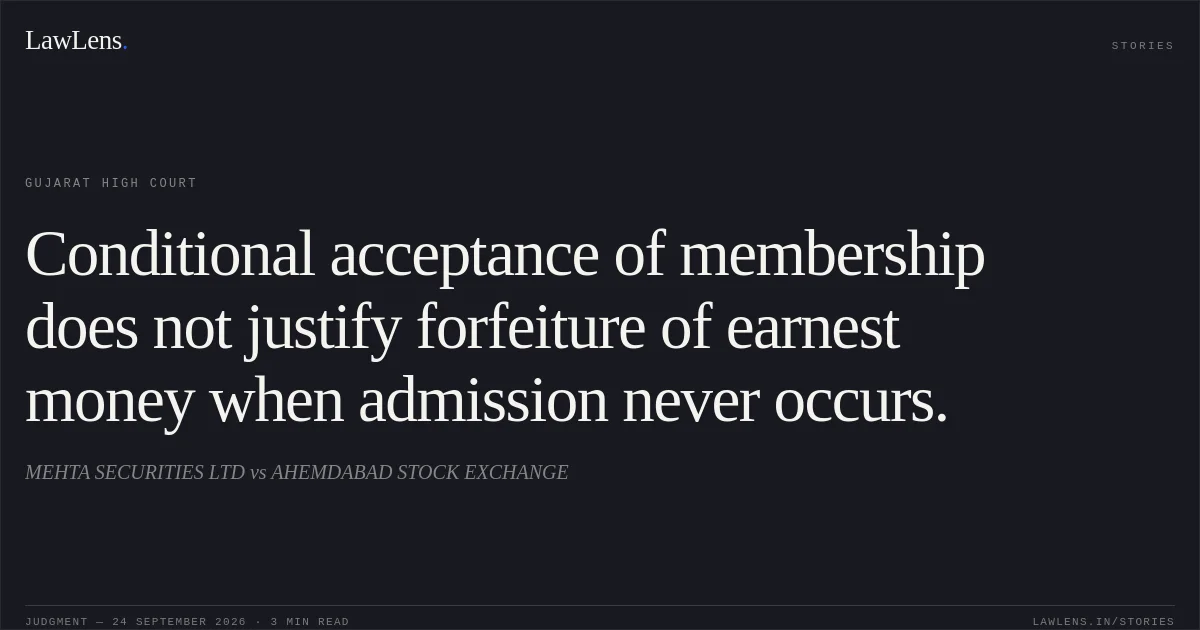
It held that the plaintiff had not become a member of the Exchange because it had not fulfilled the prescribed conditions, and that the Exchange was therefore not entitled to forfeit the ₹3,00,000 earnest-money deposit.
Source reference: p. 14; para. 14The Trial Court’s judgment and decree were set aside, the appeal was allowed, and the suit was decreed.
Source reference: p. 15; paras. 15–17In view of the merger of Ahmedabad Stock Exchange with ACML Capital Markets Limited, the plaintiff was directed to amend the cause-title, and the decree was made enforceable against the successor entity.
Source reference: p. 15; paras. 15–17The Exchange or its successor was directed to deposit ₹3,00,000 within two months, failing which the amount would carry interest at 9% per annum.
Source reference: p. 15; paras. 15–17Acts & Sections Cited
1 provisions across 1 statute referred to in this judgment. Each provision opens on LawLens.
Securities and Exchange Board of India Act, 19921
Original Court PDF
MEHTA SECURITIES LTDvsAHEMDABAD STOCK EXCHANGE
Click to open original judgment
Original judgment, available to read, download and summarize on LawLens.in