Facts
The respondent-plaintiff brought a summary suit under Order XXXVII CPC, relying on a written acknowledgment dated 21 March 2009 in which the petitioner-defendant acknowledged receipt of a short-term loan of ₹97,73,400, repayable with interest at 16% per annum; the funds had been advanced by cheque.
Source reference: p. 3The defendant sought unconditional leave to defend, contending that the payment was consideration for services relating to film production, not a loan.
Source reference: p. 7The Trial Court found a substantial and bona fide defence but granted leave subject to the defendant furnishing security for the amount ultimately decreed.
Source reference: p. 3The defendant challenged that condition under Article 227, also relying on observations in an earlier revision that the suit had substantially progressed.
Source reference: pp. 2, 8Issues
Whether the Trial Court was justified in making leave to defend conditional on the defendant furnishing security for the amount that might ultimately be decreed.
Source reference: p. 4Whether the earlier revision’s observations about the progress of the suit and the purpose of Order XXXVII proceedings required the security condition to be set aside.
Source reference: pp. 4, 8–9Law Applied
Order XXXVII Rule 3(5) CPC governs leave to defend in summary suits.
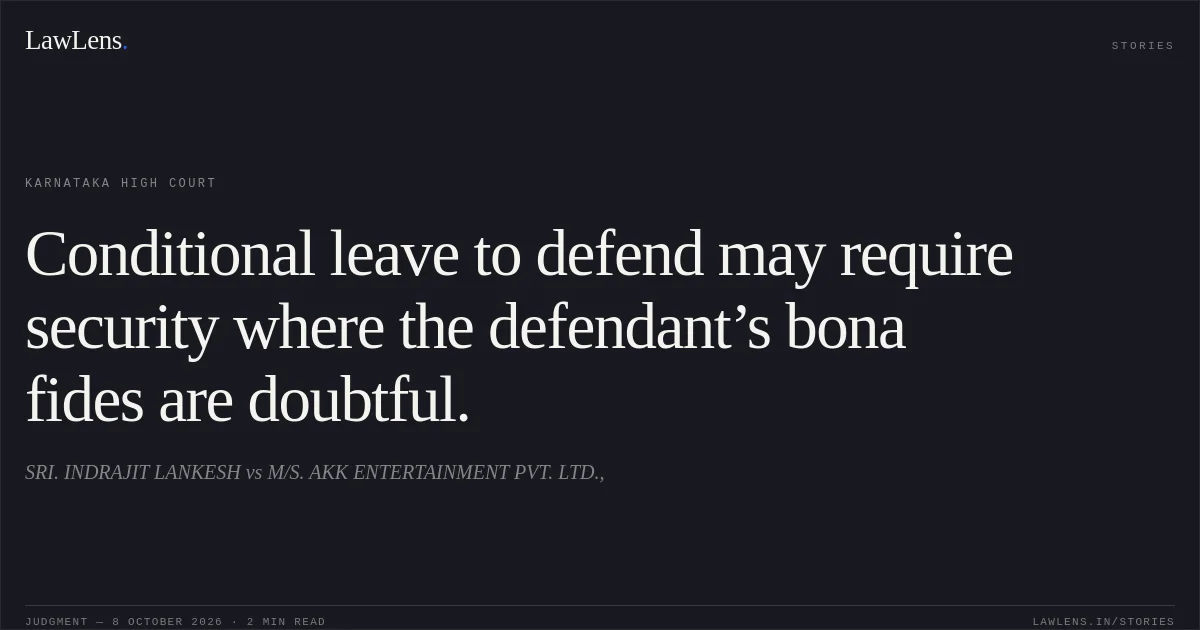
Source reference: pp. 5–6Under the principles discussed in Mechalec Engineers & Manufacturers v. Basic Equipment Corporation, IDBI Trusteeship Services Ltd. v. Hubtown Ltd., and B.L. Kashyap & Sons Ltd. v. JMS Steels & Power Corporation, unconditional leave is generally appropriate where the defendant discloses a substantial or bona fide triable defence, while conditional leave—including a requirement to furnish security—may be imposed where the defence is doubtful or the court has reason to doubt the defendant’s good faith.
Source reference: pp. 5–6The Court also noted the proviso to Rule 3(5), under which an admitted amount must be deposited as a condition precedent to leave, and referred to Rule 3(6)(b) in connection with conditional leave.
Source reference: p. 6Reasoning
The Court considered the defendant’s account—that the payment related to film-production services—alongside the written acknowledgment of debt and the cheque payment.
Source reference: pp. 7–8It held that the acknowledgment and proof of payment supported the Trial Court’s decision to require security where doubt remained about the genuineness or good faith of the defence.
Source reference: pp. 7–8The earlier revision concerned rejection of the plaint under Order VII Rule 11 CPC; its observations about the suit’s progress did not determine the distinct question of whether leave to defend should be conditional.
Source reference: pp. 8–10Nor did the procedural stage of the suit displace the court’s discretion under Order XXXVII Rule 3(5).
Source reference: pp. 8–10Holding
The High Court held that the Trial Court had not committed an error in granting leave to defend subject to the defendant furnishing security for the amount that might ultimately be decreed.
It found the earlier revision observations insufficient to invalidate that condition and dismissed the writ petition.
Source reference: pp. 10–11Original Court PDF
SRI. INDRAJIT LANKESHvsM/S. AKK ENTERTAINMENT PVT. LTD.,
Click to open original judgment
Original judgment, available to read, download and summarize on LawLens.in