Facts
The Petitioner filed a criminal complaint and an application under Section 156(3) Cr.P.C. seeking the registration of an FIR, which the Magisterial Court declined, opting instead for pre-summoning evidence.
Source reference: para. 1-2After leading evidence, the Trial Court dismissed the complaint on 09.06.2022, finding no prima facie case as the allegations were merely oral and lacked documentary support.
Source reference: para. 3The Petitioner challenged this dismissal via a Revision Petition before the Court of Sessions in 2025—nearly three years later—accompanied by a delay condonation application citing financial constraints and health issues.
Source reference: para. 4-9The Revisional Court dismissed the application on 19.11.2025, noting the delay was unexplained by evidence and the application was not even supported by the Petitioner’s own affidavit.
Source reference: para. 9-13The Petitioner subsequently moved the High Court challenging the dismissal of the revision on grounds of limitation.
Source reference: para. 7Issues
1. Whether the Petitioner demonstrated "sufficient cause" to warrant the condonation of an inordinate delay of nearly three years in filing a Revision Petition.
Source reference: para. 7-142. Whether the lack of a personal affidavit and supporting medical/financial documentation renders an application for condonation of delay liable for dismissal.
Source reference: para. 12-13Law Applied
Article 131 of the Schedule to the Limitation Act, 1963, which mandates a 90-day period for filing a criminal revision.
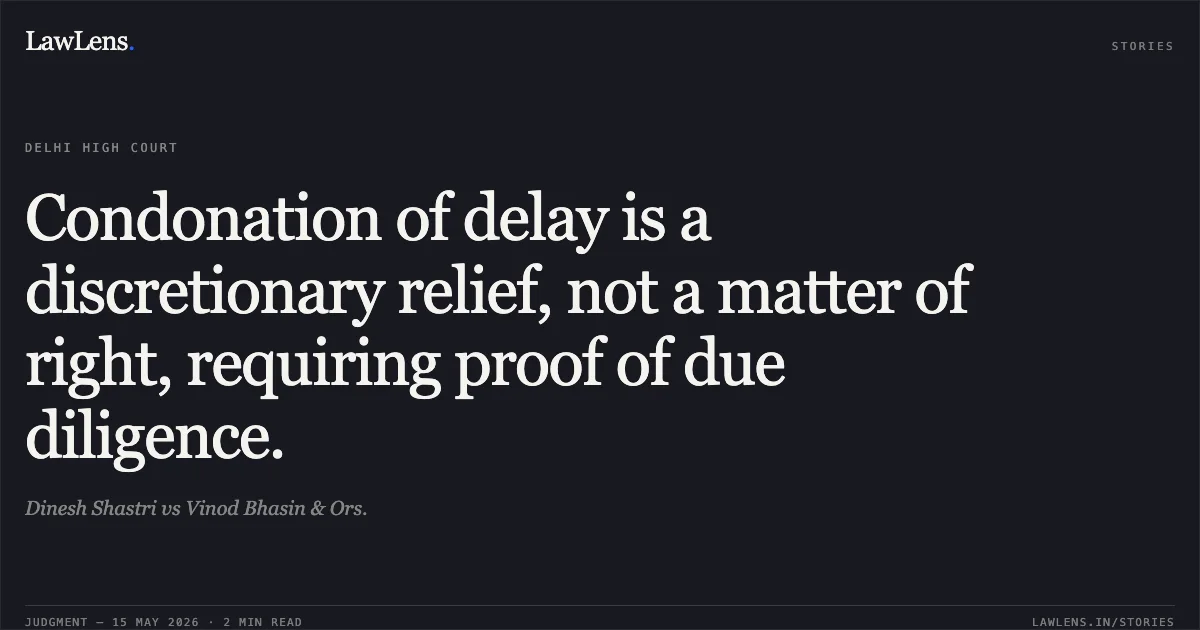
Source reference: para. 8-9Condonation of delay is a discretionary power, not a matter of right, as established in Pathapati Subba Reddy v. Collector (LA).
Source reference: para. 14Rules of limitation serve public policy and ensure litigation attains finality to prevent the "Sword of Damocles" from hanging indefinitely over a litigant (H. Guruswamy v. A. Krishnaiah).
Source reference: para. 14Fairness in justice requires balancing the complainant’s remedies with the accused’s right to certainty and finality (X v. State (NCT of Delhi)).
Source reference: para. 15Reasoning
The court observed a "lax approach" by the Petitioner, noting that while the dismissal order was passed in June 2022, the revision was filed only in March 2025.
Source reference: para. 9-10The court found the Petitioner’s explanations—financial hardship and back pain—to be "vague assertions" unsupported by any documentary evidence or medical records.
Source reference: para. 9, 12Critically, the court highlighted that the condonation application was supported only by the counsel's affidavit rather than the Petitioner's, rendering it legally insufficient.
Source reference: para. 13The court reasoned that since the Petitioner failed to account for various periods of time (specifically the 10-month gap after obtaining certified copies in May 2024), there was a total lack of due diligence.
Source reference: para. 9Following the precedent that judicial discretion for condonation cannot be exercised in cases of "inordinate delay, negligence or lack of due diligence," the court found no merit in reopening the matter.
Source reference: para. 14-15Holding
The High Court answered the issues in the negative, holding that the Petitioner failed to provide a sufficient explanation for the inordinate delay.
The High Court dismissed the petition in limine, affirming that the law of limitation is intended to ensure litigation attains finality and cannot be bypassed through casual or indifferent conduct.
Source reference: para. 15-17Acts & Sections Cited
4 provisions across 2 statutes referred to in this judgment. Each provision opens on LawLens.
Code of Criminal Procedure, 19732
Original Court PDF
Dinesh ShastrivsVinod Bhasin & Ors.
Click to open original judgment
Original judgment, available to read, download and summarize on LawLens.in