Facts
The appellant filed a writ appeal challenging the order dated 25.11.2025 passed by a Single Judge in WPS No. 7661 of 2023
Source reference: para. 2The appeal was preferred with a delay of 48 days
Source reference: para. 1The appellant filed an application for condonation of delay; however, upon inquiry by the Court, the appellant’s counsel failed to offer a plausible explanation or cogent reason for the inordinate delay
Source reference: para. 3The State respondents opposed the application, asserting that the appeal was barred by laches and lacked a bona fide explanation
Source reference: para. 4Issues
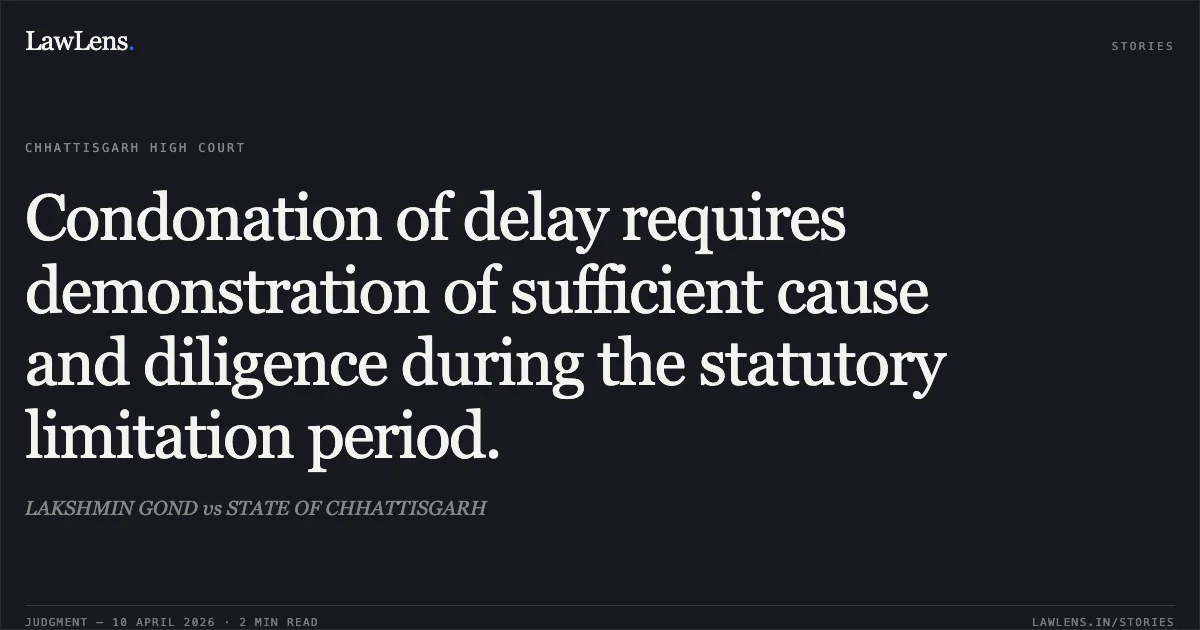
Whether the delay of approximately 48 days in preferring the writ appeal deserves to be condoned under the parameter of "sufficient cause"
Source reference: para. 6Law Applied
The Court applied the doctrine of limitation, which is rooted in public policy and equity to ensure finality in litigation
Source reference: para. 10The Court relied extensively on the precedent in State of Madhya Pradesh v. Ramkumar Choudhary (2024 INSC 932), which dictates that "sufficient cause" means an adequate reason preventing a party from approaching the court within limitation; discretion cannot be exercised if there is negligence, inaction, or lack of bona fides
Source reference: para. 7The Court further referenced Basawaraj v. Special Land Acquisition Officer (2013) 14 SCC 81, stating that condoning inordinate delay without justification disregards statutory provisions
Source reference: para. 7Finally, it noted Ajit Singh Thakur Singh v. State of Gujarat (AIR 1981 SC 733), which establishes that sufficient cause must be traced to events occurring within the prescribed period of limitation
Source reference: para. 7Reasoning
The Court examined the appellant's application and found that no "sufficient cause" was established to explain why the appeal was not filed within the statutory period
Source reference: para. 9Applying the Ramkumar Choudhary standard, the Court observed that the length of delay is a relevant factor and that limitation should not be excused as a "matter of generosity"
Source reference: para. 7The Court noted that the appellant failed to point out any specific circumstance arising within the limitation period that disabled them from timely filing
Source reference: para. 10Since the appellant’s counsel offered no cogent reasons during arguments, the Court concluded the delay was due to negligence or inaction, which cannot be overlooked under the guise of substantial justice
Source reference: para. 8, 9The Court emphasized that rules of limitation prevent the "Sword of Damocles" from hanging indefinitely over respondents at the "whims and fancies" of the appellants
Source reference: para. 7Holding
The Court held that the explanation offered by the appellant was not "sufficient cause" in the eyes of the law
The application for condonation of delay was rejected, and consequently, the writ appeal was dismissed as being "hopelessly barred by limitation" on the grounds of delay and laches
Source reference: para. 11Original Court PDF
LAKSHMIN GONDvsSTATE OF CHHATTISGARH
Click to open original judgment
Original judgment, available to read, download and summarize on LawLens.in