Facts
The Appellant was the highest bidder for commercial plots leased by the Raipur Development Authority (RDA) and deposited ₹24,38,000/- as earnest money
Source reference: p. 3Due to non-payment of subsequent installments, the RDA cancelled the allotment and forfeited the earnest money on 20-11-2023
Source reference: p. 3After a failed writ petition, the Appellant invoked arbitration. The Arbitrator dismissed the claim on 18-09-2024
Source reference: p. 3-4The Appellant filed an objection under Section 34(1) of the Arbitration and Conciliation Act, 1996, on 06-01-2025, which was 18 days beyond the three-month statutory period but within the additional 30-day grace period
Source reference: p. 3-4The Commercial Court rejected the application, holding that "sufficient cause" for the 18-day delay was not shown
Source reference: p. 4The Appellant then moved the High Court under Section 37
Source reference: p. 2Issues
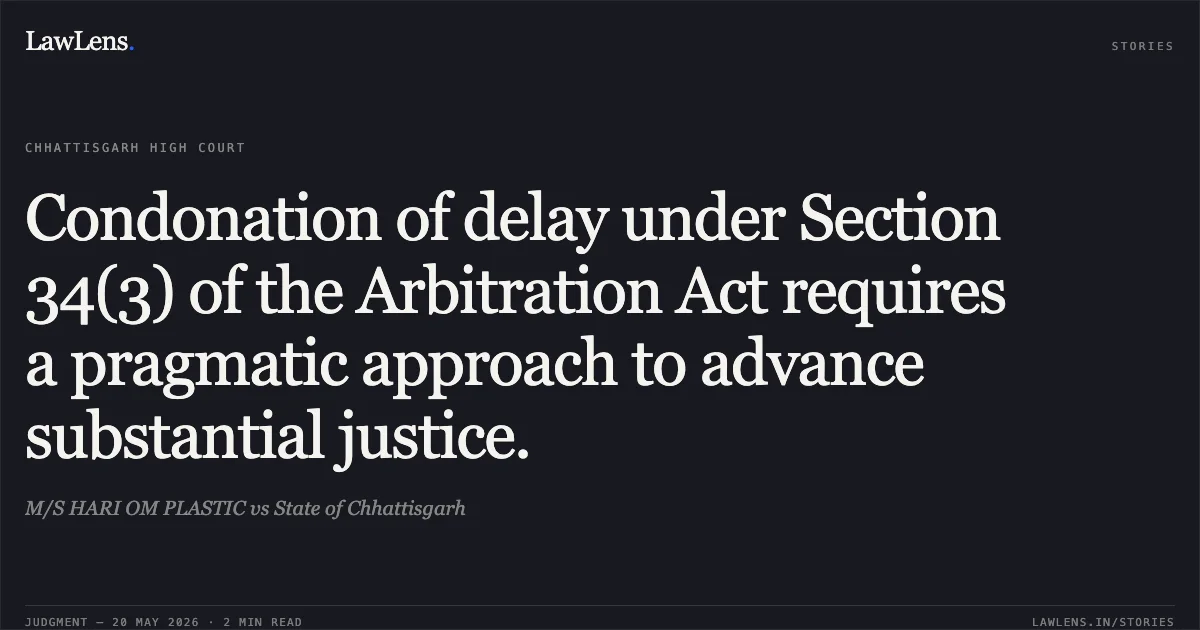
1. Whether the delay of 18 days in filing the objection application under Section 34(1) of the Act of 1996 constituted "sufficient cause" for condonation under the proviso to Section 34(3)
Source reference: p. 122. Whether the Commercial Court was justified in strictly rejecting the application for a delay that fell within the condonable limits prescribed by the Act
Source reference: p. 14Law Applied
The Court applied Section 34(3) of seeking to set aside an arbitral award, noting that the "but not thereafter" clause acts as an express exclusion under Section 29(2) of the Limitation Act, 1963
Source reference: p. 5-6Consolidated Engineering Enterprises v. Principal Secretary; established that while the Court cannot condone delay beyond 30 days post the initial three months, it has discretion within that window if sufficient cause is shown.
Source reference: p. 7State of H.P. v. Himachal Techno Engineers; established that while the Court cannot condone delay beyond 30 days post the initial three months, it has discretion within that window if sufficient cause is shown.
Source reference: p. 8-9N. Balakrishnan v. M. Krishnamurthy; mandates that "sufficient cause" should receive a liberal construction to advance substantial justice and that rules of limitation are not meant to destroy rights
Source reference: p. 12-13Reasoning
The High Court observed that the Appellant's delay of 18 days was attributed to time spent consulting advocates at the High Court and the subsequent time taken by the lawyer to peruse documents
Source reference: p. 12-13The Court reasoned that refusing to condone such a short delay would result in "substantial injustice," especially since the Appellant had a large sum of money forfeited and had been directed to various forums (Writ Court to Arbitrator)
Source reference: p. 14The Bench criticized the Commercial Court for taking a "too technical" and "unacceptably" rigid approach rather than a "pragmatic view"
Source reference: p. 14Since the total delay did not exceed the absolute outer limit of 120 days (3 months + 30 days) and the explanation provided was plausible, the Court held that the requirements of the proviso to Section 34(3) were satisfied
Source reference: p. 14Holding
The High Court allowed the appeal and set aside the Commercial Court's order dated 02-05-2025
The Court condoned the 18-day delay and remitted the matter to the Commercial Court to decide the Section 34(1) objection application on its merits. The Commercial Court was directed to expedite the proceedings given the dispute dates back to 2018
Source reference: p. 15Acts & Sections Cited
9 provisions across 3 statutes referred to in this judgment. Each provision opens on LawLens.
Arbitration and Conciliation Act, 19964
Limitation Act, 19634
General Clauses Act, 18971
Original Court PDF
M/S HARI OM PLASTICvsState of Chhattisgarh
Click to open original judgment
Original judgment, available to read, download and summarize on LawLens.in


