Facts
The Appellant, Amol Jayram Landge (aged 19), was convicted by the Special Judge, Hingoli, for kidnapping and repeatedly raping a 13-year-old victim (PW-11) under Sections 363, 366-A, 376(2)(i), 376(2)(n) of the IPC and Section 6 of the POCSO Act.
Source reference: para. 1The victim went missing on 24/10/2019 and was later recovered with the Appellant from a relative's house.
Source reference: para. 3The trial court sentenced him to 10 years of rigorous imprisonment.
Source reference: para. 1The Appellant challenged the conviction, arguing a lack of medical evidence to prove penetration.
Source reference: para. 4Simultaneously, the State appealed for an enhancement of the sentence to 20 years, citing post-2018/2019 amendments to the IPC and POCSO Act.
Source reference: para. 5, 7Issues
1. Whether a confessional statement made by an accused to a Medical Officer while in police custody is admissible in evidence
Source reference: para. 152. Whether the prosecution proved the charge of "aggravated penetrative sexual assault" under Section 6 of the POCSO Act and Rape under Section 376 of the IPC in the absence of medical signs of penetration
Source reference: para. 12, 183. Whether the sentence imposed by the trial court was legally sustainable in light of the mandatory minimum punishments introduced by the 2018 and 2019 amendments
Source reference: para. 7-9Law Applied
The court applied Section 26 of the Indian Evidence Act, 1872, which renders confessions made in police custody inadmissible unless made in the immediate presence of a Magistrate.
Source reference: para. 15-16Regarding the definition of "Sexual Assault," the court looked to Section 7 of the POCSO Act, which covers physical contact with sexual intent without penetration.
Source reference: para. 20For sentencing, it noted the 2018 Amendment to Section 376(3) of the IPC and the 2019 Amendment to Section 6 of the POCSO Act, both of which established a mandatory minimum of 20 years for the rape of a child under 16.
Source reference: para. 8-9Reasoning
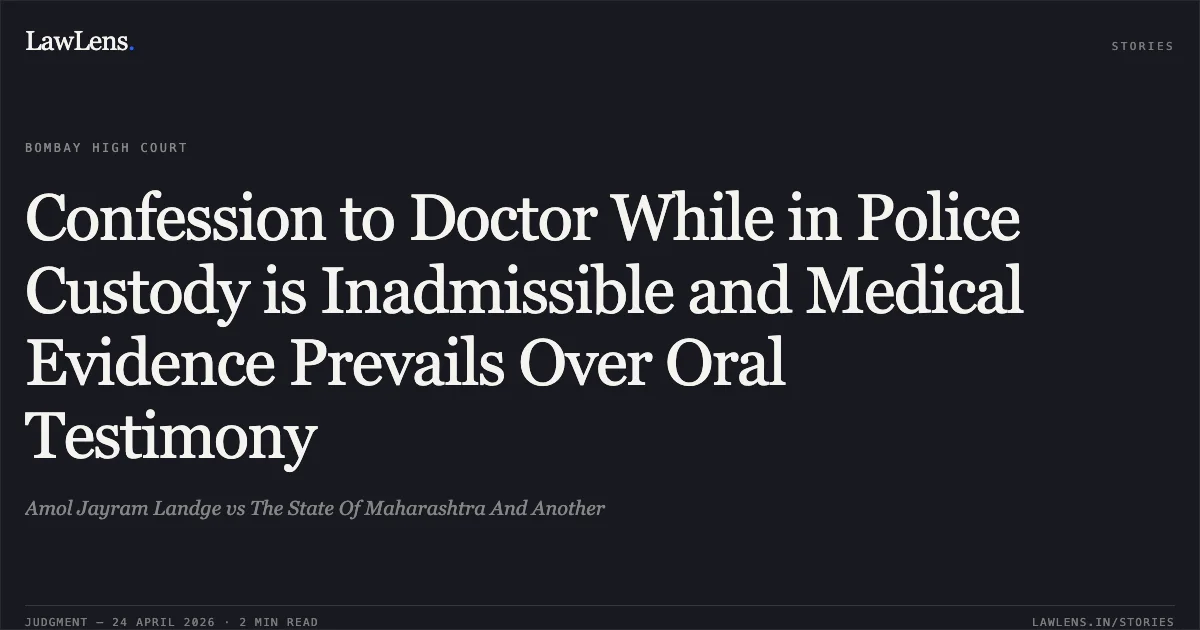
The High Court first ruled that the Appellant’s "admission" to the Medical Officer (PW-8) regarding sexual intercourse was a confession made during police custody and thus hit by the bar under Section 26 of the Evidence Act.
Source reference: para. 16Reviewing the medical evidence, the court found that PW-7 (Medical Officer) explicitly stated the victim's hymen was intact and no signs of sexual intercourse or injuries were found.
Source reference: para. 19, 23Consequently, the court held that "penetration" (a prerequisite for Section 376 IPC and Section 6 POCSO) was not proved beyond reasonable doubt.
Source reference: para. 24However, since the victim was found in the Appellant's bed and her testimony regarding physical contact was credible, the court determined the act fell under the definition of "Sexual Assault" under Section 7.
Source reference: para. 20, 25Since the charge of Section 6 failed, the State’s plea for enhancement to a 20-year minimum became redundant.
Source reference: para. 10Holding
The Court partly allowed the Appellant’s appeal, setting aside the convictions under Section 376 IPC and Section 6 POCSO Act.
Instead, it convicted the Appellant under Section 8 of the POCSO Act (punishment for sexual assault) and sentenced him to five years of rigorous imprisonment.
Source reference: para. 22, 28The convictions under Sections 363 and 366-A IPC (kidnapping) were maintained as the victim's minor age rendered her consent irrelevant.
Source reference: para. 12, 28The State’s appeal for enhancement of sentence was dismissed.
Source reference: para. 28Acts & Sections Cited
7 provisions across 2 statutes referred to in this judgment. Each provision opens on LawLens.
Indian Penal Code, 18602
Protection of Children from Sexual Offences Act, 20125
Original Court PDF
Amol Jayram LandgevsThe State Of Maharashtra And Another
Click to open original judgment
Original judgment, available to read, download and summarize on LawLens.in