Facts
The respondent, a dealer in light diesel oil (LDO), was inspected on 29/12/2007. Authorities alleged several irregularities: failure to maintain a price/stock display board, excess stock of 225 liters of LDO and 8,150 liters of furnace oil, lack of a license for furnace oil, and unupdated stock registers
Source reference: p. 2Consequently, the Collector, Bhavnagar, ordered the confiscation of 50% of the seized stock, valued at ₹84,875/-, citing breaches of the Gujarat Essential Commodities Order, 1977, and the Solvent Refrinate and Slop Order, 2000
Source reference: p. 2-3The respondent appealed to the Additional Sessions Judge, Bhavnagar, who quashed the confiscation order on 04.10.2011
Source reference: p. 3The State subsequently filed this revision application challenging the acquittal of the goods from confiscation.
Source reference: p. 3Issues
1. Whether technical irregularities in record-keeping and stock maintenance, in the absence of evidence of black-marketing, justify the confiscation of goods under the Essential Commodities Act
Source reference: p. 5-62. Whether the confiscation order passed by the Collector violated the principles of natural justice by denying the respondent an opportunity for cross-examination or rebuttal evidence
Source reference: p. 5-6Law Applied
The Court applied Sections 3, 8, and 9 of the Gujarat Essential Commodities (Control and Regulation of Business) Order, 1977
Source reference: p. 2Sections 397 and 401 of the CrPC (now Sections 438 and 442 of the BNSS)
Source reference: p. 1The core legal principle established through precedents like Karan Oil Industries v. District Collector (1996) and N. Nagender Rao & Co. v. State of Andhra Pradesh (1994) is that technical breaches or failure to maintain stock registers do not warrant seizure or confiscation unless there are specific allegations of black-marketing
Source reference: p. 6The court upheld the administrative law principle that orders passed in violation of natural justice—specifically the right to cross-examine and present rebuttal evidence—are legally unsustainable
Source reference: p. 5-6Reasoning
The High Court observed that the lower appellate court correctly identified that the discrepancies found (stock variations and display board issues) were technical rather than substantive crimes
Source reference: p. 5The Court critiqued the Collector’s summary procedure, noting that the order was passed based solely on the Supply Officer’s papers without providing the respondent a fair opportunity to cross-examine officials or explain the discrepancies through a "deep method" of measurement
Source reference: p. 5The Court reasoned that since the authorities failed to allege or prove black-marketing, the harsh penalty of confiscation was disproportionate to the "technical breaches" recorded
Source reference: p. 6It was determined that a warning or departmental reprimand would have been the appropriate response under existing government circulars rather than seizure of property
Source reference: p. 5Holding
The High Court dismissed the State's revision application and upheld the judgment of the Additional Sessions Judge, Bhavnagar
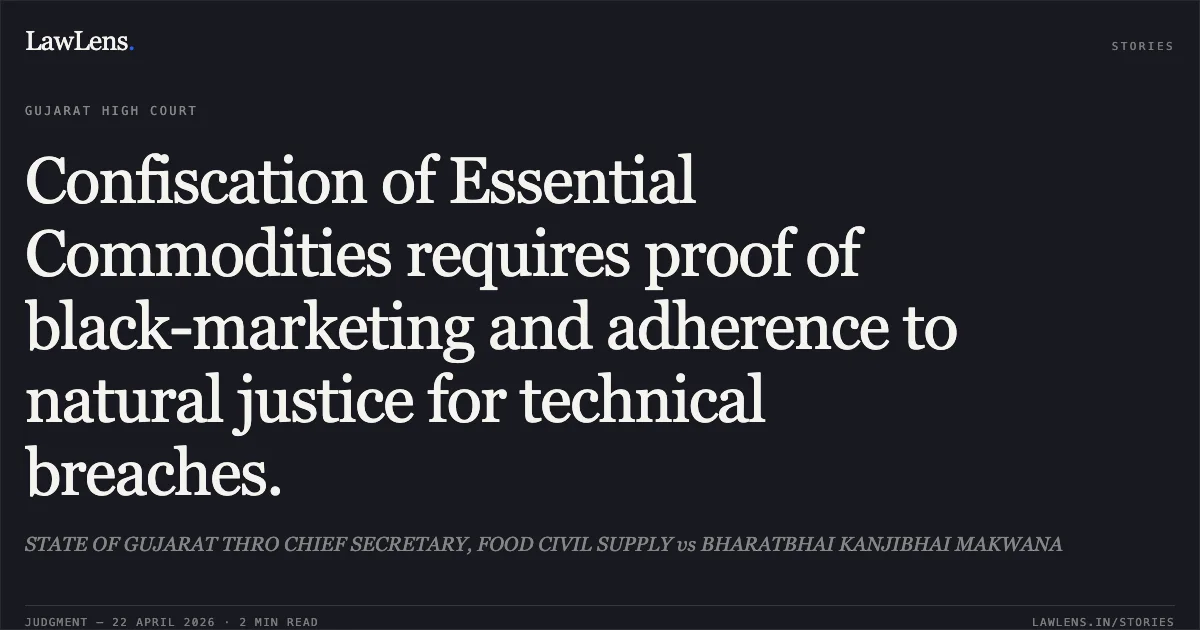
The Court held that in the absence of allegations of black-marketing, the confiscation of goods for technical irregularities is impermissible
Source reference: p. 6The order quashing the confiscation of ₹84,875/- worth of stock was affirmed, and the goods were ordered to remain released to the respondent
Source reference: p. 6Acts & Sections Cited
7 provisions across 3 statutes referred to in this judgment. Each provision opens on LawLens.
Code of Criminal Procedure, 19732
Bharatiya Nagarik Suraksha Sanhita, 20232
Original Court PDF
STATE OF GUJARAT THRO CHIEF SECRETARY, FOOD CIVIL SUPPLYvsBHARATBHAI KANJIBHAI MAKWANA
Click to open original judgment
Original judgment, available to read, download and summarize on LawLens.in