01Facts
The Defendants first appeared on May 31, 2022, and were granted time to file their Written Statement
¶ 5They filed the Written Statement on September 25, 2022—three days before the expiry of the 120-day maximum period allowed under the Delhi High Court (Original Side) Rules, 2018
¶ 10However, the Registry marked the filing as defective because it was not accompanied by the mandatory Affidavit of admission/denial of documents
¶ 5The Defendants eventually cured the defect and filed the Affidavit on December 14, 2022, which was beyond the 120-day limit
¶ 6, 11On March 17, 2023, the Joint Registrar refused to take the Written Statement on record, citing the mandatory nature of the filing requirements
¶ 4, 7The Defendants filed a Chamber Appeal (O.A. 43/2023) challenging this refusal
¶ 1, 402Issues
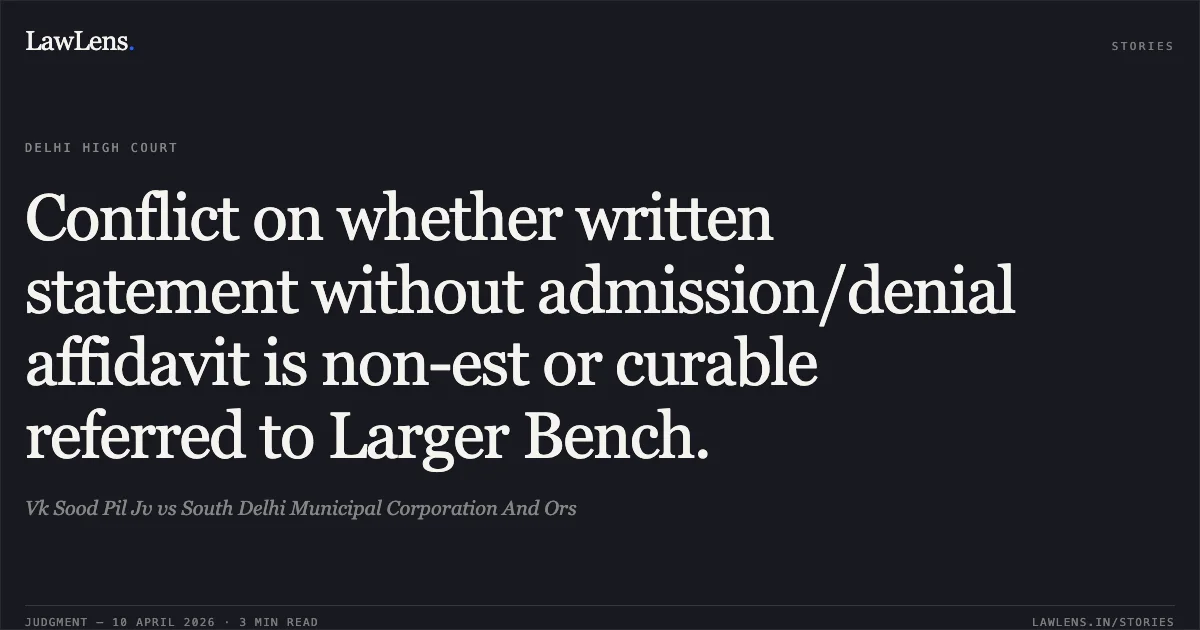
i.Whether the filing of a Written Statement within the statutory period, but without an accompanying affidavit of admission/denial of documents, renders the filing non-est in law or constitutes a curable defect
¶ 12, 3203Law Applied
The Court examined Rules 2, 3, and 4 of Chapter VII of the Delhi High Court (Original Side) Rules, 2018, which provide that a Written Statement "shall not be taken on record" unless accompanied by an affidavit of admission/denial
¶ 8-9The Court referred to the strict interpretation in Unilin Beheer B.V. v. Balaji Action Buildwell, which held the word "shall" in Rule 3 to be mandatory to prevent provisions from becoming otiose
¶ 15, 19It also noted the contrary, liberal view in COSCO International Pvt. Ltd. v. Jagat Singh Dugar, Neeraj Ahuja v. AIPIL Zorro Pvt. Ltd., and Shefali Kohli v. Neena Chatrath, which characterized the omission as a curable defect
¶ 17, 20-22Statutory interpretation principles from Ramana Dayaram Shetty v. International Airport Authority of India and Muskan Enterprises v. State of Punjab were cited to emphasize that every word in a statute must be given meaning and "shall" is ordinarily mandatory
¶ 24, 26-27Judicial discipline requirements from Dr. Vijay Laxmi Sadho v. Jagdish were applied regarding the necessity of a reference when coordinate benches conflict
¶ 29Provisions in the judgment · 2 · Linked ones open on LawLens
Limitation Act, 1963 Section 14
Code of Civil Procedure, 1908 Section 151
04Reasoning
Justice Prasad observed that the plain language of Rule 3 of the Delhi High Court Rules uses the mandatory term "shall," suggesting that a Written Statement sans an affidavit is legally incomplete
¶ 23He reasoned that a literal interpretation is the "golden rule" and that treating the requirement as discretionary would negate the objective of the 2018 Rules to expedite trial proceedings
¶ 23-25However, the Court identified a direct conflict between coordinate benches: the Unilin Beheer decision supports a strict bar, while subsequent decisions (COSCO, Neeraj Ahuja) suggest that as long as the Written Statement is filed within 120 days, the subsequent filing of the affidavit is a curable procedural defect
¶ 19-22Recognizing that judicial propriety prevents a Single Judge from ignoring or overstepping conflicting decisions of equal strength, the Court determined that the issue requires an authoritative resolution
¶ 28-3105Holding
The Court did not resolve the appeal on its merits but referred the legal question to a Larger Bench to ensure uniformity in the Court's procedure
¶ 31, 34The Court held that if the Larger Bench finds the omission to be a curable defect, the matter will return to the Joint Registrar to evaluate the Defendants' reasons for the delay; if found mandatory, the rejection of the Written Statement will be affirmed
¶ 33The matter was directed to be placed before the Hon’ble Chief Justice for the constitution of a Larger Bench
¶ 34Original Court PDF
Vk Sood Pil JvvsSouth Delhi Municipal Corporation And Ors
Click to open original judgment
Original judgment, available to read, download and summarize on LawLens.in