Facts
The Commissioner of Police, Pune City, passed an order detaining the Petitioner under Section 3(2) of the Maharashtra Prevention of Dangerous Activities Act, 1981 (“MPDA Act”) on 20 November 2025; a separate committal order directed his detention at Central Prison, Nagpur.
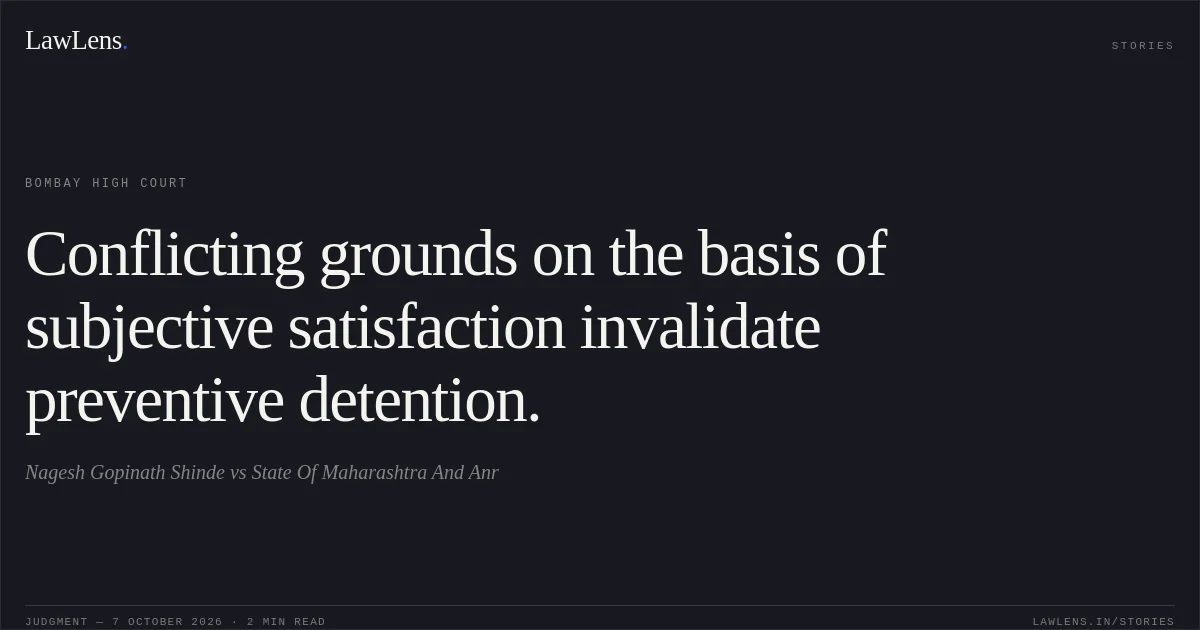
Source reference: p. 1, para. 1The Petitioner challenged the detention order, arguing that the grounds of detention were internally inconsistent: paragraph 2 stated that his past activities established that he was a dangerous person whose activities prejudiced public order, while paragraphs 7 and 8 stated that the Detaining Authority’s subjective satisfaction rested on a recent registered offence and two in-camera statements.
Source reference: pp. 2–3, paras. 3–4; p. 6, paras. 10–11The State maintained that the grounds clearly identified the materials relied on.
Source reference: p. 3, para. 5Issues
1. Whether the conflicting statements in the grounds of detention regarding the basis for the Detaining Authority’s satisfaction rendered the detention order unsustainable
Source reference: pp. 6–7, paras. 10–122. Whether that inconsistency created confusion affecting the Petitioner’s right to make an effective representation
Source reference: pp. 2–3, paras. 3–4; p. 7, para. 11Law Applied
Section 2(b-1) of the MPDA Act defines a “dangerous person” as a person who habitually commits, attempts to commit, or abets specified offences under Chapter XVI or XVII of the Indian Penal Code or Chapter V of the Arms Act, 1959.
Source reference: p. 3, para. 6Section 2(a)(iv) addresses when a dangerous person’s activities affect, or are likely to affect, the maintenance of public order.
Source reference: p. 4, para. 7Material inconsistency in the grounds of detention, where it creates confusion about the basis of the Detaining Authority’s subjective satisfaction and impairs the detainee’s ability to make an effective representation, makes the detention order unsustainable.
Source reference: p. 7, paras. 11–12Reasoning
Paragraph 2 stated that the Petitioner’s past activities made him a dangerous person and that his criminal activities prejudiced public order.
Source reference: pp. 4–5, para. 8In contrast, paragraphs 7 and 8 expressly confined the Detaining Authority’s subjective satisfaction to the recent registered offence and the two in-camera statements.
Source reference: p. 6, paras. 10–11The Court found these statements to be in clear conflict, leaving uncertainty as to what material actually formed the basis of the detention decision. That confusion affected the Petitioner’s ability to make an effective representation, rendering the detention order unsustainable.
Source reference: p. 7, paras. 11–12Holding
The Court held that the detention order could not stand and made the Rule absolute, quashing and setting aside the order dated 20 November 2025.
It directed that the Petitioner be released forthwith, unless required in any other case, and disposed of the Petition.
Source reference: p. 8, para. 13Acts & Sections Cited
3 provisions across 1 statute referred to in this judgment. Each provision opens on LawLens.
Bharatiya Nyaya Sanhita, 20233
Original Court PDF
Nagesh Gopinath ShindevsState Of Maharashtra And Anr
Click to open original judgment
Original judgment, available to read, download and summarize on LawLens.in