Facts
The petitioner, a child in conflict with law, was alleged to have committed offences under Sections 25(1-B), 26 and 35 of the Arms Act and Section 317(2) of the Bharatiya Nyaya Sanhita, 2023.
Source reference: paras. 2–6, pp. 1–2He was in custody from 30 December 2025. The Juvenile Justice Board rejected his bail application, and the Children’s Court dismissed his appeal, reasoning that release could bring him into contact with criminals or expose him to moral, physical or psychological danger.
Source reference: paras. 2–6, pp. 1–2His father offered to provide supervision and undertakings concerning the petitioner’s conduct and welfare.
Source reference: paras. 2–6, pp. 1–2Issues
Whether the courts below were justified in refusing bail to the petitioner under Section 12 of the Juvenile Justice (Care and Protection of Children) Act, 2015, on the stated grounds
Source reference: paras. 6–8, pp. 2–3Whether the petitioner should be released on bail subject to appropriate safeguards and supervision by his natural guardian and the Probation Officer
Source reference: paras. 10–11, pp. 3–4Law Applied
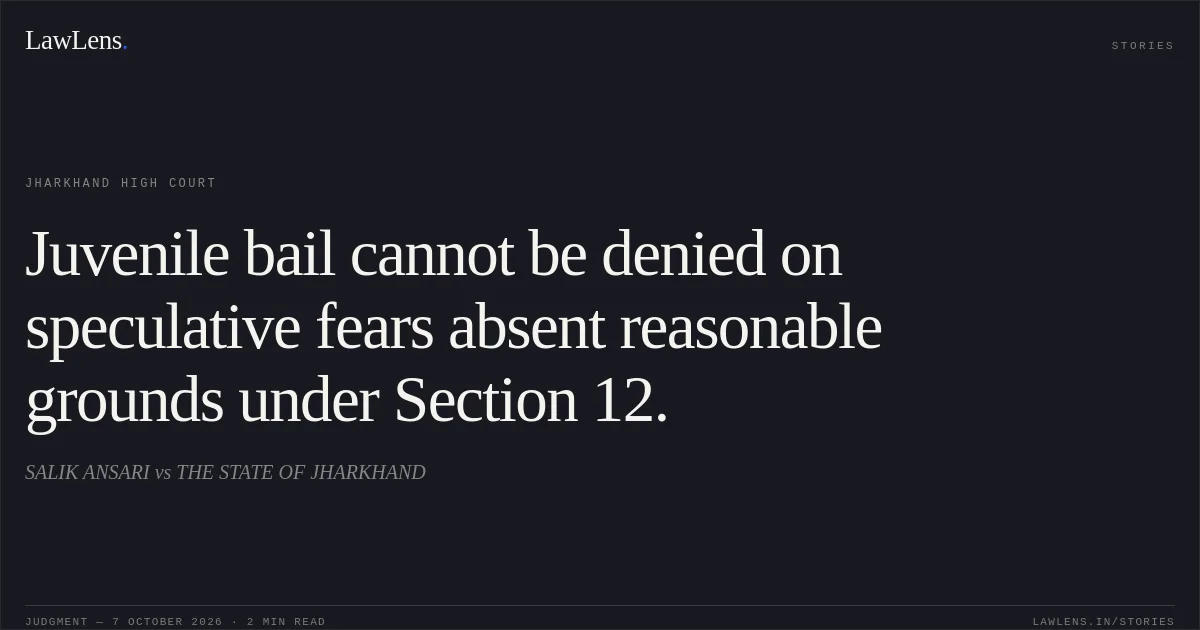
Section 12 of the Juvenile Justice (Care and Protection of Children) Act, 2015 governs bail for a child alleged to be in conflict with law and, as stated by the Court, overrides the bail provisions of the Code of Criminal Procedure, 1973 and other laws.
Source reference: para. 8, p. 2Bail is the rule and refusal is an exception: release may be denied only where there are reasonable grounds to believe it would bring the child into association with a known criminal, expose the child to moral, physical or psychological danger, or defeat the ends of justice.
Source reference: para. 8, p. 2The Act’s rehabilitative approach favours reform and rehabilitation over punishment; detention may be justified where it is necessary for the child’s development, rehabilitation or protection.
Source reference: para. 9, p. 3Reasoning
The courts below relied on the possibility that the petitioner might associate with criminals or face danger, but the High Court found that their findings were not supported by material establishing reasonable grounds under Section 12.
Source reference: paras. 7–10, pp. 2–3It also held that the lower courts had failed to adequately address the statutory grounds for denying bail.
Source reference: paras. 7–10, pp. 2–3The father’s proposed supervision and the conditions imposed by the High Court—including undertakings, continuation of education or constructive activities, and regular reporting to the Probation Officer—provided safeguards consistent with the Act’s rehabilitative purpose.
Source reference: para. 11, pp. 3–4Holding
The High Court allowed the revision and set aside the orders of the Juvenile Justice Board and the Children’s Court.
It directed the petitioner’s release on bail on his father’s personal bond with two sureties, subject to undertakings regarding supervision, protection and conduct; encouragement to pursue studies and constructive activities; monthly reporting to the Probation Officer; and the Probation Officer’s periodic monitoring and reporting to the Board.
Source reference: paras. 10–12, pp. 3–4Acts & Sections Cited
5 provisions across 3 statutes referred to in this judgment. Each provision opens on LawLens.
Arms Act, 19593
Bharatiya Nyaya Sanhita, 20231
Juvenile Justice (Care and Protection of Children) Act, 2015.1
Original Court PDF
SALIK ANSARIvsTHE STATE OF JHARKHAND
Click to open original judgment
Original judgment, available to read, download and summarize on LawLens.in