Facts
The appellants imported greyish lead-bearing powder described as “lead concentrate” and classified it under CTH 26070000 (“lead ores and concentrates”), claiming the concessional rate under Sr. No. 117 of Notification No. 12/2012-Cus.
Source reference: p. 8–9The Department alleged that the goods were washed and dried electrode paste or lead waste/scrap derived from used lead-acid batteries, classifiable under CTH 78020090, and that the import involved misdeclaration and evasion of customs duty.
Source reference: p. 3–8The Department relied on laboratory reports, load-port export documents, pre-shipment inspection certificates, statements of the appellants’ director and inspection-agency officials, technical literature, and the appellants’ status as secondary lead recyclers.
Source reference: p. 5–8, 20–26The laboratory evidence was conflicting: some reports described the goods as having the composition or characteristics of lead concentrate, while others described them as washed and dried battery electrode paste; one report found the sample to be neither lead concentrate nor battery-derived material but an off-specification industrial product.
Source reference: p. 16–19, 34–36The original adjudicating authority classified the goods under CTH 78020090, denied the exemption, ordered confiscation, and imposed penalties under the Customs Act, 1962.
Source reference: p. 7–8In the first round, the Tribunal allowed the appeal, but the Supreme Court set aside that decision for want of adequate reasons and remanded the matter for fresh adjudication, keeping all merits open.
Source reference: p. 2The present proceedings were accordingly heard afresh along with connected appeals.
Source reference: p. 2Issues
1. Whether the imported lead-bearing powder was classifiable under CTH 26070000 as “lead ores and concentrates” or under CTH 78020090 as “lead waste and scrap”
Source reference: p. 34–362. Whether the conflicting laboratory reports and documentary evidence established that the goods were derived from used lead-acid batteries and constituted restricted lead waste/scrap
Source reference: p. 34–373. Whether the Department could sustain confiscation, denial of exemption, duty consequences, and penalties on the basis of the alleged misclassification and misdeclaration
Source reference: p. 7–8, 55Law Applied
Classification must be determined by the nature and characteristics of the goods as presented for assessment, applying the Customs Tariff, its Section and Chapter Notes, and the Harmonized System of Nomenclature; commercial descriptions and end-use are relevant only to the extent legally appropriate.
Source reference: no citationSection Note 8(a) to Section XV defines “waste and scrap” as metal waste and scrap arising from manufacture or mechanical working, and metal goods rendered unusable by breakage, cutting-up, wear, or similar reasons.
Source reference: p. 15–16, 38The Tribunal relied on *Jenson Enterprises v. Collector of Customs*, 1987 (28) ELT 346 (Mad.), for preferring reasoned scientific evidence over unsupported opinion in cases of conflicting test reports.
Source reference: p. 34*Hewlett Packard India Sales Pvt. Ltd. v. Commissioner of Customs*, 2023 (383) ELT 241 (SC), and *C.C. v. Dilip Kumar & Co.*, 2018 (361) ELT 577 (SC), for the proposition that the Department bears the burden of proving a different classification.
Source reference: p. 35*C.C., Mundra v. Sunrise Traders*, 2022 (382) ELT 23 (SC), concerning inconclusive expert opinions; and *Gravitas India Ltd. v. Commissioner of Customs, Mundra*, 2024 (390) ELT 394 (Tri.-Ahmd.), involving materially similar goods and evidence.
Source reference: no citationThe Tribunal also applied the tariff structure under which lead oxide is specifically covered by Heading 2824 and metal sulphates by Heading 2833, whereas Heading 7802 concerns lead waste and scrap in metallic form.
Source reference: p. 36–37Reasoning
The Tribunal found that the Department’s case was not conclusively established by the scientific evidence.
Source reference: no citationThe reports showed that the samples principally comprised lead oxide and lead sulphate, with only small or very small quantities of metallic lead in fine-particle form; they did not consistently identify the goods as “lead waste and scrap”.
Source reference: p. 34–36The Kandla and JNCH reports supported the appellants’ description or composition claim, while the CRCL reports were themselves inconsistent: some referred to washed and dried electrode paste, and another concluded that the sample was neither lead concentrate nor material derived from lead-acid batteries.
Source reference: p. 34–35The Tribunal held that visual descriptions in pre-shipment certificates, foreign customs documents, and load-port classifications could not override the statutory tariff or resolve the scientific inconsistency.
Source reference: p. 34–37Similarly, the appellants’ secondary-recycler status, use of rotary furnaces, absence of silver production, and the manufacturing processes of certain suppliers could not determine the tariff classification, which had to be based on the goods imported rather than the importer’s plant, permissions, or subsequent use.
Source reference: p. 18–20, 32–33Applying the reasoning in *Gravitas India*, the Tribunal further held that, even if the goods were not accepted as lead concentrate, the evidence did not establish classification under Heading 7802.
Source reference: p. 36–37Since the material was predominantly lead oxide and lead sulphate rather than metallic lead waste or scrap, it could, at most, raise a question of classification under Chapter 28; that possibility independently defeated the Department’s claim under CTH 78020090.
Source reference: p. 36–37Holding
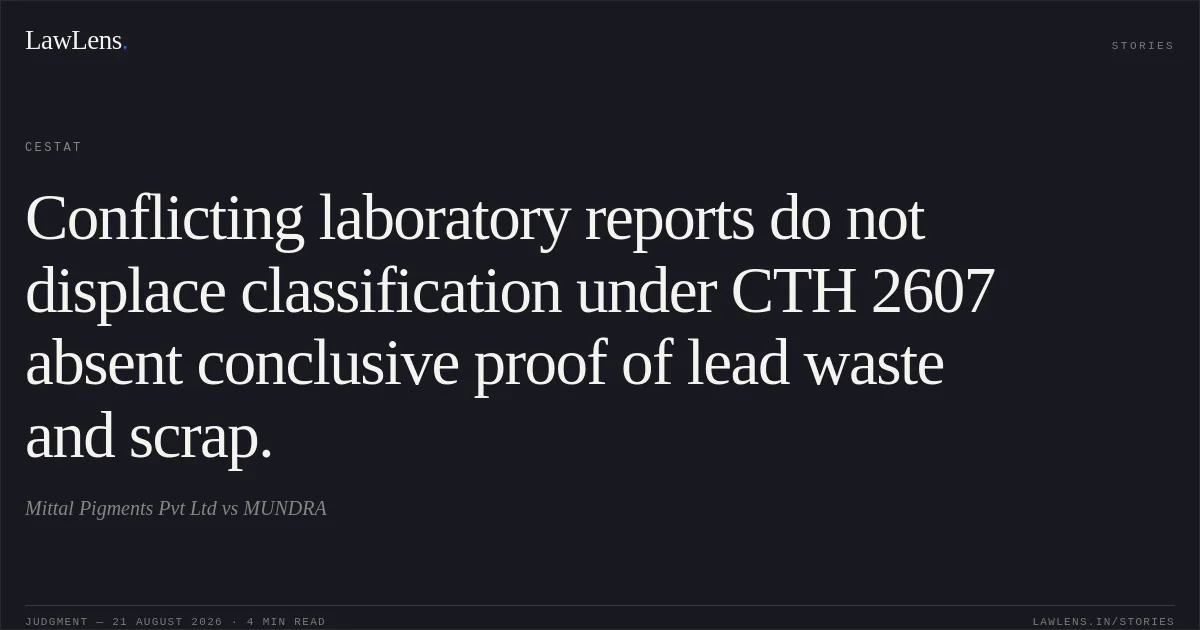
The Tribunal held that the Department failed to discharge its burden of proving that the imported goods were lead waste and scrap classifiable under CTH 78020090.
In view of the conflicting and inconclusive laboratory reports, the appellants’ classification under CTH 26070000 could not be disturbed.
Source reference: p. 34–37The orders classifying the goods under Chapter 78, denying the claimed treatment, and imposing the consequential confiscation and penalties were unsustainable.
Source reference: p. 55The connected appeals were allowed and the impugned orders were set aside, with the appellants’ declared classification left undisturbed.
Source reference: p. 55Acts & Sections Cited
5 provisions across 2 statutes referred to in this judgment. Each provision opens on LawLens.
Customs Act,19624
Customs Tariff Act, 19751
Original Court PDF
Mittal Pigments Pvt LtdvsMUNDRA
Click to open original judgment
Original judgment, available to read, download and summarize on LawLens.in