Facts
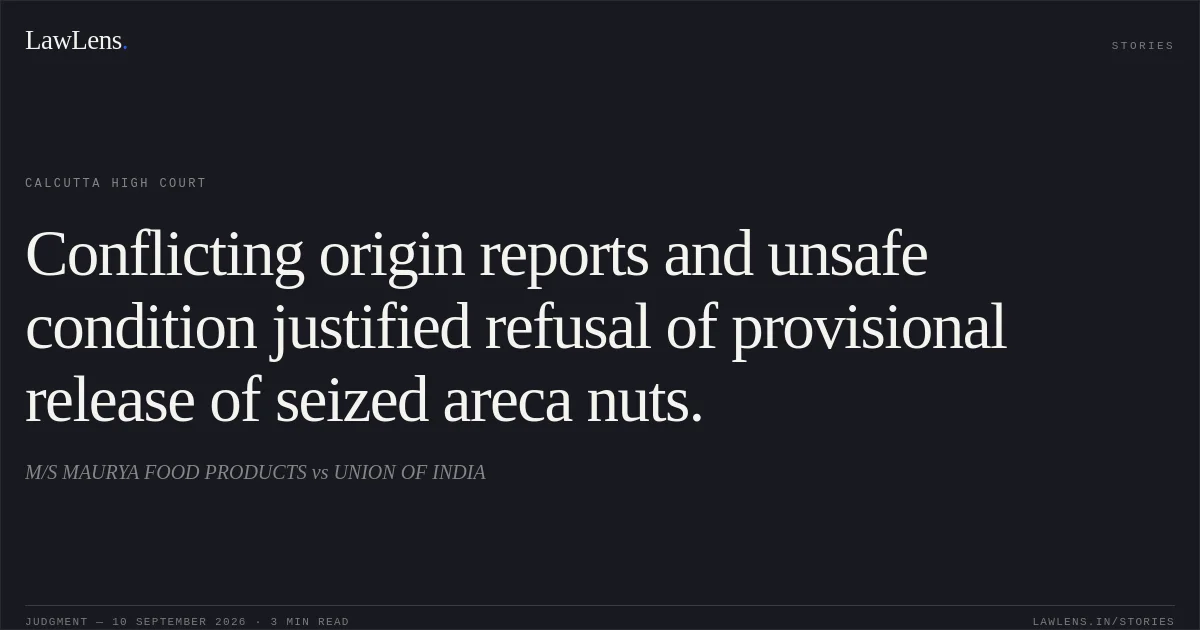
The petitioner challenged the seizure of betel nuts under Section 110 of the Customs Act, 1962 and the order dated 11 August 2026 rejecting its application for provisional release under Section 110A.
Source reference: para. 1The goods were seized on 10 October 2025 on the belief that they were of foreign origin.
Source reference: no citationAn initial sample tested by the Areca Nut Development and Research Foundation, Mangaluru (“ADRF”) reported on 23 October 2025 that the nuts mostly resembled areca/betel nuts of Indonesian origin and that approximately 13% were mould-infested.
Source reference: p. 4; para. 4At the petitioner’s request, the goods were resampled on 2 January 2026 and the same agency reported on 23 January 2026 that the samples mostly resembled Indian-origin areca/betel nuts.
Source reference: pp. 2, 4; paras. 2, 4A further test by the National Food Laboratory, FSSAI, Kolkata, dated 14 January 2026, found the nuts damaged by mould and insects beyond the prescribed limit, rendering them sub-standard and unsafe for human consumption under the Food Safety and Standards Act, 2006.
Source reference: p. 5; para. 4Relying on the subsequent ADRF report and a coordinate Bench decision in M/s Kumar Enterprise v. Union of India & Ors., the petitioner sought provisional release.
Source reference: pp. 2–3; para. 3The respondents opposed the writ petition, relying on the initial ADRF report, the FSSAI findings, and the availability of a statutory appellate remedy.
Source reference: pp. 2–3; para. 3Issues
Whether the subsequent ADRF report indicating that the betel nuts mostly resembled Indian-origin nuts displaced the basis for their seizure and entitled the petitioner to provisional release under Section 110A of the Customs Act, 1962.
Source reference: pp. 2, 4; paras. 2, 4Whether the High Court should exercise writ jurisdiction despite the petitioner’s alleged alternative statutory remedy.
Source reference: pp. 3, 5; paras. 3, 5Whether the coordinate Bench decision in M/s Kumar Enterprise required a similar direction for release of the seized goods.
Source reference: pp. 2–3, 5; paras. 2, 5Law Applied
The Court applied Section 110 of the Customs Act, 1962, concerning seizure of goods believed to be liable to confiscation, and Section 110A, which permits provisional release subject to conditions imposed by the proper officer.
Source reference: para. 1The Court also considered the statutory adjudicatory framework under Section 124 of the Customs Act, under which the respondents had issued a show-cause notice.
Source reference: para. 3The Court relied on the principle that writ jurisdiction should not ordinarily be invoked to bypass an efficacious statutory remedy, particularly where disputed factual and technical issues arise.
Source reference: paras. 3, 5It distinguished the coordinate Bench decision in M/s Kumar Enterprise v. Union of India & Ors. because the present case involved conflicting origin reports and independent findings that the goods were unsafe for human consumption.
Source reference: pp. 2–3, 5; paras. 2, 5The Court further considered Sections 3(1)(zx) and 3(1)(zz)(ix) of the Food Safety and Standards Act, 2006, as referred to in the FSSAI report concerning sub-standard and unsafe food.
Source reference: p. 5; para. 4Reasoning
The Court held that the later ADRF report showing a resemblance to Indian-origin nuts did not conclusively establish Indian origin because the initial report by the same agency had found the samples to resemble Indonesian-origin nuts and had also recorded mould infestation.
Source reference: p. 4; para. 4The existence of two inconsistent reports created a disputed factual situation that could not justify interference with the seizure or automatic provisional release in writ jurisdiction.
Source reference: no citationThe Court also attached significance to the FSSAI report, which independently found the nuts to be damaged by mould and insects beyond the permissible limit and unsafe for human consumption.
Source reference: p. 5; para. 4Consequently, the case was not comparable to M/s Kumar Enterprise, where the factual basis for the seizure was apparently absent or conclusively displaced.
Source reference: p. 5; para. 5Given the conflicting technical evidence, the pending customs proceedings, and the availability of a statutory remedy, the Court declined to exercise discretionary writ jurisdiction.
Source reference: paras. 3, 5Holding
The Court answered the issues against the petitioner.
It held that the subsequent ADRF report did not conclusively eliminate the basis for seizure, particularly in view of the earlier Indonesian-origin report and the FSSAI finding that the goods were unsafe for human consumption.
Source reference: pp. 4–5; para. 4The writ petition challenging the seizure and rejection of provisional release was dismissed, with liberty to the petitioner to pursue the available statutory remedy.
Source reference: para. 6Acts & Sections Cited
3 provisions across 2 statutes referred to in this judgment. Each provision opens on LawLens.
Customs Act,19622
Food Safety and Standards Act, 20061
Original Court PDF
M/S MAURYA FOOD PRODUCTSvsUNION OF INDIA
Click to open original judgment
Original judgment, available to read, download and summarize on LawLens.in