Facts
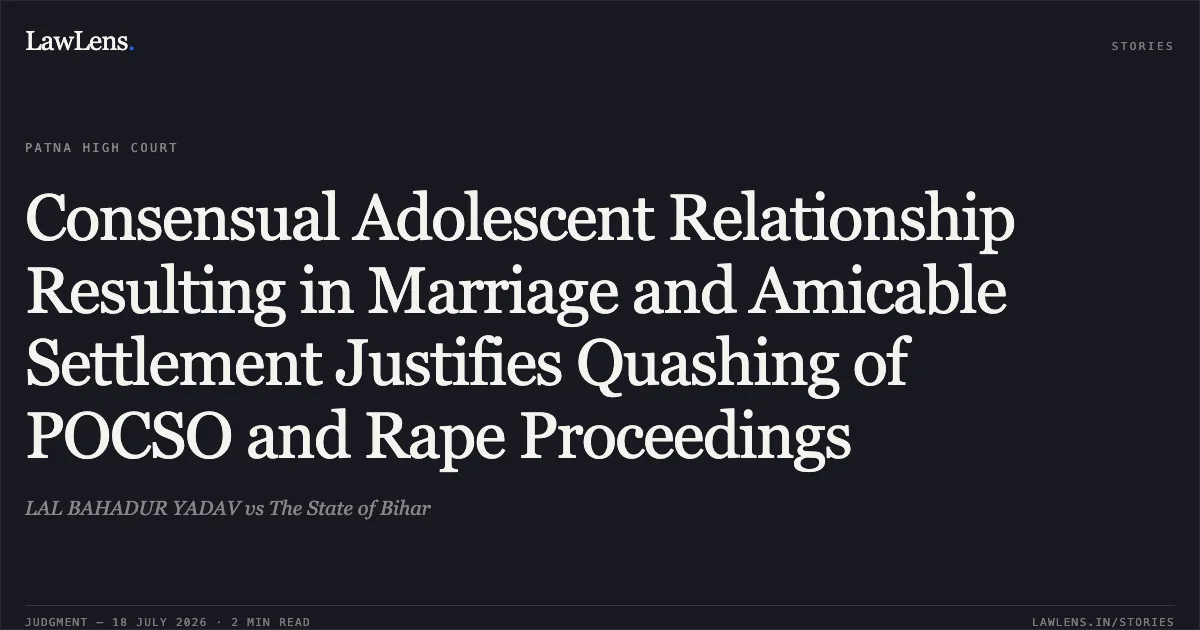
The petitioners sought quashing of a cognizance order dated 01.07.2021 for offences under Sections 363, 366(A), 376/34 of the IPC and Sections 8/17 of the POCSO Act.
Source reference: para. 2The FIR was lodged by the victim’s father (O.P. No. 3), alleging his 16-year-old daughter was forcibly kidnapped at gunpoint.
Source reference: para. 3The petitioners contended the relationship was consensual and that the victim and Petitioner No. 5 had solemnized a marriage.
Source reference: para. 5While school certificates suggested minority, medical reports estimated the victim's age between 18–19 years.
Source reference: para. 6Subsequently, a settlement was reached via a panchayat, and the victim—having attained majority—filed an affidavit stating she had married another person (Mukesh Kumar) and did not wish to pursue the criminal case.
Source reference: para. 7-8Issues
1. Whether criminal proceedings under the POCSO Act and IPC should be quashed when the material suggests a consensual adolescent relationship and the parties have reached an amicable settlement?
Source reference: para. 9-112. Whether the continuance of prosecution in a case of consensual relationship, where the victim no longer supports the charges, constitutes an abuse of the process of the court?
Source reference: para. 15Law Applied
Section 482 of the Cr.P.C. (now Section 528 of the BNSS) regarding the High Court’s inherent power to prevent abuse of process and secure the ends of justice.
Source reference: para. 10, 14Prashant v. State of NCT Delhi (2025) 5 SCC 764, which cautioned against criminalizing consensual relationships that turn bitter.
Source reference: para. 9Kapil Gupta v. State of NCT of Delhi (2022) SCC OnLine SC 1030, regarding the relevance of settlements in improving mutual harmony.
Source reference: para. 10State of Uttar Pradesh v. Anurudh (2026) SCC OnLine SC 40, which highlighted the misuse of POCSO provisions in consensual adolescent "Romeo-Juliet" scenarios.
Source reference: para. 12Samadhan v. State of Maharashtra (2025) INSC 1351, which mandated quashing where consent is devoid of coercion or fraud.
Source reference: para. 14Reasoning
The court reasoned that the case originated from "adolescent love" rather than criminal intent, noting that the victim’s medical report and judicial statement under Section 164 Cr.P.C. placed her at or near the age of majority (17–19 years), indicating sufficient maturity to understand her actions.
Source reference: para. 6, 13The court observed a "worrying trend" of criminalizing consensual relationships via POCSO and emphasized that welfare legislations should not be used to settle personal scores or harass parties after they have moved on.
Source reference: para. 9, 12, 15Since the victim had entered into a settlement, married elsewhere, and expressly stated she left voluntarily, the court determined that the legal ingredients for kidnapping and sexual assault were not met on a factual level.
Source reference: para. 13Connecting the law to the facts, the court held that forcing a trial where the victim refuses to support the prosecution would be a futile exercise and a waste of judicial machinery.
Source reference: para. 14-15Holding
The Court answered the issues in the affirmative, holding that continuing the prosecution would entail undue harassment and constitute an abuse of the process of law.
The High Court allowed the application and quashed the cognizance order dated 01.07.2021 passed by the Additional Sessions Judge-VI-cum-Special Judge, POCSO, Supaul. All pending interlocutory applications were disposed of accordingly.
Source reference: para. 16, 17Acts & Sections Cited
10 provisions across 5 statutes referred to in this judgment. Each provision opens on LawLens.
Indian Penal Code, 18603
Protection of Children from Sexual Offences Act, 20122
Code of Criminal Procedure, 19732
Bharatiya Nagarik Suraksha Sanhita, 20232
Indian Contract Act, 18721
Original Court PDF
LAL BAHADUR YADAVvsThe State of Bihar
Click to open original judgment
Original judgment, available to read, download and summarize on LawLens.in