Facts
The appellant challenged the judgment dated 31.01.2025 by the Additional Sessions Judge, Belonia, convicting him under Section 376(1) of the IPC and sentencing him to 10 years rigorous imprisonment
Source reference: p. 1-2The complainant alleged that the appellant, under a proposal of love, committed rape against her will in September 2017
Source reference: p. 2Subsequently, the parties entered into a notarized marriage declaration in January 2018 and lived as husband and wife
Source reference: p. 2The complainant alleged that the appellant later refused to conduct a formal social marriage ceremony in 2022, leading to the FIR
Source reference: p. 3During the trial, the victim admitted to a long-term consensual relationship, a subsisting marriage, and an instance of medical abortion during their time together
Source reference: p. 5, 7Issues
1. Whether the sexual intercourse between the appellant and the complainant was without her consent, thereby attracting the offense of rape under Section 376(1) IPC.
Source reference: p. 5-62. Whether a refusal to perform a social marriage ceremony, following a period of cohabitation and a recognized private marriage, constitutes "rape" under the guise of a false promise to marry.
Source reference: p. 6, 8Law Applied
The court primarily applied Section 375 of the Indian Penal Code (IPC), which defines "rape" and emphasizes that the act must be "against her will" or "without her consent"
Source reference: p. 6The Court applied the principle that consensual physical relationships, especially those occurring within the subsistence of a marriage or a long-term relationship where the victim is a mature adult capable of understanding consequences, do not fall under the purview of Section 375 IPC
Source reference: p. 7-8It further relied on the trite law that consensual cohabitation between a husband and wife (or parties living as such) cannot be treated as rape
Source reference: p. 7Reasoning
The Court observed that the victim’s own testimony and her Section 164 Cr.P.C. statement revealed a deep love affair and physical relations that were "absolutely consensual in nature"
Source reference: p. 5The Court noted there was no protest or complaint at the initial stage in 2017; instead, the parties formalised their relationship through a notarized declaration and continued to live as husband and wife
Source reference: p. 6-7The Court highlights that the victim was "matured enough to understand the consequence" and did not raise any alarm over several years
Source reference: p. 7Crucially, the Court found that the marriage was still in subsistence during the trial and the victim personified herself as the appellant's wife
Source reference: p. 4, 7Since the physical intimacy was a result of a voluntary emotional and legal bond, the prosecution failed to establish the essential ingredient of "lack of consent" required for a conviction under Section 376
Source reference: p. 8Holding
The High Court held that the prosecution miserably failed to prove the charge beyond a shadow of doubt
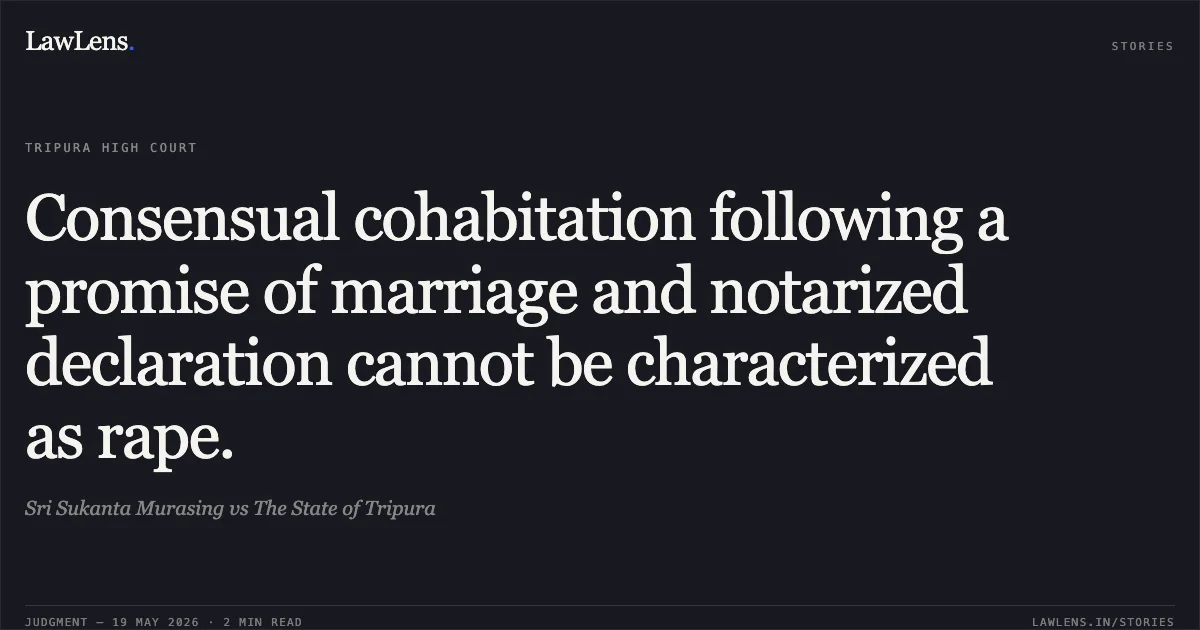
the court answered that a consensual relationship within a subsisting marriage cannot be categorized as rape
Source reference: p. 7Consequently, the appeal was allowed, the judgment of conviction and sentence dated 31.01.2025 was set aside, and the appellant was acquitted and ordered to be set free
Source reference: p. 8Acts & Sections Cited
7 provisions across 2 statutes referred to in this judgment. Each provision opens on LawLens.
Indian Penal Code, 18605
Code of Criminal Procedure, 19732
Original Court PDF
Sri Sukanta MurasingvsThe State of Tripura
Click to open original judgment
Original judgment, available to read, download and summarize on LawLens.in


