Facts
The Appellant, formerly a Livestock Inspector, was accused of entering the room of an Anganwadi worker (the complainant) on January 2, 2001, and establishing a physical relationship under the threat of a knife and a promise of marriage
Source reference: p. 2The complainant alleged that this relationship continued until June 2002, when the Appellant promised to marry her at Sonepur but failed to appear and subsequently transferred to another district without notice
Source reference: p. 3A private complaint was filed before the S.D.J.M., Boudh, leading to a trial for offences under Sections 376, 493, 313, 417, and 380/109 of the IPC and Section 4 of the D.P. Act
Source reference: p. 1-4The Trial Court acquitted the Appellant of all charges except Section 417 (cheating), sentencing him to a fine of ₹30,000
Source reference: p. 2The Appellant challenged this conviction in the High Court.
Source reference: no citationIssues
1. Whether the essential ingredients of "cheating" under Section 417 of the IPC were established, specifically regarding the existence of a dishonest or fraudulent intention at the inception of the relationship
Source reference: p. 7 / para. 72. Whether the act of the Appellant leaving his place of posting after a transfer constitutes intentional deception to attract criminal liability
Source reference: p. 7 / para. 7Law Applied
Section 417 of the Indian Penal Code, 1860, which prescribes punishment for cheating
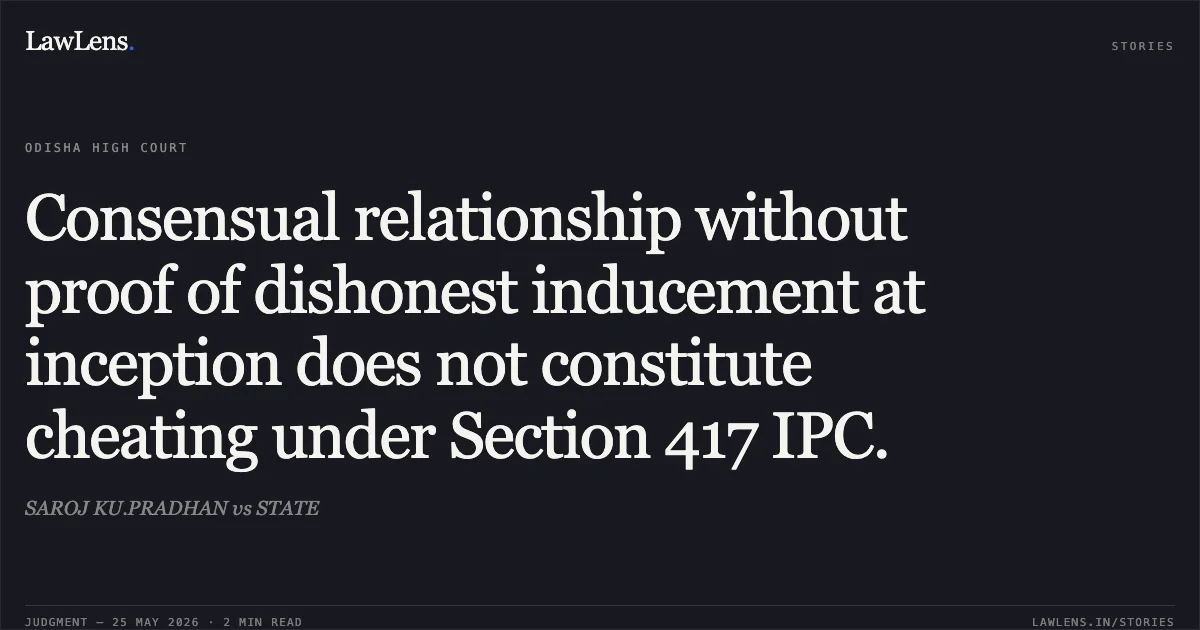
Source reference: p. 1For an offence of cheating to be made out, there must be evidence of "intentional deception" and "dishonest inducement" at the very inception of the act
Source reference: p. 9 / para. 8It further distinguishes between a breach of promise and the criminal offence of cheating, noting that a consensual relationship does not automatically imply a fraudulent promise of marriage without cogent evidence of deceptive intent
Source reference: p. 8 / para. 8Reasoning
The High Court found that the Trial Court's conviction was based on the flawed assumption that a consensual physical relationship between an unmarried woman and a man must necessarily imply a promise of marriage
Source reference: p. 8 / para. 8The Court noted that the Trial Court had already found the evidence regarding the alleged marriage at Shiva Temple to be unreliable
Source reference: p. 8 / para. 8The High Court reasoned that the prosecution failed to prove "dishonest or fraudulent intention from the very inception"
Source reference: p. 8Merely because the Appellant moved following a professional transfer or could not be traced later did not prove he intended to deceive the complainant when the relationship began
Source reference: p. 8 / para. 8The evidence indicated a consensual relationship, and the "conspicuous absence" of intentional inducement at the start of the relationship meant the legal threshold for Section 417 was not met
Source reference: p. 9Holding
The Court held that the prosecution failed to establish the foundational elements of cheating. Consequently, the Appellant was acquitted of the charge under Section 417 of the IPC
The High Court allowed the appeal and set aside the judgment of conviction and order of sentence dated August 7, 2006
Source reference: p. 9Acts & Sections Cited
8 provisions across 3 statutes referred to in this judgment. Each provision opens on LawLens.
Code of Criminal Procedure, 19731
Indian Penal Code, 18606
Dowry Prohibition Act, 19611
Original Court PDF
SAROJ KU.PRADHANvsSTATE
Click to open original judgment
Original judgment, available to read, download and summarize on LawLens.in