Facts
The petitioner (victim) filed an application under Section 378(4) of the Code of Criminal Procedure (CrPC) seeking leave to appeal against the judgment dated 01.02.2023 passed by the First Additional Sessions Judge (FTC), Bemetara.
Source reference: para. 2The trial court had acquitted Respondent No. 2 (accused) of charges under Sections 376 and 376(2)(h) of the Indian Penal Code (IPC).
Source reference: para. 2The prosecution case alleged that the respondent induced the petitioner with a promise of marriage and established physical relations on 25.07.2022.
Source reference: para. 3At the time of the incident, the petitioner was already married to another man and was three months pregnant.
Source reference: para. 3The written complaint was filed nearly three months after the incident.
Source reference: para. 3After examining 16 prosecution witnesses, the trial court concluded the relationship was consensual.
Source reference: para. 5Issues
Whether the petitioner should be granted leave to appeal against the judgment of acquittal under Section 378(4) of the CrPC.
Source reference: para. 2, 8Whether the physical relationship established between the accused and the petitioner (a major, married, and pregnant woman) constituted rape or was consensual in nature.
Source reference: para. 8Law Applied
The Court primarily considered the requirements for granting leave to appeal against acquittal under Section 378(4) of the CrPC.
Source reference: para. 2It applied the definition of "rape" under Section 375 of the IPC, specifically examining the vitiation of consent.
Source reference: para. 8The Court relied on the principle that sexual intercourse with a major person does not amount to rape if established with the will and consent of the woman.
Source reference: para. 8It further observed that consent is not validly given if obtained through fear of injury, misconception of fact, or if the victim is unable to understand the consequences of her consent; however, such factors must be proven by evidence.
Source reference: para. 8Reasoning
The High Court examined the depositions and found no evidence that the respondent obtained consent by putting the petitioner in fear of death or hurt.
Source reference: para. 8The Court emphasized that the petitioner was a major and a married woman at the time of the incident, making it impossible for her to believe she was lawfully married to the accused.
Source reference: para. 8There was no evidence of unsoundness of mind, intoxication, or incapacity to understand the nature of the act.
Source reference: para. 8The Court reasoned that since the petitioner was a major and married, her voluntary participation in physical relations—even if preceded by a promise of marriage—amounted to consensual sex rather than rape.
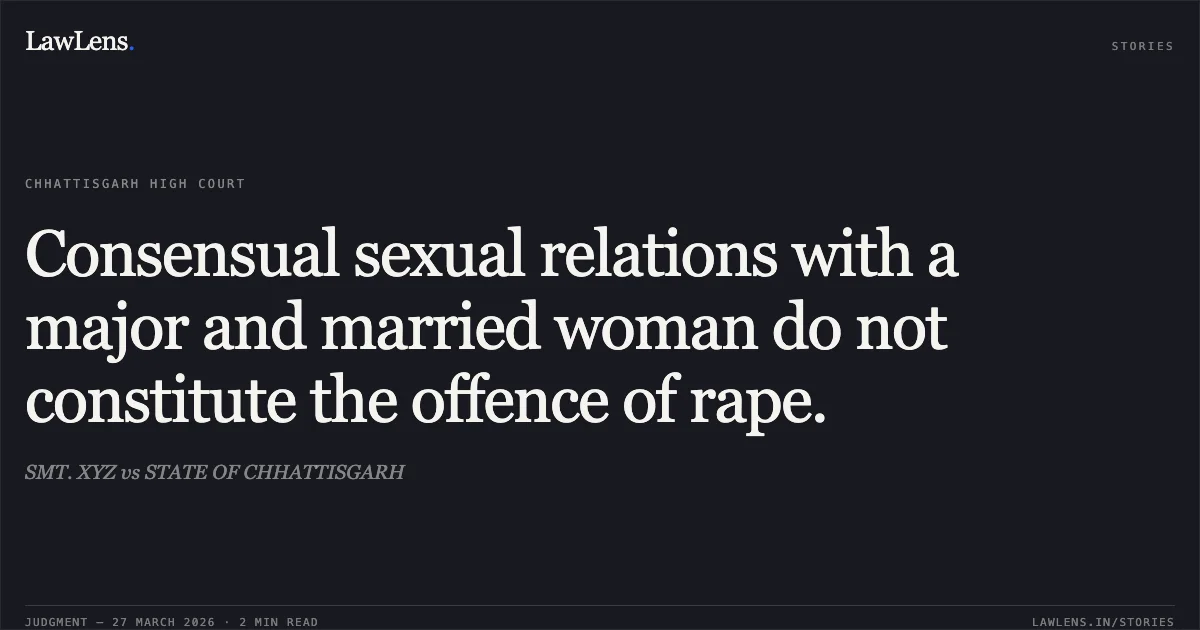
Source reference: para. 8Consequently, the Court found no legal error in the trial court’s conclusion that consensual relations with a major married woman do not constitute an offense under Section 376 IPC.
Source reference: para. 8Holding
The Court held that the case was not a fit instance to grant leave to appeal as the trial court’s findings were supported by the evidence on record.
The Court affirmed that physical relations established with a major and married woman with her consent do not constitute rape.
Source reference: para. 8The CRMP was accordingly dismissed, and leave to appeal was denied.
Source reference: para. 9Original Court PDF
SMT. XYZvsSTATE OF CHHATTISGARH
Click to open original judgment
Original judgment, available to read, download and summarize on LawLens.in


