Facts
The petitioner, a 36-year-old teacher, sought the quashing of an order of cognizance dated 31.08.2022 for offences under Sections 376 (rape) and 420 (cheating) of the IPC, and Section 4 of the Dowry Prohibition Act
Source reference: p.1The complainant, a 30-year-old woman, alleged that she entered into a physical relationship with the petitioner on the assurance of marriage, but he later refused to marry her
Source reference: p.2, para. 3The record indicated the parties were in a consensual relationship for approximately three years before the FIR was lodged on 06.07.2022
Source reference: p.2, para. 4Issues
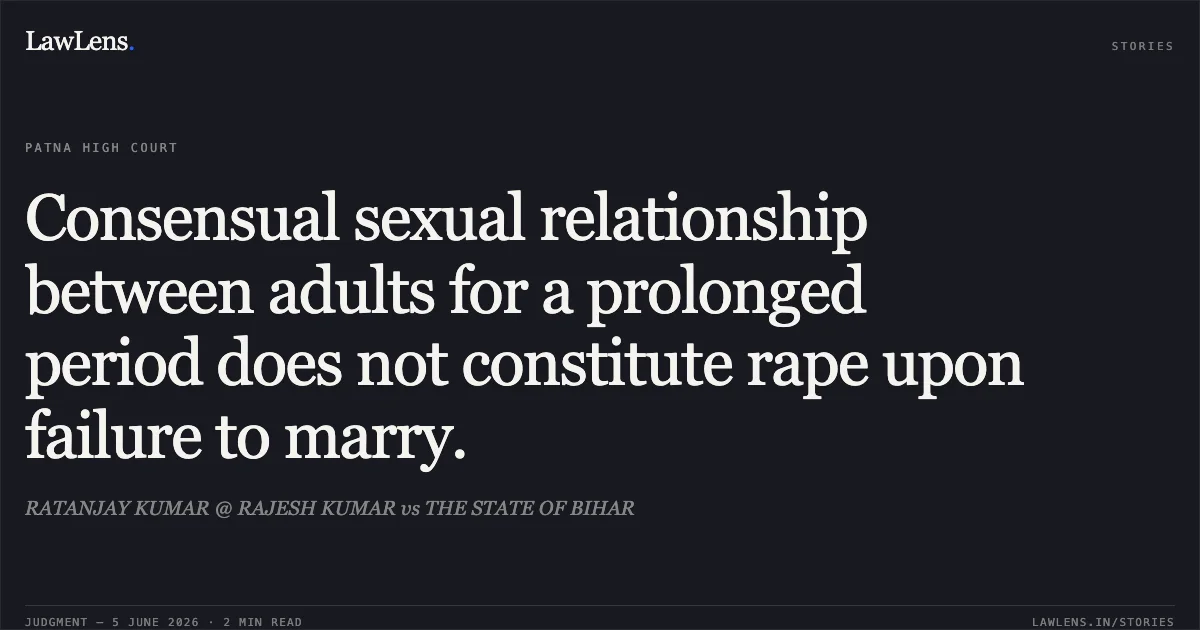
1. Whether consensual sexual relations maintained between two adults over a prolonged period under a promise of marriage constitutes "rape" under Section 376 IPC when the marriage does not fructify
Source reference: p.4, para. 8-92. Whether the refusal to marry after a consensual relationship attracts the ingredients of "cheating" under Section 420 IPC or "dowry demand" under Section 4 of the Dowry Prohibition Act in the absence of specific evidence
Source reference: p.5-6, para. 10Law Applied
The court primarily applied Section 375 of the IPC regarding consent and Section 90 regarding "misconception of fact"
Source reference: p.3, para. 7It relied on the precedent set in Pramod Suryabhan Pawar v. State of Maharashtra (2019), which distinguished between a "false promise" (given in bad faith at the outset) and a "breach of promise"
Source reference: p.3, para. 7The court also applied the principle from Prashant v. State (NCT of Delhi) (2025), holding that a consensual relationship's failure to culminate in marriage cannot be criminalized
Source reference: p.5, para. 9Regarding the other charges, Sections 415/420 IPC (Cheating) and Section 4 of the Dowry Prohibition Act were applied, requiring proof of dishonest inducement and actual dowry demands, respectively
Source reference: p.5, para. 10Reasoning
The Court analyzed the duration of the relationship—three years—and the age of the informant (30 years), concluding she was a consenting adult capable of independent decisions
Source reference: p.4-5, para. 9Applying the Pramod Suryabhan Pawar test, the Court found no evidence that the petitioner had a "bad faith" intention from the very beginning or that the sole reason for sexual indulgence was the promise of marriage
Source reference: p.4, para. 8It reasoned that a mere breakdown of a cordial, long-standing relationship between two adults does not satisfy the ingredients of Section 376 IPC
Source reference: p.5, para. 9Regarding Section 420, the Court noted the FIR lacked any allegation of dishonest inducement leading to delivery of property
Source reference: p.5, para. 10Finally, the Section 4 DPA charge was found to be without any factual foundation, as the FIR was silent on any demand for dowry
Source reference: p.6, para. 10Holding
The Court answered the issues in the negative, holding that the criminal proceedings were an abuse of process.
The High Court allowed the petition and quashed the order of cognizance dated 31.08.2022 passed by the S.D.J.M., Jehanabad, in its entirety regarding the petitioner
Source reference: p.6, para. 11-12Acts & Sections Cited
6 provisions across 3 statutes referred to in this judgment. Each provision opens on LawLens.
Indian Penal Code, 18604
Code of Criminal Procedure, 19731
Dowry Prohibition Act, 19611
Original Court PDF
RATANJAY KUMAR @ RAJESH KUMARvsTHE STATE OF BIHAR
Click to open original judgment
Original judgment, available to read, download and summarize on LawLens.in


