Facts
The appellant was convicted by the Trial Court under Section 376 of the IPC and Section 6 of the POCSO Act for allegedly establishing a physical relationship with the victim for over a year on the pretext of marriage, resulting in pregnancy.
Source reference: p.2The appellant later admitted the relationship and paternity but contended the victim was a major and the relationship was consensual.
Source reference: p.5, 17The prosecution relied on a medical report (Exhibit-3) and an age determination report (Exhibit-4) prepared at a late stage to assert minority.
Source reference: p.4, 6The appellant challenged the conviction, primarily contesting the victim’s age and the procedural validity of the age determination evidence.
Source reference: p.5-6Issues
1. Whether the prosecution proved the minority of the victim beyond reasonable doubt to attract the provisions of the POCSO Act.
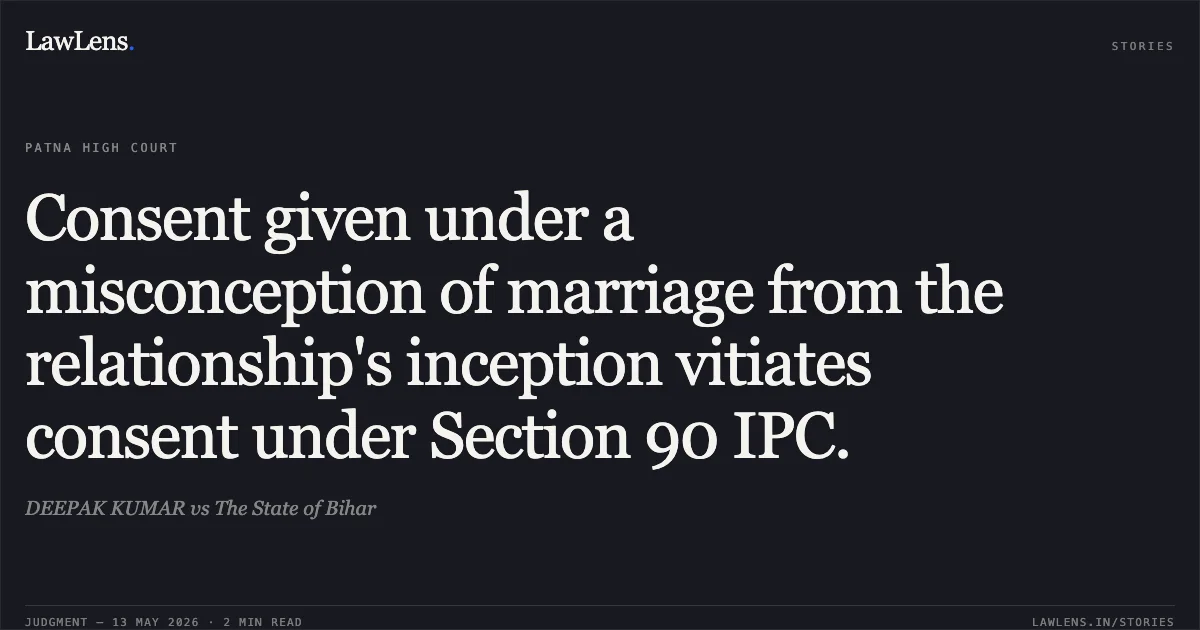
Source reference: p.5, 182. Whether a consent obtained under a misconception of fact (false promise of marriage) constitutes valid consent under Section 90 of the IPC.
Source reference: p.21-22Law Applied
The court applied Section 376 and Section 90 of the Indian Penal Code (IPC) and Section 6 of the POCSO Act.
Source reference: p.21, p.1The court relied on Section 94 of the Juvenile Justice (Care and Protection of Children) Act, 2015 for age determination standards.
Source reference: p.6Regarding medical age estimation, the court applied the "margin of error" principle (plus/minus two years) established in Rajak Mohammad v. H.P. (2018) and Court on its Own Motion v. NCT of Delhi (2024), which mandates adopting the upper age limit in the reference range in favor of the accused.
Source reference: p.19-20Reasoning
The court found that the prosecution failed to produce primary age evidence like matriculation or birth certificates.
Source reference: p.18The medical assessment estimated the victim's age between 16 and 17 years; however, applying the judicial precedent of a two-year "margin of error," the court determined the victim’s upper age could be 19 years, making her a major at the time of the occurrence.
Source reference: p.20Regarding the IPC charge, the court noted the appellant's own admissions in court filings and letters confirming the relationship and paternity.
Source reference: p.17The court reasoned that since the physical relationship was induced by a promise to marry—which the appellant later refused—the consent was obtained under a "misconception of fact" per Section 90 IPC, rendering it invalid for the purposes of Section 376.
Source reference: p.22Holding
The court set aside the conviction under Section 6 of the POCSO Act due to the prosecution's failure to prove the victim's minority, but upheld the conviction under Section 376 of the IPC as the consent was vitiated by a false promise of marriage.
The court held that the period of seven years and one month already served by the appellant was sufficient to meet the ends of justice and directed his discharge.
Source reference: p.22-23Acts & Sections Cited
8 provisions across 4 statutes referred to in this judgment. Each provision opens on LawLens.
Indian Penal Code, 18603
Protection of Children from Sexual Offences Act, 20122
Code of Criminal Procedure, 19732
Juvenile Justice (Care and Protection of Children) Act, 2015.1
Original Court PDF
DEEPAK KUMARvsThe State of Bihar
Click to open original judgment
Original judgment, available to read, download and summarize on LawLens.in