Facts
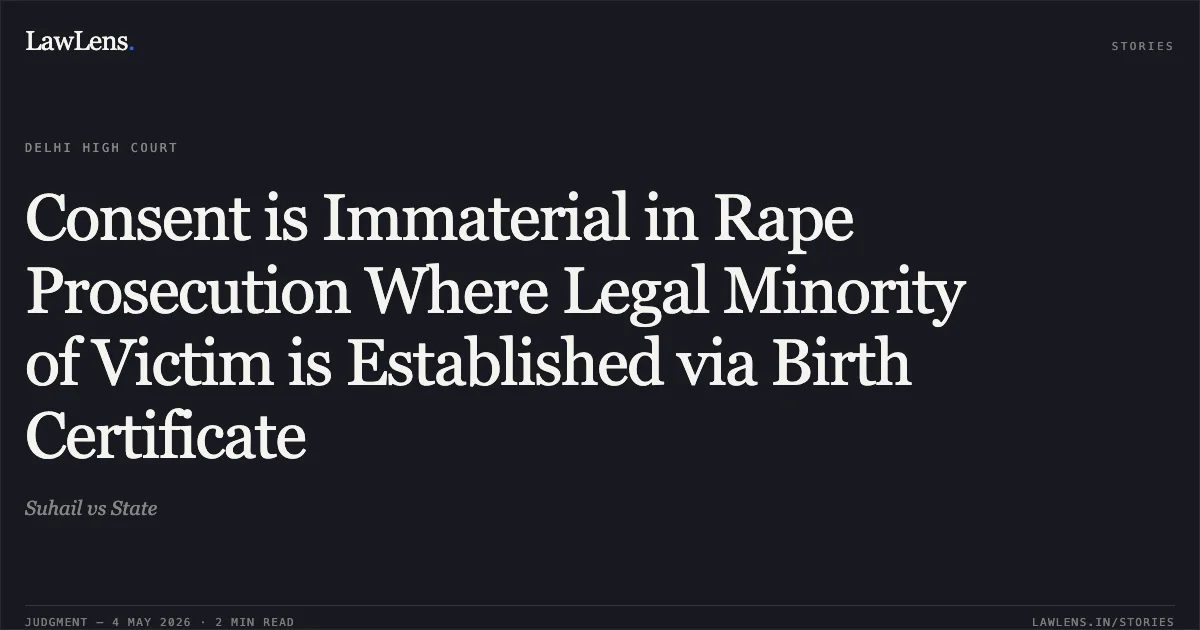
The appellant was convicted by the trial court for kidnapping and repeatedly raping a girl (PW1) on 20.01.2014
Source reference: p.2The prosecution alleged that the appellant lured PW1, aged approximately 15 years and 6 months, to Rampur, U.P., where he committed penetrative sexual assault
Source reference: p.2The appellant contended that PW1 was a major who accompanied him voluntarily and that sexual relations were consensual
Source reference: p.4, 6The trial court sentenced the appellant to 7 years rigorous imprisonment under Sections 363 and 366 IPC, and 10 years under Section 376(2)(n) IPC
Source reference: p.5Issues
1. Whether the prosecution established beyond reasonable doubt that the victim was a minor on the date of the incident
Source reference: p.17-182. Whether the evidence supported a conviction for kidnapping and abduction under Sections 363 and 366 of the IPC
Source reference: p.15-163. Whether the conviction under Section 376(2)(n) of the IPC can be sustained based on the victim’s testimony and the appellant's statement under Section 313 Cr.P.C.
Source reference: p.17, 20Law Applied
The court applied Section 94 of the Juvenile Justice Act, 2015, which prioritizes a birth certificate from a municipal authority over medical estimates for age determination
Source reference: p.18It also examined Section 361 IPC (Kidnapping from lawful guardianship) and Section 366 IPC (Kidnapping for illicit intercourse), noting that "enticing" or "taking" is essential for these offenses
Source reference: p.15-16the court applied Section 375 IPC, emphasizing that if a victim is below the age of consent (18 years), any sexual intercourse is rape, regardless of purported consent
Source reference: p.20The court also relied on Bishnu Prasad Sinha v. State of Assam, noting that an accused's statement under Section 313 Cr.P.C. can be read alongside other evidence to corroborate the occurrence of an act
Source reference: p.20Reasoning
Regarding age, the court rejected the defense's reliance on the onset of menarche as an age-determination factor, holding that the birth certificate (Ext. PW5/A) proving PW1 was 15 years and 6 months old was conclusive under the JJ Act
Source reference: p.18-19On the charges of kidnapping (Sec 363/366 IPC), the court found PW1's testimony contradictory; she admitted to joining the appellant voluntarily after being beaten by her brother and stated there was no threat or coercion during her travel to Rampur. This negated the elements of "taking" or "enticing" by the accused.
Source reference: p.16-17regarding rape (Sec 376(2)(n) IPC), even though the court found the sexual act was likely consensual—contradicting the victim's claim of "force"—the appellant’s own admission of intercourse in his Sec 313 statement, coupled with the victim’s evidence, established the physical act. Since minority was established, the victim’s consent was legally irrelevant, fulfilling the requirements for statutory rape
Source reference: p.20-21Holding
The High Court partly allowed the appeal. It set aside the conviction and sentences under Sections 363 and 366 IPC, finding the prosecution failed to prove kidnapping or abduction.
the court upheld the conviction and the 10-year sentence under Section 376(2)(n) IPC, holding that the victim's minority rendered her consent immaterial. All pending applications were closed
Source reference: p.21, 22Acts & Sections Cited
1 provisions across 1 statute referred to in this judgment. Each provision opens on LawLens.
Juvenile Justice (Care and Protection of Children) Act, 2015.1
Original Court PDF
SuhailvsState
Click to open original judgment
Original judgment, available to read, download and summarize on LawLens.in