Facts
The State appealed against a Trial Court judgment dated 18th December 2019, which acquitted the respondent, Deepak, of charges under Sections 363/365/366A/342/376 of the IPC and Section 4 of the POCSO Act.
Source reference: p. 1-2The prosecution alleged that on 9th May 2014, the respondent abducted the prosecutrix (aged approximately 15-16 years) near a public lavatory, confined her in his jhuggi for two days, and repeatedly sexually assaulted her.
Source reference: p. 2-3The respondent claimed a consensual love affair and disputed the prosecutrix's minority.
Source reference: p. 4The Trial Court granted the respondent the benefit of doubt regarding the prosecutrix's age and acquitted him based on the possibility of consent.
Source reference: p. 4, 16Issues
1. Whether the Trial Court erred in discarding the birth certificate issued by the Municipal Corporation for determining the age of the prosecutrix.
Source reference: p. 102. Whether the consent of the prosecutrix is legally relevant given her status as a minor under the POCSO Act.
Source reference: p. 16-173. Whether the scientific evidence (DNA profiling) and circumstantial evidence were sufficient to establish the guilt of the respondent.
Source reference: p. 20Law Applied
Section 94 of the Juvenile Justice (Care and Protection of Children) Act, 2015, and Rule 12 of the Juvenile Justice Rules, 2007, which grant primacy to birth certificates issued by municipal authorities in determining age.
Source reference: p. 5, 12The precedent set in Jarnail Singh v. State of Haryana, affirming that Rule 12 applies to victim age determination.
Source reference: p. 12Strict liability principles of the POCSO Act, 2012, which render the consent of a minor irrelevant to the commission of sexual offences.
Source reference: p. 17Section 45 of the Indian Evidence Act regarding expert DNA testimony was also central to corroborating the physical act.
Source reference: p. 20Reasoning
The High Court found the Trial Court’s rejection of the birth certificate (Ex. PW-8/C) to be "perverse and erroneous".
Source reference: p. 21The Court reasoned that since the certificate was registered in 2009—well before the 2014 incident—the possibility of fabrication was nonexistent.
Source reference: p. 11Under the statutory hierarchy of evidence, the birth certificate carries a presumption of correctness that oral testimonies of illiterate parents cannot displace.
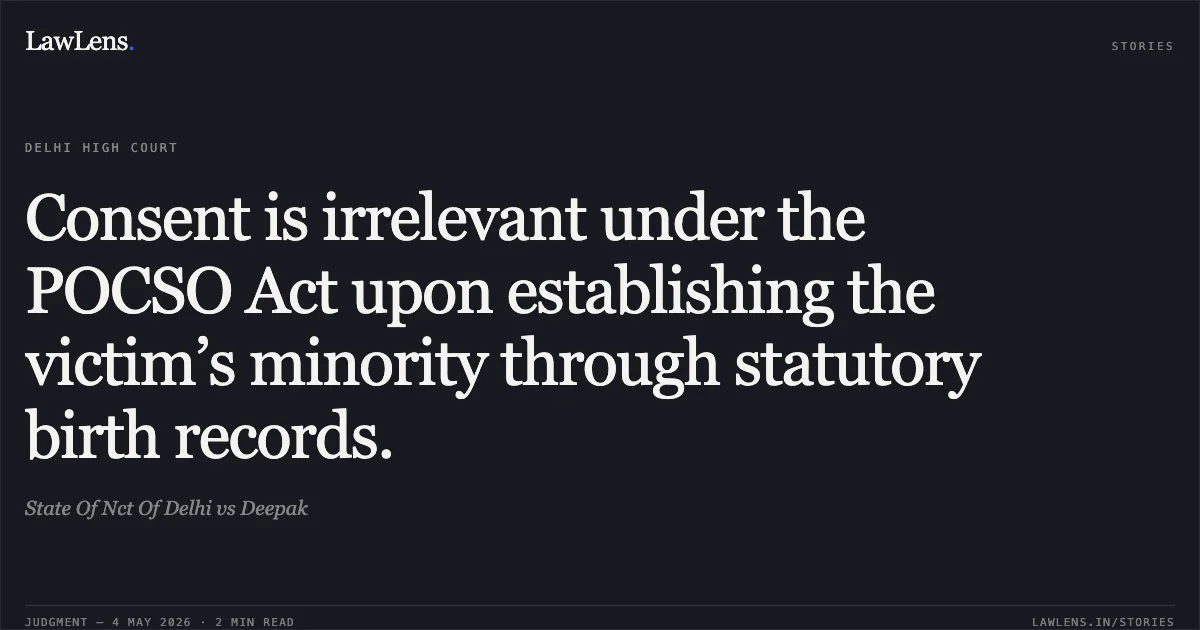
Source reference: p. 6, 12Upon establishing the prosecutrix was a minor (born 23.01.1999), the Court held that the Trial Court's inquiry into "consent" was "legally untenable" as the law does not recognize a minor's capacity to consent to sexual activity.
Source reference: p. 16-17The Court noted that FSL report (Ex. PW-4/A) provided conclusive STR analysis matching the respondent's DNA to seminal stains on the prosecutrix's clothing, thereby scientifically confirming the assault.
Source reference: p. 20Holding
The High Court set aside the acquittal, holding that the prosecution proved the prosecutrix was a minor and that the respondent committed the alleged acts.
The Court answered the issues by affirming the primacy of the birth certificate and the irrelevance of consent in cases involving minors.
Source reference: p. 13, 17The respondent, Deepak, was convicted under Sections 363/366/342 of the IPC and Section 6 of the POCSO Act.
Source reference: p. 21The matter was scheduled for 7th May 2026 to hear arguments on the quantum of sentence.
Source reference: p. 21Acts & Sections Cited
11 provisions across 4 statutes referred to in this judgment. Each provision opens on LawLens.
Indian Penal Code, 18605
Code of Criminal Procedure, 19733
Juvenile Justice (Care and Protection of Children) Act, 2015.1
Original Court PDF
State Of Nct Of DelhivsDeepak
Click to open original judgment
Original judgment, available to read, download and summarize on LawLens.in