Facts
The respondents had filed OA No. 603/2021 under Section 19 of the Administrative Tribunals Act, 1985, challenging ESIC’s revised All India seniority list for Head Clerk/Assistant in Level 6 of the 7th CPC as on 31 March 2016 and seeking its redrawing
Source reference: p.1Before the Central Administrative Tribunal, counsel for the respondents stated that, pursuant to the revised policy dated 24 May 2022, necessary steps had been taken and undertook to complete compliance within twelve weeks.
Source reference: p.2On that basis, the Tribunal directed redrawing of the seniority list and disposed of the OA, recording that the applicant’s prayer stood satisfied.
Source reference: p.2ESIC thereafter challenged the Tribunal’s order before the High Court.
Source reference: p.2The High Court noted substantial delay: the decision to challenge was allegedly taken more than six months after the Tribunal’s order; the writ petition was filed thereafter; defects remained uncured; and the petition was pursued only after contempt proceedings and an order directing the personal presence of ESIC’s Director General.
Source reference: pp.2–3Issues
1. Whether the High Court should exercise its discretionary jurisdiction under Article 226 despite the unexplained and inordinate delay in challenging the Tribunal’s order.
Source reference: pp.2–42. Whether an order passed by the Tribunal on the basis of a statement or consent made by counsel could ordinarily be challenged by way of a writ petition.
Source reference: p.43. Whether, in the facts of the case, the Tribunal’s direction to redraw the seniority list under the revised policy dated 24 May 2022 warranted interference.
Source reference: pp.2, 4Law Applied
The High Court applied the discretionary nature of jurisdiction under Article 226 of the Constitution, holding that inordinate delay and laches, when not satisfactorily explained, constitute a ground to decline relief.
Source reference: p.3It relied on Chairman, Uttar Pradesh Power Corporation Ltd. v. Ram Gopal, (2021) 13 SCC 225, and Mrinmoy Maity v. Chhanda Koley, (2024) 15 SCC 215, on the need to consider unexplained delay while exercising writ jurisdiction.
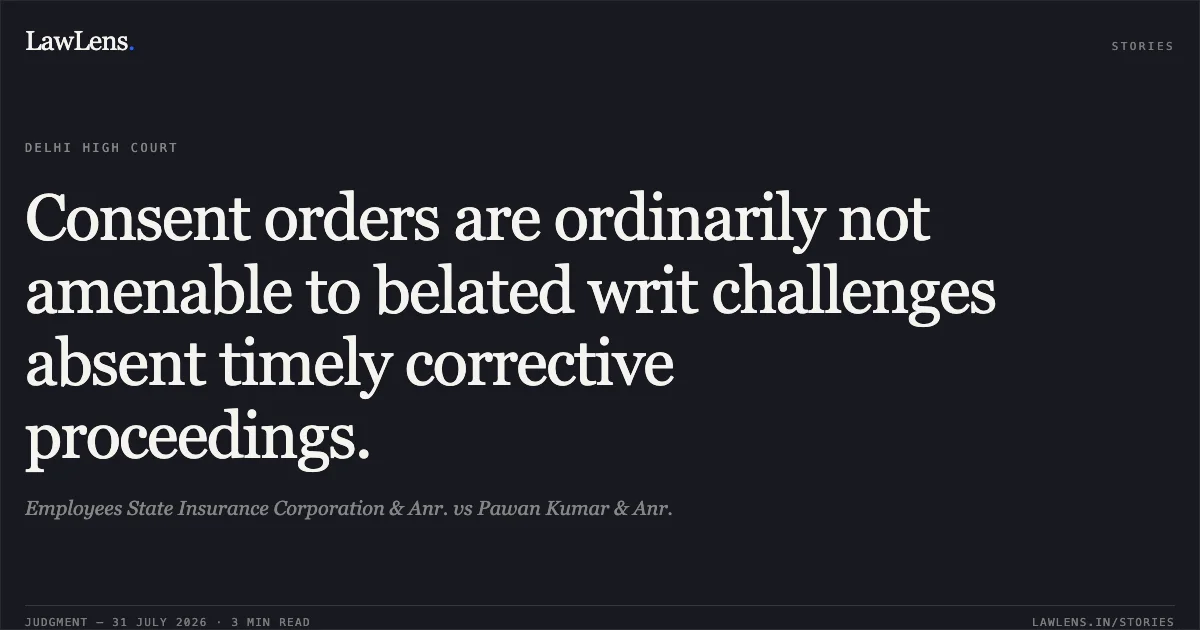
Source reference: p.3The Court further applied the principle that orders passed on consent or on the basis of a statement made by counsel are ordinarily not amenable to challenge; where consent was allegedly unauthorised or unjustified, the appropriate remedy is to approach the same court in appropriate proceedings.
Source reference: p.4The underlying OA had been filed under Section 19 of the Administrative Tribunals Act, 1985.
Source reference: p.1Reasoning
The Court found the explanation for the delay “woefully inadequate,” noting that the petitioners did not satisfactorily account for the period between the Tribunal’s order, the decision to challenge it, the filing of the writ petition, and the prolonged failure to cure defects.
Source reference: pp.2–3The petitioners also failed to act promptly even after contempt proceedings were initiated before the Tribunal and continued to pursue the challenge only after the Director General was directed to appear personally.
Source reference: p.3Independently, the impugned order was based on counsel’s categorical statement that the seniority list would be redrawn in accordance with the revised policy dated 24 May 2022, and the Tribunal disposed of the OA on that basis.
Source reference: p.2Since no attempt had been made before the Tribunal to withdraw, correct, or otherwise challenge the alleged consent or lack of authority, the High Court held that the order was ordinarily not open to collateral challenge in writ proceedings.
Source reference: p.4The combined effect of consent and gross delay/laches justified refusal to interfere.
Source reference: no citationHolding
The High Court declined to exercise its jurisdiction under Article 226 on two independent grounds: the impugned order was a consent-based order, and the writ petition suffered from gross, inadequately explained delay and laches.
The writ petition was accordingly dismissed.
Source reference: p.4The Court clarified that its decision was confined to the peculiar facts of the case.
Source reference: p.4Original Court PDF
Employees State Insurance Corporation & Anr.vsPawan Kumar & Anr.
Click to open original judgment
Original judgment, available to read, download and summarize on LawLens.in