Facts
The Union of India awarded M/s ANS Construction Ltd. a contract for construction of residential quarters and allied development works at Balrampur, Uttar Pradesh, with the stipulated completion date of 28 December 2011.
Source reference: p.2, para. 2(a)The contractor furnished various fixed deposits and bank guarantees towards earnest money, performance security and security deposit.
Source reference: p.2, para. 2(b)Disputes arose and were initially referred to a sole arbitrator, who passed an award dated 26 July 2017 in favour of the contractor, after adjusting the Union’s counter-claim for mobilisation advance.
Source reference: pp.2–4, para. 2(c)–(e)The first award was subsequently settled between the parties, and the settlement amount was paid by the Union.
Source reference: pp.7–8, paras. 9, 18Six additional claims concerning release of bank guarantees, fixed deposits and related amounts were not adjudicated in the first arbitration.
Source reference: p.3, para. 2(f)A second arbitrator terminated those proceedings under Section 25(a) of the Arbitration and Conciliation Act, 1996, owing to the contractor’s failure to file its statement of claim.
Source reference: p.3, para. 2(f)Thereafter, by consent of the parties, the High Court appointed Ms. Justice Pratibha Rani (Retd.) as arbitrator to adjudicate the six additional claims and any claim for reimbursement of interest or charges incurred in keeping the bank guarantees alive.
Source reference: pp.5–7, paras. 6–8The arbitrator passed the impugned award dated 5 April 2019, permanently restraining encashment of the specified bank guarantees and FDR, directing their release, and awarding Rs.7,08,375 towards bank charges, besides arbitral costs and post-award interest.
Source reference: pp.10–11, para. 17The Union challenged the award under Section 34 of the Act.
Source reference: no citationIssues
Whether the High Court-appointed arbitrator could validly adjudicate the six additional claims after the earlier arbitral proceedings concerning those claims had been terminated under Section 25(a) of the Act?
Source reference: pp.4–5, paras. 3–4; pp.9–10, paras. 14–16Whether the arbitrator exceeded the scope of reference by awarding reimbursement of interest and bank charges incurred for keeping the bank guarantees alive?
Source reference: pp.11–13, paras. 19–21Whether the impugned award disclosed perversity, violation of the fundamental policy of Indian law, or any other ground warranting interference under Section 34 of the Act?
Source reference: pp.9–12, paras. 17–18, 22Law Applied
The Court applied Section 34 of the Arbitration and Conciliation Act, 1996, under which judicial interference with an arbitral award is limited to the statutory grounds, including violation of the fundamental policy of Indian law and perversity.
Source reference: no citationSection 25(a) permits termination of arbitral proceedings where the claimant fails to communicate its statement of claim, but such termination did not preclude the subsequent consensual reference of the claims in the circumstances of this case.
Source reference: p.3, para. 2(f)The Court also applied the principles of waiver, consent and acquiescence: a party that consented to a reference and failed to object to the jurisdiction at the relevant stage could not raise the objection belatedly.
Source reference: pp.9–10, paras. 15–16It further relied on the principle that concluded disputes should not be reopened through inconsistent proceedings, consistent with the doctrines of res judicata and constructive res judicata, and held that once the underlying contractual disputes had been finally adjudicated and settled, the corresponding performance securities could not be retained or invoked without an outstanding contractual liability.
Source reference: pp.10–12, paras. 17–18The Court considered, but found no basis to apply, the petitioner’s reliance on M/s Tantia Constructions Ltd. v. Union of India, SLP (Civil) No.10722 of 2022, order dated 15 July 2022.
Source reference: p.5, para. 4Reasoning
The Court rejected the Union’s objection that the second reference was legally impermissible because the earlier arbitrator had declined to adjudicate the six claims and the subsequently appointed arbitrator had terminated proceedings under Section 25(a).
Source reference: pp.9–10, paras. 15–16The decisive circumstance was that, on 4 September 2018, the High Court appointed another arbitrator by consent to adjudicate the very same six claims and related bank-charge claims.
Source reference: pp.9–10, paras. 15–16The Union neither objected to that reference on the ground of the prior termination nor challenged the order of appointment; consequently, its belated jurisdictional objection was held unsustainable.
Source reference: pp.9–10, paras. 15–16On the merits, the first award had determined the parties’ reciprocal contractual liabilities and had thereafter been settled and acted upon.
Source reference: pp.10–12, paras. 17–18The arbitrator therefore reasonably concluded that no subsisting liability remained which could justify encashment or retention of the performance guarantees, security deposits or FDR.
Source reference: pp.10–12, paras. 17–18The award of bank charges was also within the reference because the High Court’s order expressly authorised adjudication of claims for interest and charges incurred in maintaining the bank guarantees.
Source reference: pp.12–13, paras. 19–21The Court found the arbitrator’s reasoning consistent with settled legal principles and detected neither perversity nor any violation of the fundamental policy of Indian law.
Source reference: p.13, para. 22Holding
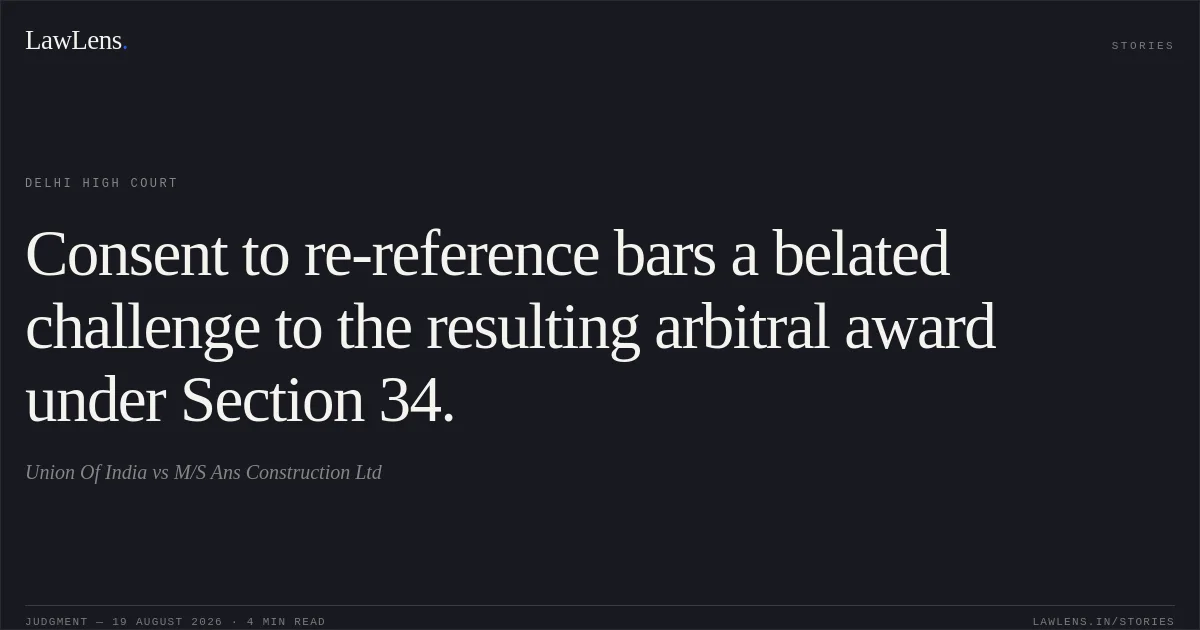
The Court answered all issues against the Union of India and dismissed both Section 34 petitions.
It upheld the impugned award permanently restraining encashment of the specified bank guarantees and FDR, directing their return/release, awarding Rs.7,08,375 towards bank charges, granting arbitral costs to the extent of the tribunal fee, and providing for interest at 12% per annum if the awarded amount was not paid within three months of the award.
Source reference: pp.10–11, para. 17The Court held that the Union, having consented to the subsequent reference and having settled the first award, could not belatedly challenge the arbitrator’s jurisdiction or retain the securities in the absence of any surviving contractual liability.
Source reference: pp.9–13, paras. 15–23Acts & Sections Cited
4 provisions across 1 statute referred to in this judgment. Each provision opens on LawLens.
Arbitration and Conciliation Act, 19964
Original Court PDF
Union Of IndiavsM/S Ans Construction Ltd
Click to open original judgment
Original judgment, available to read, download and summarize on LawLens.in