Facts
Aggrieved persons obtained orders from the Adjudicating Authority under the Real Estate (Regulation and Development) Act, 2016 (“RERA”) on various dates between 13 December 2019 and 10 November 2022.
Source reference: p. 7, para. 3The District Collector initiated recovery proceedings under the Revenue Recovery Act to implement those orders.
Source reference: p. 7, para. 3The appellants challenged the Collector’s proceedings, contending that they had not been made parties before the Adjudicating Authority and that this violated the principles of natural justice.
Source reference: pp. 8–9, paras. 4–7They did not appeal the Adjudicating Authority’s orders before the statutory Appellate Tribunal.
Source reference: pp. 8–9, paras. 4–7The Single Judge dismissed their writ petitions, prompting these intra-court appeals.
Source reference: pp. 8–9, paras. 4–7Issues
1. Whether the appellants could challenge the District Collector’s consequential recovery proceedings in writ petitions without first challenging the underlying Adjudicating Authority orders through the statutory appellate remedy.
Source reference: pp. 8–9, paras. 4–72. Whether the appellants’ contention that they were not parties before the Adjudicating Authority, and were thereby denied natural justice, could be pursued through an appeal against those orders.
Source reference: pp. 8–9, paras. 4, 6Law Applied
The Court relied on the RERA appellate scheme, referring to Section 44 as providing a remedy before the Appellate Tribunal for a person aggrieved by an order of the Adjudicating Authority, and Section 58 as providing a further appeal to the High Court.
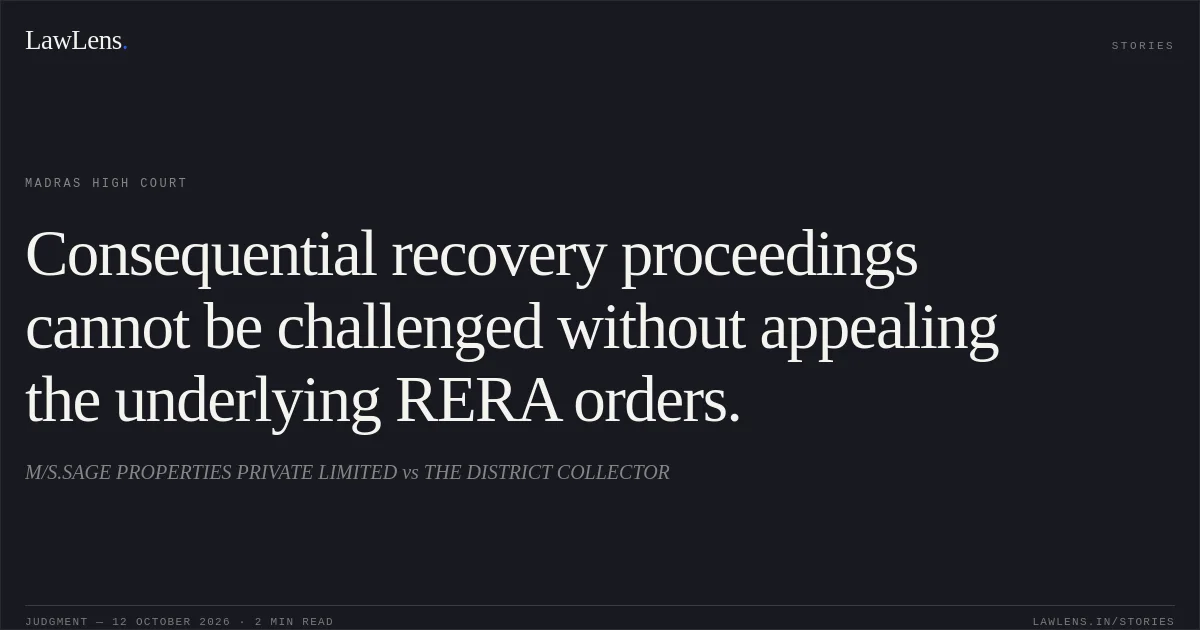
Source reference: p. 9, para. 6Where the statute provides an appellate remedy to challenge the underlying order, a party cannot avoid that remedy by challenging only consequential recovery proceedings implementing the order; objections to the underlying decision must be raised through the statutory appeal.
Source reference: pp. 8–9, paras. 5–7Reasoning
The Collector’s recovery proceedings were consequential to the Adjudicating Authority’s orders, which remained unchallenged before the Appellate Tribunal.
Source reference: pp. 8–10, paras. 5–8The appellants’ non-joinder and natural-justice objections went to the validity of those underlying orders and could be raised in a statutory appeal.
Source reference: pp. 8–10, paras. 5–8Because the appellants instead challenged only the Collector’s implementation proceedings, the Court found no error in the Single Judge’s conclusion that the writ petitions were not maintainable on that basis.
Source reference: pp. 8–10, paras. 5–8Holding
The Court dismissed all four writ appeals, finding no error in the Single Judge’s decision.
It left open the appellants’ liberty to file appropriate statutory appeals and stated that, if appeals were filed, they would be entitled to seek exclusion of the time spent before the High Court when limitation was reckoned.
Source reference: pp. 10–11, para. 8There was no order as to costs; the specified miscellaneous petitions, including the impleading applications, were closed.
Source reference: pp. 10–11, para. 8Acts & Sections Cited
2 provisions across 1 statute referred to in this judgment. Each provision opens on LawLens.
Real Estate (Regulation and Development) Act, 2016.2
Original Court PDF
M/S.SAGE PROPERTIES PRIVATE LIMITEDvsTHE DISTRICT COLLECTOR
Click to open original judgment
Original judgment, available to read, download and summarize on LawLens.in


