Facts
On September 26, 1998, Roshan (the deceased) was admitted to Safdarjung Hospital with 50% burns
Source reference: p. 2She gave three separate statements: first to the attending doctor (PW-21) recorded in the MLC, second to the Investigating Officer (PW-18/23), and third to the SDM (PW-7).
Source reference: p. 3, 6In all declarations, she alleged that her husband (the Appellant) poured kerosene from a stove and set her ablaze following a quarrel over dowry demands.
Source reference: p. 3The Appellant claimed he was not present at the time and suggested the incident was an accidental stove burst.
Source reference: p. 4The Trial Court convicted the Appellant under Sections 302, 304-B, and 498-A of the IPC.
Source reference: p. 4The Appellant challenged the conviction primarily on the ground of inconsistencies in the multiple dying declarations.
Source reference: p. 5Issues
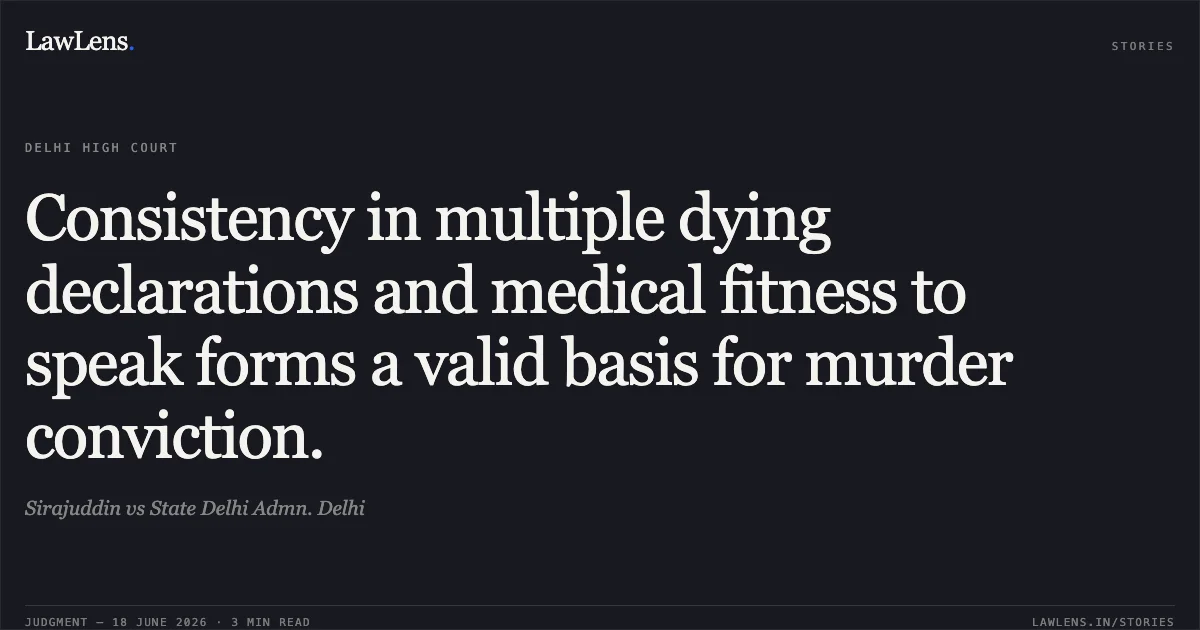
1. Whether multiple dying declarations that contain minor inconsistencies can form the sole basis of conviction under Section 302 IPC
Source reference: p. 13 / para. 302. Whether the prosecution proved the ingredients of dowry death under Section 304-B IPC and cruelty under Section 498-A IPC
Source reference: p. 8-9 / para. 18-193. Whether the conduct of the Appellant post-incident and scientific evidence (CFSL report) corroborated the dying declarations
Source reference: p. 11-12 / para. 24-26Law Applied
The court applied Section 302 (Murder), Section 304-B (Dowry Death), and Section 498-A (Cruelty) of the Indian Penal Code, 1860.
Source reference: p. 2It relied on the evidentiary principle of nemo moriturus praesumitur mentiri (a man will not meet his Maker with a lie in his mouth) enshrined in Section 32(1) of the Indian Evidence Act.
Source reference: para. 30The court followed the Supreme Court’s synthesis in Abhishek Sharma v. State (NCT of Delhi) regarding multiple dying declarations, which mandates that such statements must be voluntary, reliable, and consistent in material particulars.
Source reference: p. 18 / para. 39It further applied Section 8 of the Evidence Act regarding the relevance of the accused's conduct.
Source reference: p. 31 / para. 51Reasoning
The Court found that all three dying declarations were materially consistent regarding the core "substratum" of the case: the Appellant poured kerosene and ignited the deceased.
Source reference: p. 19, 27It rejected the Appellant's argument regarding "fit for statement" discrepancies, noting that different doctors (PW-21 and PW-22) certified her fitness at different stages of her treatment.
Source reference: p. 10, 22The Court dismissed the "accidental stove burst" theory because the CFSL report confirmed kerosene residues on the victim's clothes—implying kerosene was poured—and photographs showed the stove was intact, not exploded.
Source reference: p. 29-30The Appellant’s absconding nature and failure to visit his critically injured wife were deemed incriminating conduct under Section 8 of the Evidence Act.
Source reference: p. 30-31While the allegations of dowry demands (scooter, fridge, and Rs. 50,000/-) were upheld as proving cruelty under Section 498-A, the Court determined that once a conviction for murder under Section 302 is established based on direct evidence, a parallel conviction for the "lesser" or alternative charge of dowry death (Section 304-B) is not warranted.
Source reference: p. 33, 37Holding
The Court upheld the conviction and life sentence under Section 302 IPC and the sentence under Section 498-A IPC, finding the dying declarations truthful and corroborated by forensic and circumstantial evidence.
However, it set aside the conviction under Section 304-B IPC, holding it was unnecessary given the affirmation of the murder charge.
Source reference: p. 37The Court directed the Appellant to surrender within two weeks to serve the remaining sentence.
Source reference: p. 37Acts & Sections Cited
2 provisions across 1 statute referred to in this judgment. Each provision opens on LawLens.
Indian Penal Code, 18602
Original Court PDF
SirajuddinvsState Delhi Admn. Delhi
Click to open original judgment
Original judgment, available to read, download and summarize on LawLens.in