Facts
Mobin Jahan, the appellant’s daughter, suffered extensive burns at approximately 1:00–2:00 a.m. on 1 September 2012.
Source reference: paras. 2–4At the hospital, she made two statements alleging that the appellant poured kerosene on her, set her ablaze, locked the room from outside, and fled because he disapproved of her relationship with Tinku Maurya.
Source reference: paras. 2–4, 14, 16The first statement was recorded by Sub-Inspector Mahendra Pal Singh, and the second by the Naib Tehsildar after a medical certification of her fitness to make the statement.
Source reference: paras. 14, 16, 23She died the same day from burn injuries; the case was consequently converted from Section 307 to Section 302 IPC.
Source reference: paras. 3, 17–18The appellant denied the allegations and claimed that the incident was accidental.
Source reference: para. 8The Additional Sessions Judge, Rampur, convicted him under Section 302 IPC and sentenced him to life imprisonment with a fine of ₹20,000. The present appeal challenged that conviction.
Source reference: paras. 1, 9Issues
Whether the two dying declarations made by the deceased were voluntary, truthful, reliable, and legally sufficient to sustain a conviction under Section 302 IPC.
Source reference: paras. 20–26Whether the testimony of the deceased’s mother, who turned hostile and suggested that the fire was accidental and the door was locked from inside, created a reasonable doubt regarding the prosecution case.
Source reference: paras. 15, 27–28Whether the medical and physical evidence, including the extensive burns, kerosene pipes, burnt cot beams, and molten ceiling-fan components, corroborated the prosecution version and excluded accidental or self-inflicted injury.
Source reference: paras. 29–31Whether the alleged deficiencies concerning the absence of matchsticks and the failure to specify whether the thumb impression was of the left or right thumb undermined the prosecution case.
Source reference: para. 30Law Applied
The Court applied Section 302 IPC concerning culpable homicide amounting to murder and the law governing dying declarations under Section 32(1) of the Indian Evidence Act, 1872.
Source reference: no citationRelying on Laxman v. State of Maharashtra, (2002) 6 SCC 710, it held that a dying declaration is admissible if the declarant was in a fit mental condition and the statement was voluntary and truthful; a medical certificate is desirable but not indispensable where the recording officer is satisfied about the declarant’s fitness.
Source reference: paras. 24–26Relying on Rajendra s/o Ramdas Kohle v. State of Maharashtra, 2024 SCC OnLine SC 941, the Court reiterated that a credible dying declaration may form the sole basis of conviction without corroboration, although its reliability must be assessed in light of the surrounding circumstances.
Source reference: paras. 20–21Under Khujji alias Surendra Tiwari v. State of M.P., (1991) 3 SCC 627, and Rohtash Kumar v. State of Haryana, (2013) 14 SCC 434, the testimony of a hostile witness is not wholly effaced and may be accepted to the extent it remains dependable.
Source reference: paras. 27–28Reasoning
The Court found both dying declarations materially consistent on the identity of the assailant, the use of kerosene, the setting of the deceased on fire, and the appellant’s motive arising from his disapproval of her relationship with Tinku Maurya.
Source reference: para. 20The Naib Tehsildar testified that the attending medical officer certified the deceased as fit to make a statement and that she remained conscious after the declaration; the Court therefore held that the declarations were voluntary, reliable, and free from tutoring or mental incapacity.
Source reference: paras. 23–26Although the mother denied the appellant’s involvement and described the occurrence as accidental, the Court accepted her evidence only regarding the time, place, screams, burn injuries, and removal of the deceased to hospital, treating her denial of the appellant’s role as an attempt to protect her husband.
Source reference: paras. 27–28The extensive burn injuries, the recovery of kerosene pipes and burnt cot material, and the molten ceiling-fan components were considered consistent with an intense kerosene-fuelled fire and corroborative of the declarations.
Source reference: paras. 29–31The absence of matchsticks and the unspecified side of the thumb impression were held to be minor defects that did not discredit otherwise reliable dying declarations.
Source reference: para. 30Holding
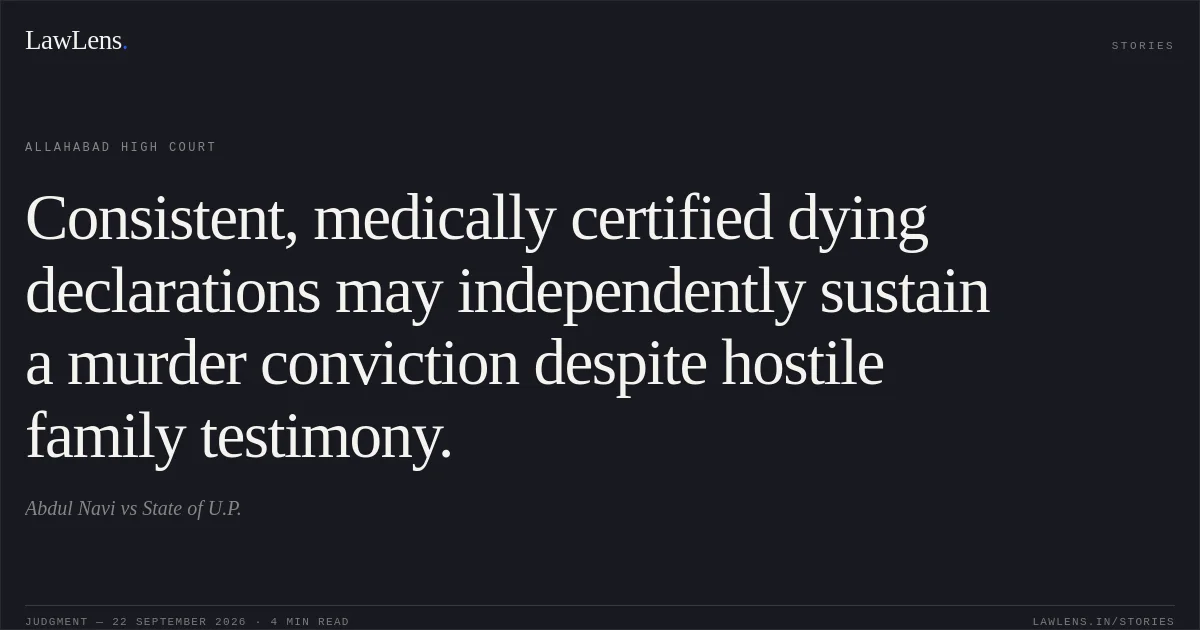
The Court answered the issues against the appellant. It held that the two dying declarations were credible and legally sufficient, that the hostile testimony of the mother did not create a reasonable doubt, and that the medical and physical evidence corroborated the prosecution case.
The conviction of Abdul Navi under Section 302 IPC and the sentence of life imprisonment with a fine of ₹20,000, with one year’s additional imprisonment in default of payment, were affirmed. The criminal appeal was dismissed.
Source reference: para. 33The Court also directed the Legal Services Authority to pay ₹25,000 as legal-aid fees to the learned amicus curiae.
Source reference: para. 34Acts & Sections Cited
4 provisions across 2 statutes referred to in this judgment. Each provision opens on LawLens.
Indian Penal Code, 18602
Code of Criminal Procedure, 19732
Original Court PDF
Abdul NavivsState of U.P.
Click to open original judgment
Original judgment, available to read, download and summarize on LawLens.in