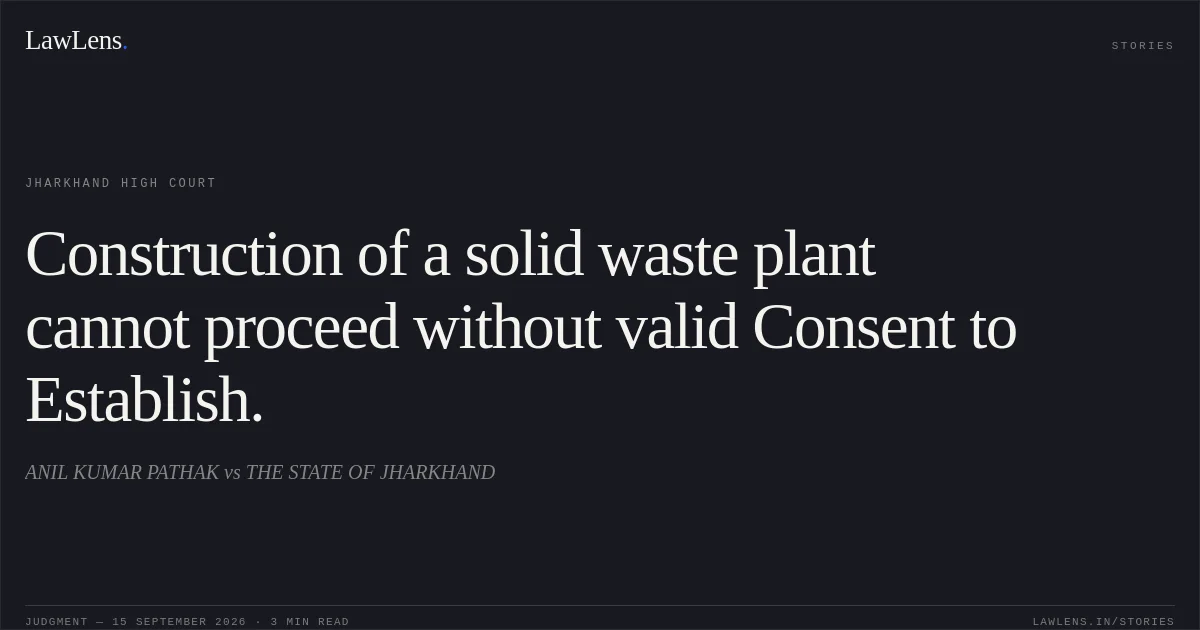
Facts
The petitioners challenged the proposed establishment of a solid-waste management plant by the 7th respondent/project proponent at Mauza Harkha, Khata No. 49, Plot No. 877A, Latehar. They alleged, inter alia, that the plot was situated on the bank of rivers and that part of it constituted a water body.
Source reference: para. 2–3; p. 1–2The Jharkhand State Pollution Control Board (“JSPCB”) had granted Consent to Establish (“CTE”) on 15 June 2023 on an application made by the Executive Officer, Latehar Nagar Panchayat. The CTE was valid for one year.
Source reference: para. 4; p. 2The State subsequently admitted that neither renewal nor a fresh CTE application had been made after expiry of the original consent.
Source reference: para. 5; p. 2The respondents stated that construction had stopped pursuant to assurances given before the Court and that no construction would resume until all requisite permissions, including a valid CTE, were obtained.
Source reference: para. 8; p. 2–3The project proponent agreed to apply afresh for CTE within fifteen days.
Source reference: para. 9; p. 3Issues
1. Whether the project proponent or the 7th respondent could proceed with construction of the solid-waste management plant on the basis of the CTE dated 15 June 2023 after its one-year validity had expired?
Source reference: para. 4–7; p. 22. Whether the JSPCB should consider a fresh application for CTE after hearing the petitioners and permitting them to submit objections concerning the site and the proposed plant?
Source reference: para. 10–16; p. 3–53. Whether construction of the plant or dumping of garbage/solid waste could continue before obtaining a valid CTE and other required permissions?
Source reference: para. 17; p. 4–5Law Applied
The Court applied the regulatory principle that construction and operation of a solid-waste management plant cannot proceed without a valid Consent to Establish and other requisite statutory permissions.
Source reference: para. 6–7, 17; p. 2, 4–5A CTE granted for a specified period ceases to authorise the project upon expiry unless it is duly renewed or replaced by a fresh consent.
Source reference: para. 4–6; p. 2The Court further applied the principles of fresh administrative consideration and procedural fairness by directing the JSPCB to reconsider the matter independently, hear the project proponent and the petitioners, and examine the objections and supporting documents in accordance with law.
Source reference: para. 12–16; p. 3–5No specific statutory provision or precedent was expressly cited in the judgment.
Source reference: no citationReasoning
The Court treated the expiry of the one-year CTE as decisive: since the consent dated 15 June 2023 was no longer valid and no renewal or fresh application had been made, the respondents could not rely on it to continue construction.
Source reference: para. 4–7; p. 2Although the respondents disputed the petitioners’ allegations and maintained that the earlier CTE had been lawfully granted, the Court did not adjudicate the merits of those objections at that stage. Instead, it required a fresh application and directed the JSPCB to consider it afresh, without being influenced by the earlier orders or affidavits, after hearing both sides.
Source reference: para. 8, 11–14; p. 2–4This procedure ensured that the petitioners’ objections regarding the location, riverbank and water-body issues would be placed before the competent regulatory authority.
Source reference: para. 3, 10, 12; p. 2–4Holding
The Court held that the expired CTE did not authorise any further construction and that the project could not proceed without a fresh CTE and other required permissions.
The project proponent was directed to apply for a fresh CTE within fifteen days. Before filing, a copy of the application was to be supplied to the petitioners, who could submit objections and documents within ten days of receipt.
Source reference: para. 9, 12; p. 3–4The JSPCB was directed to hear the project proponent and one nominated petitioner or the petitioners’ advocate and decide the application within 120 days of receipt, communicating its decision to the parties.
Source reference: para. 13–15; p. 4–5Until the CTE and all other required permissions were obtained, no construction or dumping of garbage/solid waste could take place at the site.
Source reference: para. 17; p. 5The PIL was disposed of without costs.
Source reference: para. 18; p. 5Original Court PDF
ANIL KUMAR PATHAKvsTHE STATE OF JHARKHAND
Click to open original judgment
Original judgment, available to read, download and summarize on LawLens.in
![Post-superannuation challenge to dismissal fails; retiral benefits may be pursued only upon acquittal.. Manohar Prasad vs D/o Posts. CAT - ['Kolkata']. LawLens](/stories/thumbnails/post-superannuation-challenge-to-dismissal-fails-retiral-benefits-may-be-pursued-only-upon-952bb65805134b3eb584dc223c8196a7.webp)
![An otherwise eligible unmarried daughter cannot be denied family pension solely for omission from service records.. Kumari Usha jain vs RAILWAY. CAT - ['Delhi']. LawLens](/stories/thumbnails/an-otherwise-eligible-unmarried-daughter-cannot-be-denied-family-pension-solely-for-omissi-d5f0e6353cd1407ab0a1294bc657b4f1.webp)