Facts
Vinita @ Kamlesh married Appellant No. 1, Naveen Kumar Verma, on 29 November 2002. On 10 April 2003, approximately four and a half months after the marriage, she was found hanging from a ceiling fan at her matrimonial home and died as a result of the hanging.
Source reference: pp. 2, 7, 15; paras. 3–4, 26Her father alleged before the SDM that Naveen and his brother, Ajay Kumar Verma, had been beating Vinita and demanding ₹50,000 as dowry. Her mother similarly alleged dowry-related harassment and an attempt by Ajay to establish illicit relations with the deceased.
Source reference: pp. 2–3; para. 4The prosecution relied principally on the testimonies of the deceased’s parents, siblings and uncle, who consistently spoke of the ₹50,000 demand and harassment.
Source reference: pp. 8–10; paras. 15–18The Trial Court convicted both appellants under Sections 304-B and 498-A IPC and sentenced them to ten years’ rigorous imprisonment under Section 304-B and three years’ rigorous imprisonment with fine under Section 498-A, with the sentences to run concurrently.
Source reference: pp. 1–2; para. 1Issues
Whether the prosecution proved beyond reasonable doubt that Vinita was subjected to cruelty or harassment by the appellants for, or in connection with, a demand for dowry soon before her death, thereby attracting Sections 498-A and 304-B IPC.
Source reference: p. 7; para. 14Whether the prosecution established the foundational facts necessary to invoke the presumption of dowry death under Section 113-B of the Indian Evidence Act, 1872.
Source reference: pp. 14–15; paras. 25–26Whether the alleged inconsistencies, improvements, absence of physical injuries or prior complaints, and the defence evidence created a reasonable doubt warranting interference with the conviction.
Source reference: pp. 3–6, 9–14; paras. 7–12, 18–24Whether the Trial Court’s conviction and sentence suffered from perversity requiring appellate interference.
Source reference: p. 7; para. 14Law Applied
The Court applied Sections 304-B and 498-A IPC. Section 304-B requires proof that a married woman died otherwise than under normal circumstances within seven years of marriage and was subjected, soon before her death, to cruelty or harassment by her husband or his relative in connection with a dowry demand; Section 498-A criminalises cruelty by the husband or his relative and does not necessarily require a dowry-related demand.
Source reference: pp. 7–8; para. 14, relying on Gurdip Singh v. State of PunjabUnder Section 113-B of the Evidence Act, the statutory presumption of dowry death arises only after the prosecution proves these foundational facts beyond reasonable doubt.
Source reference: pp. 14–15; para. 25The expression “soon before” denotes a proximity or live-link requirement and is not synonymous with “immediately before”; whether the requirement is satisfied depends on the facts and circumstances of each case.
Source reference: pp. 16–17; para. 29, relying on State of Madhya Pradesh v. Jogendra and Kans Raj v. State of PunjabRelationship alone does not render a witness unreliable, particularly where family members are natural recipients of complaints concerning cruelty within the matrimonial home.
Source reference: pp. 10–11; para. 19, relying on Rajesh Yadav v. State of U.P.Minor discrepancies and omissions concerning dates or details do not invalidate otherwise consistent testimony.
Source reference: pp. 12–14; para. 23, relying on Goverdhan v. State of Chhattisgarh and Bharwada Bhoginbhai Hirjibhai v. State of GujaratReasoning
The Court found that Vinita’s death by hanging within four and a half months of marriage established an unnatural death within seven years of marriage, satisfying the first foundational requirements of Section 304-B IPC.
Source reference: p. 15; para. 26The testimonies of five prosecution witnesses consistently identified a specific demand for ₹50,000 and alleged beatings and harassment beginning after the marriage; the Court treated the witnesses as related but natural witnesses, rather than inherently interested witnesses.
Source reference: pp. 8–11; paras. 15–19, 27Although the evidence concerning the 8 April 2003 telephone call and certain details contained omissions or improvements, the Court held that these did not affect the consistent core allegation of dowry demand and cruelty.
Source reference: pp. 12–14; para. 23The Court further held that the absence of physical injuries, a suicide note or a prior complaint did not, by itself, exclude non-physical cruelty or dowry-related harassment.
Source reference: p. 14; para. 24Since the alleged harassment persisted during the short period of the marriage and the death followed within approximately three months of the alleged commencement of harassment in January 2003, the required proximity between the dowry-related cruelty and death was established.
Source reference: pp. 15–17; paras. 27–29The appellants failed to rebut the Section 113-B presumption: their pleas of absence from the house and an alternative illicit relationship were found unsubstantiated and, in part, unsupported even by their own evidence.
Source reference: pp. 17–18; para. 30Holding
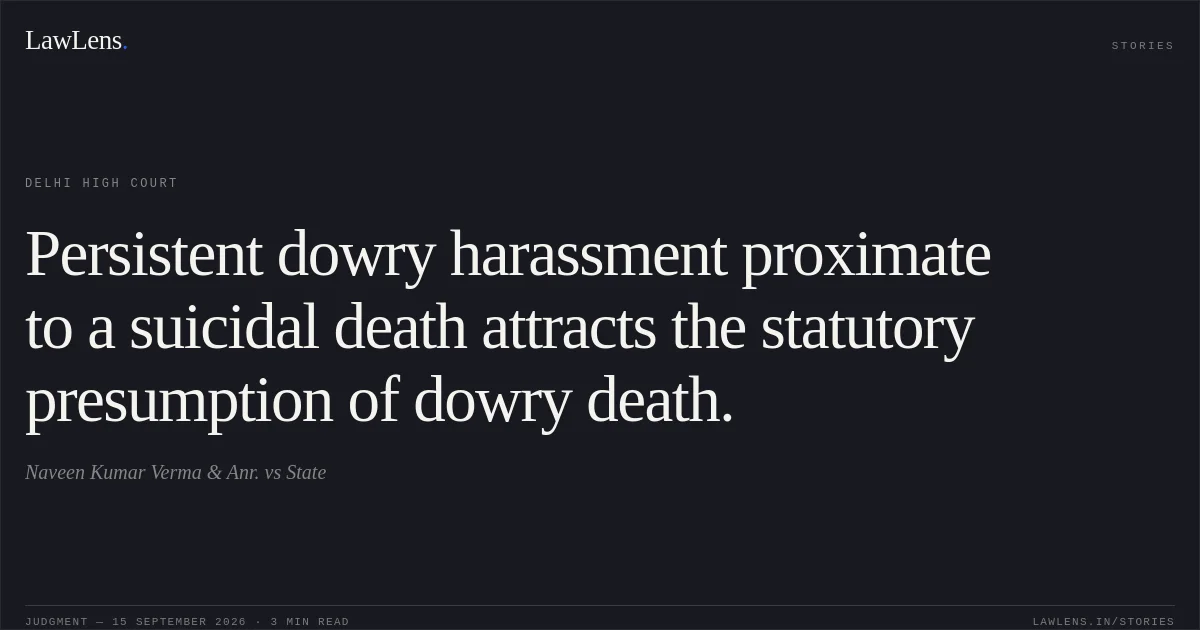
The Court held that the prosecution proved beyond reasonable doubt that Vinita was subjected to dowry-related cruelty and harassment soon before her unnatural death, thereby attracting Sections 304-B and 498-A IPC and the presumption under Section 113-B of the Evidence Act.
The conviction dated 16 August 2004 and order on sentence dated 17 August 2004 were affirmed, and the appeal was dismissed.
Source reference: p. 18; paras. 31–32The appellants were directed to surrender forthwith to undergo the remaining sentence, with the benefit of set-off under Section 428 Cr.P.C.
Source reference: p. 19; para. 33Acts & Sections Cited
5 provisions across 2 statutes referred to in this judgment. Each provision opens on LawLens.
Indian Penal Code, 18601
Code of Criminal Procedure, 19734
Original Court PDF
Naveen Kumar Verma & Anr.vsState
Click to open original judgment
Original judgment, available to read, download and summarize on LawLens.in