Facts
The appellant was convicted in Sessions Trial No. 13/7 of 2020 arising from FIR No. 25/2020 under Sections 354A, 354D, 376 and 506 IPC and Section 4(2) of the POCSO Act. He was sentenced to 20 years’ rigorous imprisonment under Section 4(2) POCSO, along with additional sentences under the IPC.
Source reference: para. 2During the pending criminal appeal, the State sought permission under Section 432 BNSS, corresponding to Section 391 CrPC, to produce the child victim’s Matriculation Certificate and relevant school records, and to re-examine the victim and examine the concerned school record-keeper/Principal.
Source reference: para. 1During trial, the prosecution had already sought to establish the victim’s date of birth as 9 August 2004 through a birth certificate proved by the Panchayat Secretary and a Pariwar Register proved by the Investigating Officer.
Source reference: para. 4The State submitted that the Matriculation Certificate and school record had not been collected or produced due to inadvertence or the Investigating Officer’s ignorance of the preferential method of age determination under Section 94 of the Juvenile Justice (Care and Protection of Children) Act, 2015.
Source reference: paras. 5–9The appellant opposed the application, contending that the prosecution was attempting to fill a lacuna at the appellate stage and that the application was belated and prejudicial.
Source reference: paras. 13–18Issues
Whether the Appellate Court should permit the State to adduce additional evidence under Section 432 BNSS, corresponding to Section 391 CrPC, to prove the victim’s age through her Matriculation Certificate and school records?
Source reference: paras. 19–20, 26–32Whether permitting the additional evidence would amount to filling a lacuna, conducting a retrial, or causing prejudice to the appellant?
Source reference: paras. 15–18, 22–28Whether the victim should be re-examined and the concerned school official examined for proving the relevant age records?
Source reference: paras. 32–33Law Applied
Section 432 BNSS, corresponding to Section 391 CrPC, empowers an Appellate Court to take additional evidence or direct such evidence to be taken where it is necessary for a just decision, provided reasons are recorded and the accused is afforded an opportunity to be present and cross-examine the witnesses.
Source reference: para. 20Section 348 BNSS, corresponding to Section 311 CrPC, permits the Court at any stage to summon, examine, recall or re-examine a person whose evidence appears essential to the just decision of the case.
Source reference: para. 20Section 94 of the Juvenile Justice Act, 2015 prescribes the preferential evidentiary method for determining the age of a child, including reliance on school or Matriculation records.
Source reference: paras. 5, 28The Court relied on Natasha Singh v. CBI, Varsha Garg v. State of Madhya Pradesh, Swapan Kumar Chatterjee v. CBI, Rajeshwar Prasad Misra v. State of West Bengal, Rambhau v. State of Maharashtra, Ashok Tshering Bhutia v. State of Sikkim and V.N. Patil v. K. Niranjan Kumar, holding that additional evidence may be permitted where essential to prevent failure of justice, but not as a disguise for retrial, to change the nature of the case, or merely to fill an incurable lacuna; the power must be exercised sparingly, judiciously and without prejudice to the accused.
Source reference: paras. 21–25Reasoning
The Court held that the proposed evidence concerned an issue already forming part of the prosecution case—namely, that the victim was born on 9 August 2004—and did not introduce any new factual or legal case against the appellant.
Source reference: para. 26Although the prosecution had already produced the birth certificate and Pariwar Register, the Court considered that those documents might not be sufficient under the preferential requirements of Section 94 of the Juvenile Justice Act, particularly when a Matriculation Certificate or school record was available.
Source reference: para. 28The failure to collect and produce the school record was treated as an irregularity arising from investigative negligence or ignorance, rather than an incurable lacuna.
Source reference: paras. 26–30Since the additional evidence was limited to proving the victim’s age, would assist the Court in reaching a just decision, and could be tested through cross-examination and rebuttal evidence, it would neither constitute a retrial nor cause prejudice to the appellant.
Source reference: paras. 26–30The Court therefore found it essential to re-examine the victim and examine the competent school official with the relevant records.
Source reference: paras. 32–33Holding
The application was allowed.
The State was permitted to re-examine PW-1, the child victim, and to examine the record-keeper, Office Superintendent, Principal or other competent official of the concerned school, along with the Matriculation Certificate and complete relevant school record, for the limited purpose of proving the victim’s date of birth in accordance with law.
Source reference: paras. 32–33The appellant was preserved the right to remain present and cross-examine the witnesses on the additional evidence.
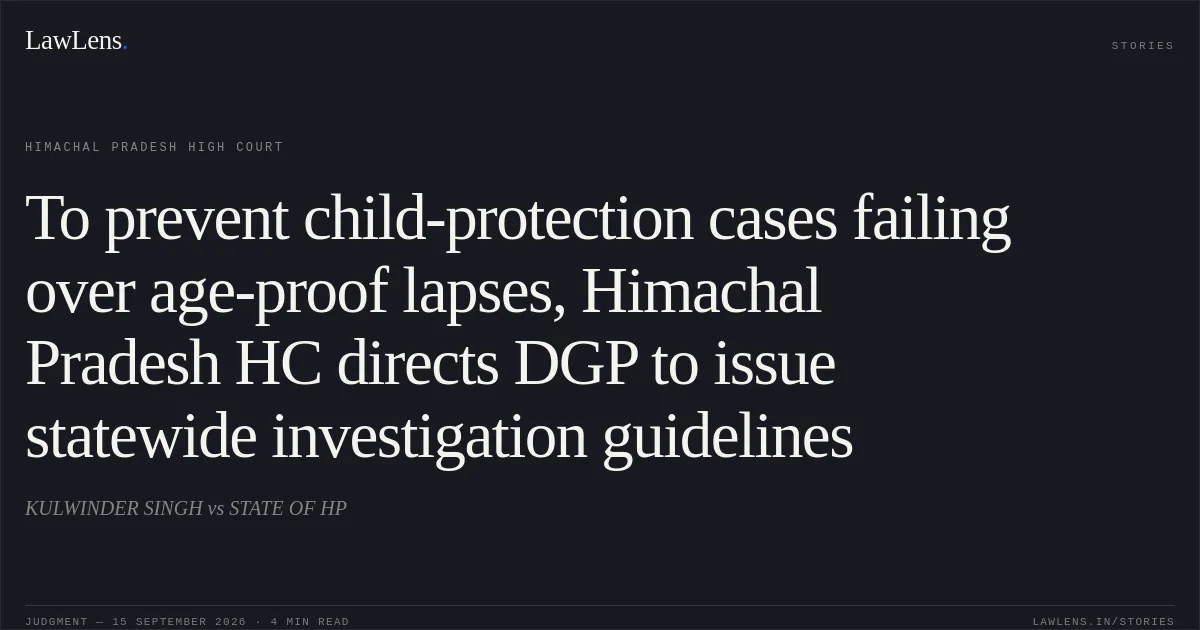
Source reference: paras. 32–33The Court also directed the Director General of Police, Himachal Pradesh, to circulate guidelines requiring Investigating Officers to collect and prove all relevant age documents in cases involving child victims or children in conflict with law.
Source reference: paras. 34–38Acts & Sections Cited
9 provisions across 5 statutes referred to in this judgment. Each provision opens on LawLens.
Bharatiya Nagarik Suraksha Sanhita, 20232
Code of Criminal Procedure, 19733
Indian Penal Code, 18602
Protection of Children from Sexual Offences Act, 20121
Juvenile Justice (Care and Protection of Children) Act, 2015.1
Original Court PDF
KULWINDER SINGHvsSTATE OF HP
Click to open original judgment
Original judgment, available to read, download and summarize on LawLens.in