Facts
The respondents (plaintiffs) filed Partition Suit No. 273 of 2024 in the court of the Civil Judge, Senior Division at Kandi, Murshidabad
Source reference: para. 14The Trial Judge passed Order No. 9 dated June 21, 2025, granting a temporary injunction directing both parties to maintain status quo regarding the nature and character of the suit property
Source reference: paras. 5, 14The appellant challenged this order, contending that they were constructing on a demarcated portion of the property separated by a boundary wall, as evidenced by a Commissioner’s report and title deeds
Source reference: paras. 6, 7The appellant had already completed the ground floor construction up to the roof level
Source reference: para. 8Issues
1. Whether the grant of a status quo injunction was justified given the stage of construction and the demarcated nature of the possession.
Source reference: para. 102. Whether the balance of convenience and the risk of irreparable injury favored the maintenance of the injunction or its vacation.
Source reference: paras. 11, 12Law Applied
The Court applied the traditional tripartite test for civil injunctions under Order XXXIX Rules 1 and 2 of the Code of Civil Procedure, focusing on the principles of "balance of convenience and inconvenience" and "irreparable injury"
Source reference: paras. 8, 11, 12In partition suits, a co-sharer may be permitted to make constructions at their own risk and cost, subject to the final allocation of shares and without claiming special equity
Source reference: paras. 16, 18Reasoning
The Court analyzed the Commissioner’s report, which confirmed that the appellant’s construction reached the roof level and was situated within a demarcated portion separated from the plaintiffs by a boundary wall
Source reference: para. 10The Court reasoned that since the construction was already significantly progressed and physically separated, no "irreparable injury" would be caused to the respondents if the appellant were allowed to complete it
Source reference: para. 11The Court found the "balance of convenience" favored allowing the construction more than halting it, provided certain safeguards were in place
Source reference: para. 12The Court determined that the respondents' interests could be protected by stripping the appellant of any "special equity" and requiring the demolition of the structure at the appellant's cost if the specific land is not eventually allotted to them in the final decree
Source reference: paras. 16, 18Holding
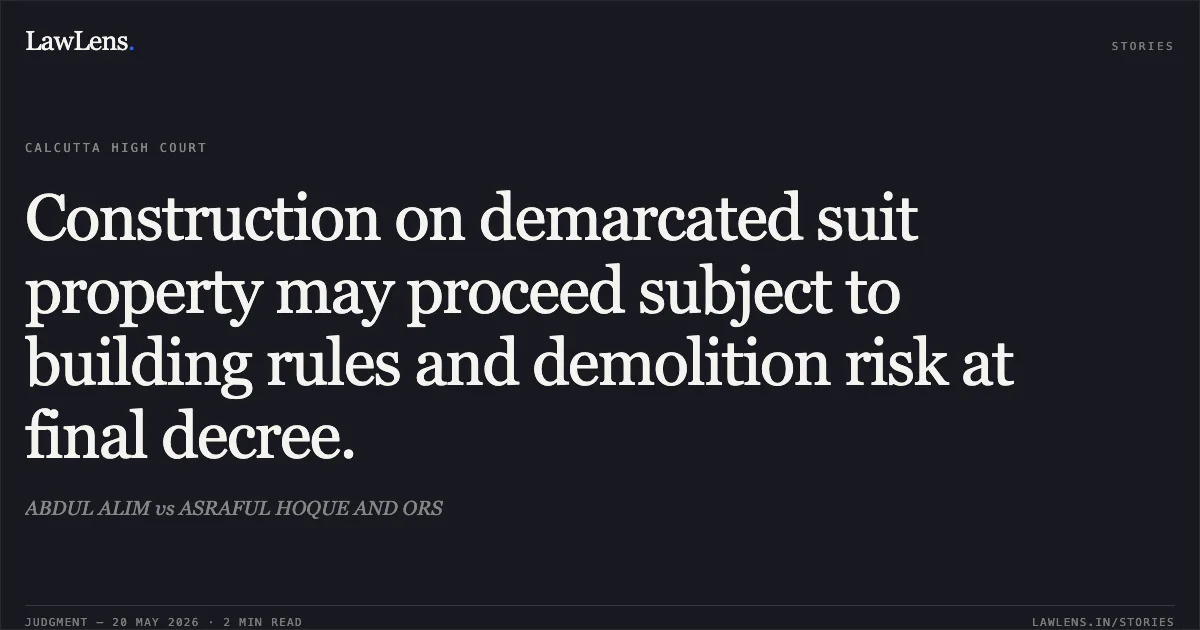
The Court allowed the appeal (FMA 1464 of 2025) and set aside the Trial Court’s status quo order dated June 21, 2025
The holding permitted the appellant to proceed with construction subject to conditions: (i) construction must be on the demarcated portion and comply with building regulations; (ii) the appellant shall claim no special equity; (iii) construction is at the appellant's sole cost; and (iv) if the property is later allocated to other parties in the final partition decree, the appellant must demolish the construction at their own expense.
Source reference: paras. 15, 16, 17, 18Application CAN 1 of 2025 was disposed of accordingly
Source reference: para. 19Acts & Sections Cited
1 provisions across 1 statute referred to in this judgment. Each provision opens on LawLens.
Code of Civil Procedure, 19081
Original Court PDF
ABDUL ALIMvsASRAFUL HOQUE AND ORS
Click to open original judgment
Original judgment, available to read, download and summarize on LawLens.in