Facts
The Appellant, an MSME, pursued unpaid invoices before the Micro and Small Enterprises Facilitation Council.
Source reference: para. 5–9After conciliation failed, the dispute was referred under Section 18(3) of the Micro, Small and Medium Enterprises Development Act, 2006 to the Delhi Arbitration Centre, which appointed a sole arbitrator.
Source reference: para. 5–9The arbitrator awarded the Appellant ₹27,76,996.
Source reference: para. 5–9The Respondent’s Section 34 challenge was allowed solely on the ground that Rule 11(3) of the Consumer Protection (Conditions of Service of President and Members of the State Commission or District Commission) Model Rules, 2020 barred the arbitrator, then President of the Delhi State Consumer Disputes Redressal Commission, from undertaking arbitral work.
Source reference: para. 11–13The Respondent raised that objection for the first time in its rejoinder to the Section 34 petition.
Source reference: para. 11–13The Appellant appealed under Section 37 of the Arbitration and Conciliation Act, 1996.
Source reference: para. 1–3Issues
Whether Rule 11(3), as a service-condition restriction, rendered the arbitrator ineligible under Section 12(5) read with the Seventh Schedule, requiring an express written waiver to validate the award.
Source reference: para. 20, 29–30Whether the alleged restriction otherwise established de jure inability under Section 14(1)(a) sufficient to invalidate the award.
Source reference: para. 20, 23–25Law Applied
Section 12(5) of the Arbitration and Conciliation Act, 1996 makes a person ineligible where their relationship with a party, counsel, or the subject matter falls within a category in the Seventh Schedule; the ineligibility may be waived only by an express written agreement made after the disputes have arisen.
Source reference: para. 21–25Section 14(1)(a) addresses termination of an arbitrator’s mandate upon de jure or de facto inability to perform.
Source reference: para. 21–25As explained in Bhadra International (India) Pvt. Ltd. v. Airports Authority of India, de jure inability may arise under the Arbitration Act or another law, while Section 12(5) ineligibility is a species of that broader category and is confined to the Seventh Schedule.
Source reference: para. 21–25Bharat Broadband Network Limited v. United Telecoms Ltd. confirms the post-dispute written-waiver requirement where Section 12(5) applies.
Source reference: para. 28In Delhi Integrated Multi Modal Transit Systems Ltd. v. Delhi Jal Board, the Court held that a breach of an arbitrator’s service conditions does not, by itself, automatically terminate the arbitral mandate.
Source reference: para. 32–33Reasoning
The objection rested solely on Rule 11(3), a provision regulating the service conditions of Consumer Commission officeholders; the Respondent did not establish any relationship or circumstance bringing the arbitrator within a Seventh Schedule category.
Source reference: para. 29–31Accordingly, Section 12(5) and its written-waiver proviso were not engaged.
Source reference: para. 29–31The Court distinguished the broader concept of de jure inability under Section 14(1)(a) from statutory ineligibility under Section 12(5), and held that any consequence of breaching a service condition would arise under the law governing that office, not automatically under the Arbitration Act.
Source reference: para. 25, 33–35, 43The arbitrator’s appointment through the DAC followed a statutory reference under the MSMED Act, and the Respondent participated in the arbitration without raising the objection; although the delay was not independently decisive, it did not support treating the service restriction as a Section 12(5) bar.
Source reference: para. 37, 39–41Holding
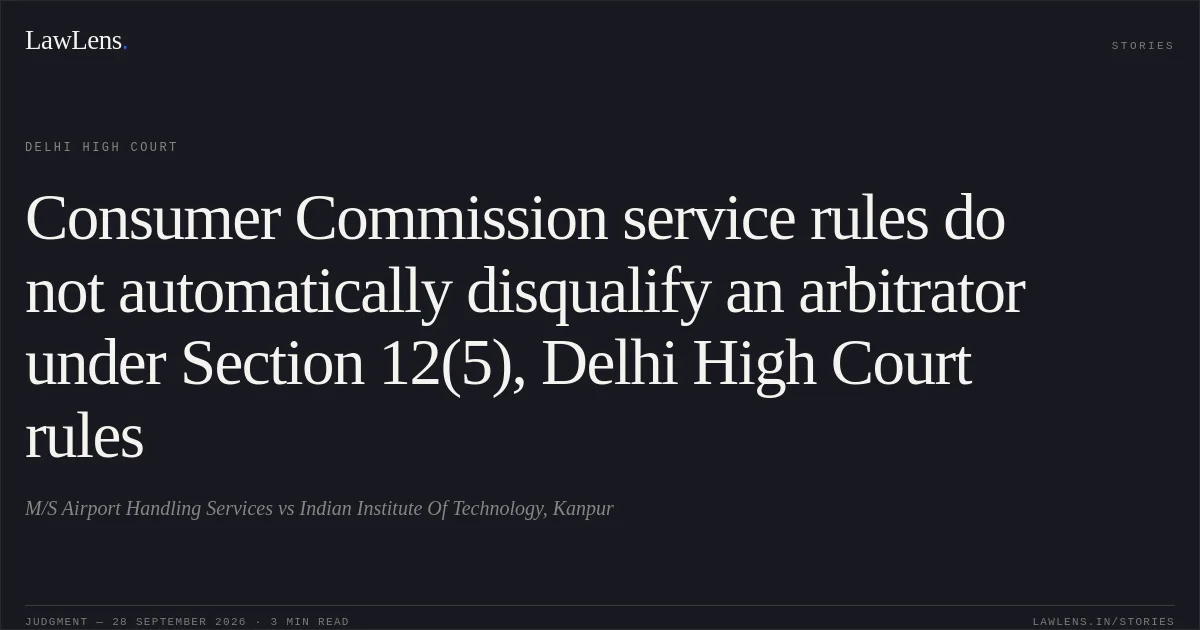
The Court held that Rule 11(3), without a demonstrated Seventh Schedule circumstance, did not render the arbitrator ineligible under Section 12(5) or make the absence of a written waiver fatal to the award.
It allowed the appeal, set aside the Section 34 judgment insofar as it invalidated the award on that ground, and restored the award dated 28 February 2024.
Source reference: para. 49–52The unchallenged findings on the other Section 34 grounds remained undisturbed.
Source reference: para. 49–52Acts & Sections Cited
12 provisions across 3 statutes referred to in this judgment. Each provision opens on LawLens.
Arbitration and Conciliation Act, 1996
Commercial Courts Act, 20151
Micro, Small and Medium Enterprises Development Act, 20062
Original Court PDF
M/S Airport Handling ServicesvsIndian Institute Of Technology, Kanpur
Click to open original judgment
Original judgment, available to read, download and summarize on LawLens.in