Facts
The petitioner’s late father held two Fixed Deposits (FDRs) under the “Kuber Yojana Deposit Scheme” at UCO Bank
Source reference: p. 1, para. 2Following his father's death in 2004, the petitioner obtained a Succession Certificate on 18.05.2023 from the Saket Courts, specifically authorizing the collection of these FDR balances
Source reference: p. 1-2, para. 3Despite submitting the required documents, the bank failed to release the funds, leading the petitioner to file W.P.(C) 16096/2023. Although the Court directed the bank to take steps per the Succession Certificate on 24.02.2025, the bank remained recalcitrant
Source reference: p. 2-3, paras. 4-7The petitioner then filed this contempt petition, prompting the bank to release the principal amount on 10.03.2025, but with only 6% simple interest for the post-maturity period
Source reference: p. 3, paras. 8–9Issues
1. Whether the delay in releasing the FDR amounts following the grant of a Succession Certificate constitutes wilful disobedience of judicial orders
Source reference: p. 4, para. 142. Whether the Court, in its contempt jurisdiction, can grant additional interest and costs to compensate a petitioner for the loss of the "fruits" of a judgment due to a respondent's delay
Source reference: p. 4, para. 15Law Applied
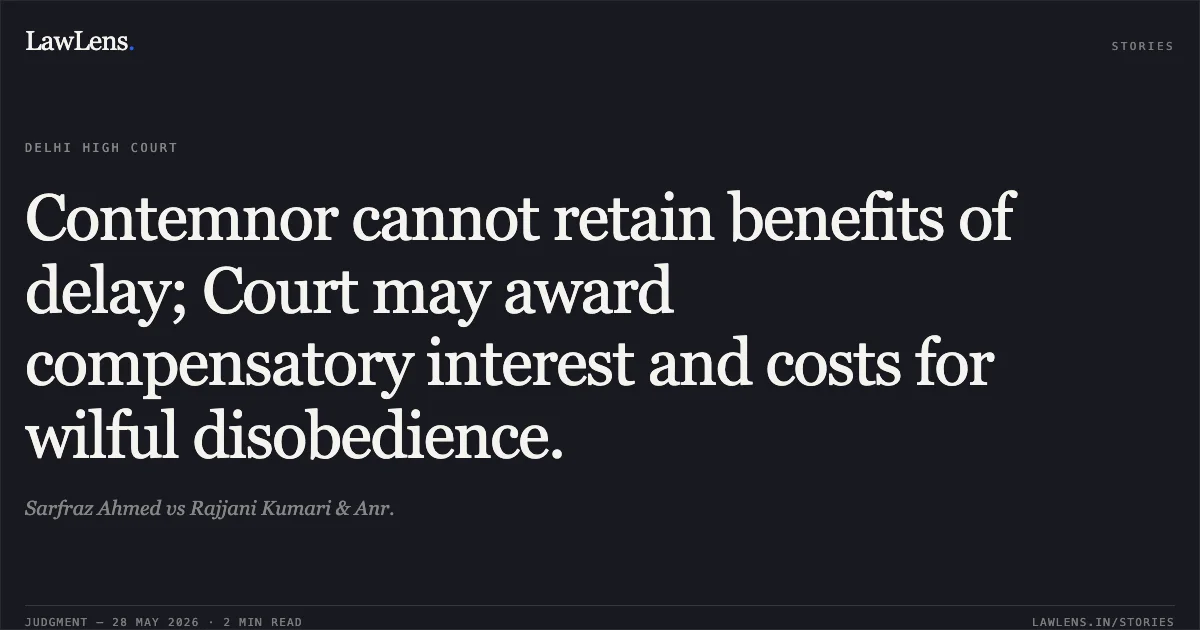
The Court applied the principle that a contemnor cannot be permitted to enjoy the fruits of wilful disobedience, as established in DDA v. Skipper Construction Co. (P) Ltd.
Source reference: p. 4, para. 15(i)It relied on Balwantbhai Somabhai Bhandari v. Hiralal Somabhai, which held that the majesty of law requires nullifying any advantage secured through contumacious conduct
Source reference: p. 6, para. 15(ii)The Court applied the rationale from Anuradha Sharma v. Tis Hazari Courts, asserting that a court in contempt jurisdiction has the power to reverse the "aggravation" caused by the non-implementation of an order by granting interest, as money depreciates over time
Source reference: p. 7, para. 15(iii)Reasoning
The Court found that while the bank complied with its internal policy regarding post-maturity interest rates, there was no valid justification for the delay in releasing the funds between the issuance of the Succession Certificate (18.05.2023) and the actual payout (10.03.2025)
Source reference: p. 4, para. 13The Court determined that this delay resulted in an infraction of the orders passed in the Succession Case and subsequent writ proceedings
Source reference: p. 4, para. 14Reasoning that no litigant should suffer due to the bank's recalcitrance or the court's process, the Court held that the only way to remedy the "wrong" and maintain the majesty of law was to ensure the petitioner was compensated for the period he was deprived of his legitimate dues
Source reference: p. 7, para. 15(iii)Holding
The Court held the bank responsible for wilful disobedience and issued the following directions: (i) The bank must pay an additional 6% p.a. interest on the aggregate amount for the delay period between 18.05.2023 and 10.03.2025
The bank must pay litigation expenses of Rs. 1,00,000/- to the petitioner due to the multiple proceedings required to realize the amount, and all payments must be disbursed within 15 days, upon which the Court refrained from further action against the bank officials and disposed of the petition
Source reference: p. 7-8, paras. 16(ii)-18Acts & Sections Cited
3 provisions across 3 statutes referred to in this judgment. Each provision opens on LawLens.
Indian Succession Act, 19251
Code of Civil Procedure, 19081
Transfer of Property Act, 18821
Original Court PDF
Sarfraz AhmedvsRajjani Kumari & Anr.
Click to open original judgment
Original judgment, available to read, download and summarize on LawLens.in