Facts
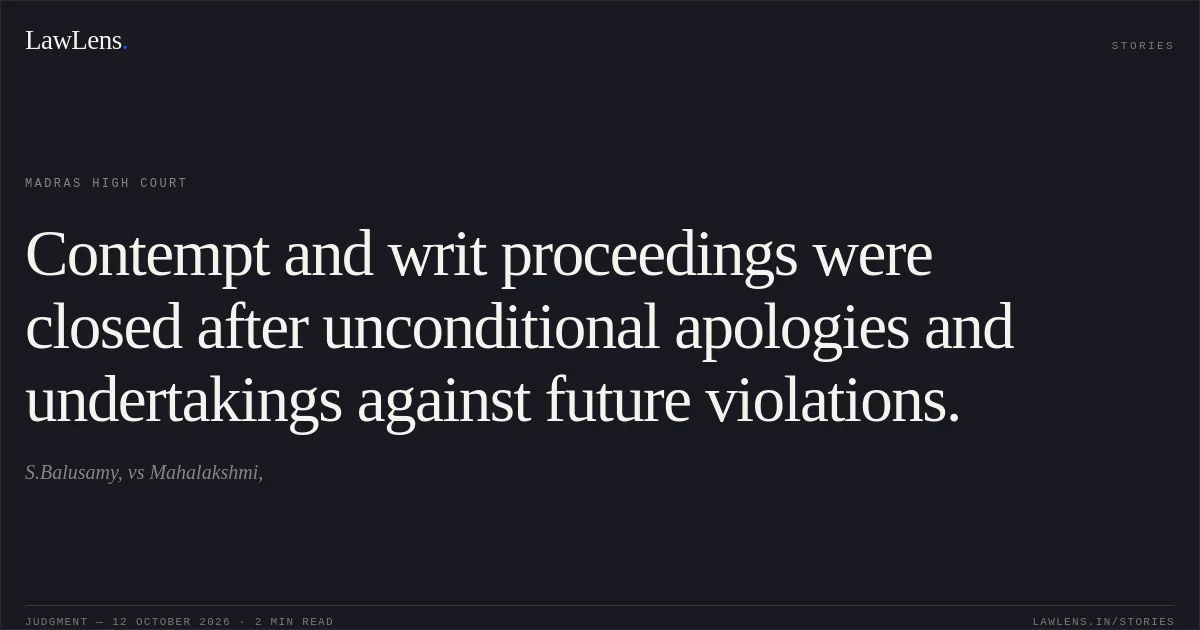
S. Balusamy filed a writ petition seeking a peace committee meeting and postponement of a temple-festival Mulaipari event scheduled for 28–29 July 2026, alleging that it was proposed without including him and 26 other families.
Source reference: p.3The writ petition referred to alleged conduct by private respondents; the later contempt order recorded an allegation that respondents had played songs despite an order prohibiting them from doing so.
Source reference: p.4Balusamy then initiated contempt proceedings alleging non-compliance with the High Court’s order dated 27 July 2026. On 23 September 2026, the Court directed respondents 2 to 5 in the contempt petition to appear and file affidavits explaining whether they had played the songs.
Source reference: p.4On 8 October 2026, those respondents appeared and filed affidavits tendering unconditional apologies.
Source reference: p.5Issues
1. Whether respondents 2 to 5 had wilfully disobeyed the High Court’s earlier order so as to warrant further action in contempt.
Source reference: pp.4–52. Whether the contempt petition and the connected writ petition could be closed after the respondents tendered unconditional apologies and undertook not to repeat the alleged violations.
Source reference: p.5Law Applied
The contempt petition was brought under Section 11 of the Contempt of Courts Act, 1971.
Source reference: p.2The writ petition invoked Article 226 of the Constitution. The Court did not set out or apply any detailed statutory test, precedent, or general contempt doctrine in its order. Its stated basis for disposing of the proceedings was the respondents’ unconditional apologies and their assurance that they would not repeat the alleged violations.
Source reference: pp.3, 5Reasoning
The Court required the respondents to explain, by affidavit and in person, whether they had played songs contrary to the earlier order.
Source reference: p.4When they appeared, tendered unconditional apologies, and stated that they would not repeat the conduct alleged by the petitioner, the Court recorded those undertakings and considered them sufficient to close both proceedings. It did not make a separate express finding on whether contempt had been wilful.
Source reference: p.5Holding
The Court closed the contempt petition and the writ petition, directed the alleged contemnors not to repeat the violations in future, and made no order as to costs.
The connected miscellaneous petitions were also closed.
Source reference: p.5Acts & Sections Cited
1 provisions across 1 statute referred to in this judgment. Each provision opens on LawLens.
Contempt of Courts Act, 19711
Original Court PDF
S.Balusamy,vsMahalakshmi,
Click to open original judgment
Original judgment, available to read, download and summarize on LawLens.in