01Facts
The petitioner alleged wilful disobedience of the Delhi High Court’s order dated 3 July 2026 in W.P.(C) 8635/2026, which directed the NCTE to verify the petitioner institution’s status and, if it was found to be recognised, update its name on the NCTE website within two weeks and thereafter communicate the status to the affiliating body and the Gujarat Department of Higher Education
p. 1 · pp. 2–3 · ¶ 6The petitioner contended that, despite verification, its recognised status had not been uploaded
p. 3 · ¶ 3In response, the NCTE produced the minutes of the 172nd meeting of its Western Regional Committee, held from 13–15 October 2012, showing that the petitioner’s own request for withdrawal of recognition had been accepted and that its fixed deposit receipts were to be returned
p. 3 · ¶ 4 · pp. 5–7 · ¶ 7The NCTE also relied on the petitioner’s 2012 letter stating that it had closed the college and seeking refund of the deposited FDRs
pp. 3–6 · ¶ 5–702Issues
i.Whether the respondents wilfully disobeyed the order dated 3 July 2026 by failing to update the petitioner’s status as a recognised institution on the NCTE website
p. 1 · ¶ 1 · p. 3 · ¶ 3ii.Whether the compliance direction was attracted when the petitioner’s recognition had previously been withdrawn pursuant to its own request and the institution was no longer recognised
pp. 3–8 · ¶ 4–9iii.Whether the petitioner was entitled to challenge the withdrawal of recognition despite the absence of formal communication of the relevant minutes or decision
p. 8 · ¶ 10–1103Law Applied
The Court applied the terms of its earlier order, under which the NCTE was required to update the petitioner’s website status only if verification established that the institution was recognised, and to communicate that status thereafter
pp. 2–3 · ¶ 6The Court also applied the principle that contempt jurisdiction requires a clear and enforceable direction capable of wilful disobedience; where the foundational factual condition for compliance is absent, no contempt can arise.
The Court further recognised that an administrative decision withdrawing recognition may be challenged by the affected institution in accordance with law, particularly where the decision or minutes were not formally communicated
p. 8 · ¶ 10–11No specific statutory provision or precedent was expressly relied upon in the judgment
04Reasoning
The earlier writ direction was conditional: the NCTE had to update the website only if, upon verification, the petitioner was found to be a recognised institution
pp. 2–3 · ¶ 6The materials produced by the respondents demonstrated that the petitioner had itself represented in 2012 that it had closed the college and had sought refund of its FDRs; the WRC subsequently accepted the withdrawal of recognition and directed return of the FDRs
pp. 3–7 · ¶ 4–8Since the petitioner was therefore no longer a recognised institution, the condition precedent to the earlier compliance direction was absent.
Consequently, the failure to list the petitioner as a recognised institution could not constitute wilful disobedience of the order dated 3 July 2026
p. 8 · ¶ 9However, because the petitioner asserted that the withdrawal decision had never been formally communicated, the Court preserved its right to challenge that decision separately
p. 8 · ¶ 10–1105Holding
The Court held that no further order was required in the contempt proceedings because the petitioner was not presently a recognised institution and the earlier direction to update the website was conditional upon recognition
p. 8 · ¶ 9The contempt petition and pending application were disposed of.
p. 8 · ¶ 11–12The petitioner was granted liberty to challenge the withdrawal of recognition in accordance with law
p. 8 · ¶ 11–12Original Court PDF
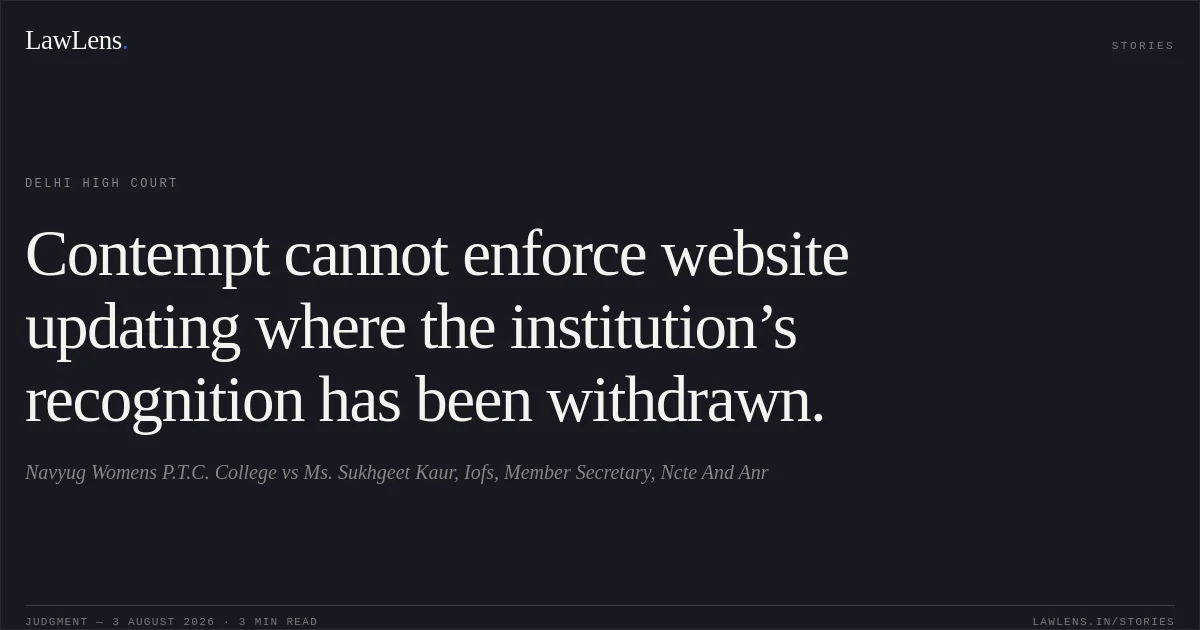
Navyug Womens P.T.C. CollegevsMs. Sukhgeet Kaur, Iofs, Member Secretary, Ncte And Anr
Click to open original judgment
Original judgment, available to read, download and summarize on LawLens.in