Facts
The petitioner challenged the Central Administrative Tribunal’s order dated 26 May 2025, which closed Contempt Petition (CP) No. 339/2024 after finding substantial compliance with its order dated 1 February 2024.
Source reference: p.1The Tribunal’s operative directions required the respondents to refund the amount recovered from the petitioner’s DCRG with applicable GPF interest, pay leave encashment, issue final pension, and pay interest on leave encashment from superannuation until payment.
Source reference: p.2The respondents stated that they had paid the petitioner amounts towards leave encashment, pension commutation, insurance, gratuity, and interest on GPF.
Source reference: p.1The petitioner nevertheless alleged that his pay had not been restored or re-fixed.
Source reference: no citationThe High Court had earlier upheld the Tribunal’s order dated 1 February 2024, while clarifying that any proposed downward re-fixation could be undertaken only prospectively and in accordance with law and natural justice.
Source reference: pp.3–4Issues
1. Whether the respondents’ failure to restore or re-fix the petitioner’s pay constituted wilful and contumacious disobedience of the Tribunal’s order dated 1 February 2024.
Source reference: pp.2–32. Whether the High Court’s earlier order dated 18 November 2024 in W.P.(C) 14959/2024 mandated re-fixation or restoration of the petitioner’s pay.
Source reference: pp.3–43. Whether the petitioner’s grievance regarding pay fixation could be adjudicated in contempt proceedings.
Source reference: p.4Law Applied
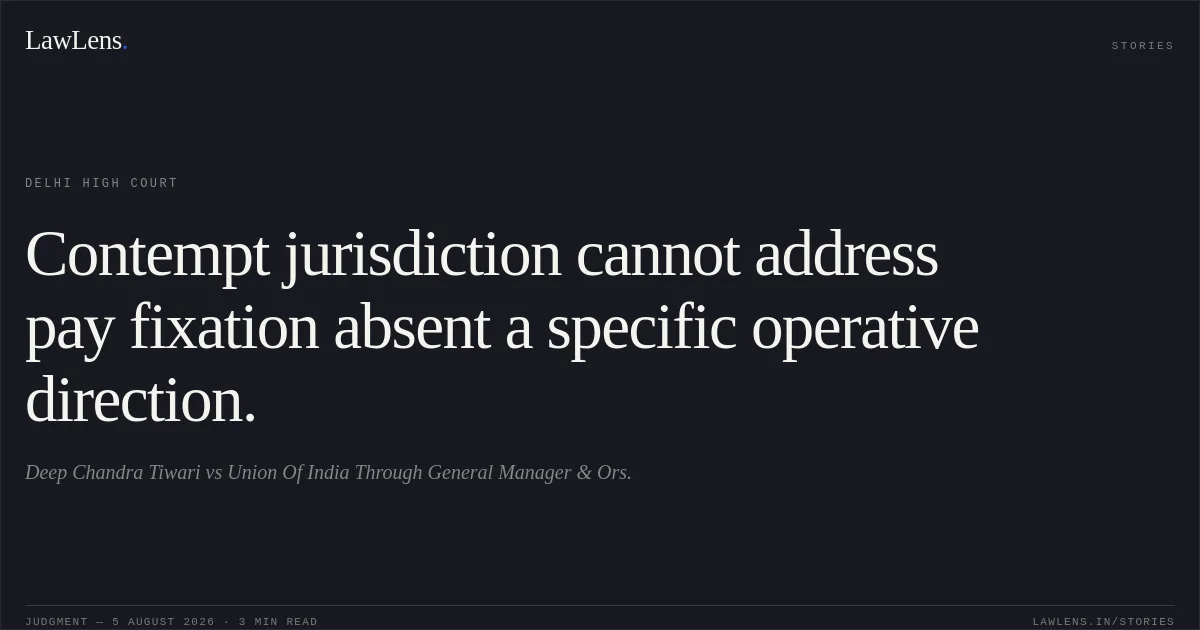
The Court applied the principle that contempt jurisdiction is confined to determining whether a specific and operative judicial direction has been wilfully and contumaciously disobeyed; it cannot be used to adjudicate matters not covered by the original order or to issue new substantive directions.
Source reference: pp.2–4The Court further applied the principle that a proposed downward re-fixation of pay must comply with natural justice and prescribed procedure, and may operate only prospectively where so directed.
Source reference: p.3The earlier judgment dated 18 November 2024 did not itself mandate pay re-fixation; it merely preserved the respondents’ liberty to undertake such action in accordance with law.
Source reference: pp.3–4Reasoning
The Tribunal’s order dated 1 February 2024 directed payment of specified retiral and pensionary dues, but contained no direction requiring restoration or re-fixation of the petitioner’s pay.
Source reference: p.2Since the respondents had paid the amounts directed under that order, there was no non-compliance with its operative terms.
Source reference: p.4The High Court rejected the petitioner’s interpretation of its earlier judgment, holding that the observations concerning possible downward re-fixation were made only in response to the Railways’ request for liberty and were not a mandamus requiring re-fixation.
Source reference: pp.3–4As the contempt petition alleged disobedience only of the Tribunal’s order dated 1 February 2024—not of the High Court’s later judgment—and that Tribunal order did not deal with pay fixation, the petitioner’s grievance fell outside the scope of contempt jurisdiction.
Source reference: p.4Holding
The Court held that non-restoration or non-re-fixation of the petitioner’s pay did not constitute disobedience, much less wilful and contumacious disobedience, of the Tribunal’s order dated 1 February 2024.
Finding no error in the Tribunal’s decision to close the contempt petition, the Court dismissed the writ petition in limine.
Source reference: p.5However, it reserved liberty to the petitioner to pursue appropriate remedies in accordance with law concerning fixation or restoration of pay, clarifying that any authority deciding such proceedings would not be influenced by either the Tribunal’s order dated 26 May 2025 or the present judgment.
Source reference: p.5Original Court PDF
Deep Chandra TiwarivsUnion Of India Through General Manager & Ors.
Click to open original judgment
Original judgment, available to read, download and summarize on LawLens.in