Facts
The petitioner, an advocate appearing in person, filed a contempt case against the office-bearers of the Metropolitan Criminal Court Bar Association, Nampally, alleging violation of the Supreme Court’s directions in Ex-Capt. Harish Uppal v. Union of India and Rule 17 of the Telangana High Court Rules of Practice, 1980.
Source reference: para. 3The respondents had passed a resolution dated 16 June 2025 calling upon advocates to abstain from Court work for one day in protest against alleged attacks on members of the legal profession.
Source reference: para. 3On the same day, the petitioner attempted to enter the Court premises to attend proceedings in a criminal matter and alleged that he was obstructed, threatened and physically assaulted by members of the Bar, including the General Secretary, after he declined to participate in the boycott.
Source reference: para. 3FIR Nos. 159 and 160 of 2025 were registered in relation to the incident, based on the petitioner’s complaint and a counter-complaint by the General Secretary.
Source reference: para. 3.1The petitioner sought punishment of the respondents under Sections 10 to 12 of the Contempt of Courts Act, 1971, and their debarment from practice.
Source reference: para. 1Issues
Whether the resolution dated 16 June 2025 calling upon advocates to abstain from Court work violated the principles laid down by the Supreme Court in Ex-Capt. Harish Uppal v. Union of India and the applicable Rules of Practice.
Source reference: para. 10, Issue No. 1Whether the alleged obstruction and assault of the petitioner in furtherance of the boycott resolution constituted contempt under the Contempt of Courts Act, 1971.
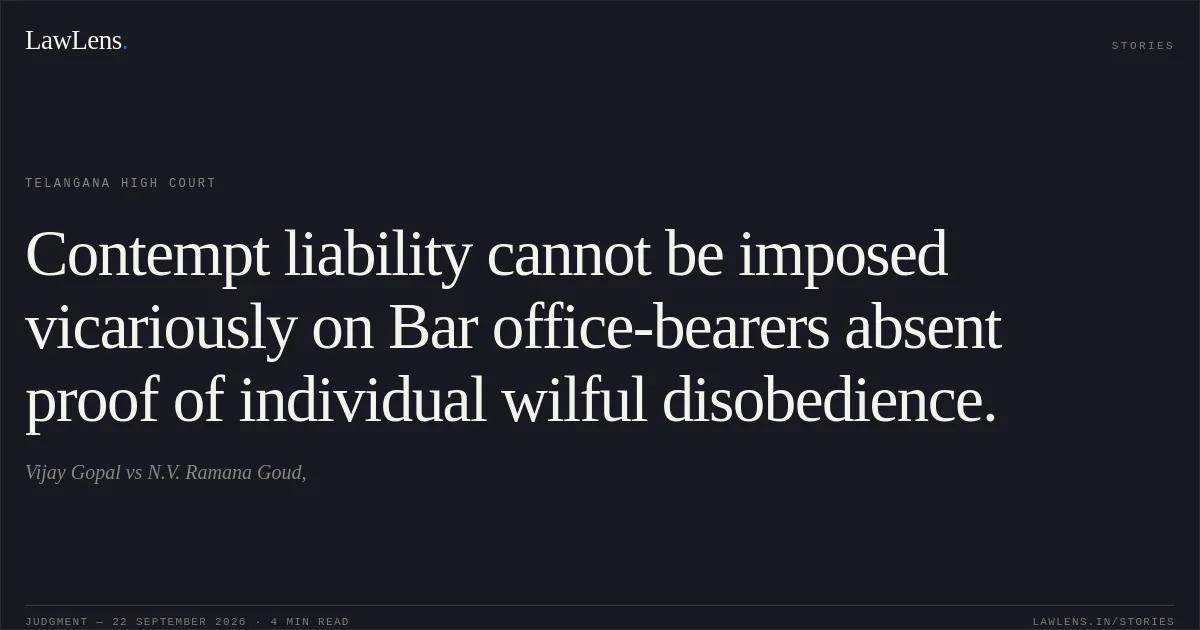
Source reference: para. 10, Issue No. 2Whether contempt liability could be imposed collectively upon the office-bearers of the Bar Association without specific allegations and proof of the individual role of each respondent.
Source reference: paras. 19–20Law Applied
The Court applied Section 2(b) of the Contempt of Courts Act, 1971, under which civil contempt requires wilful disobedience of a judgment, decree, direction, order, writ or other process of a Court, and considered Sections 10 to 12 concerning contempt jurisdiction and punishment.
Source reference: paras. 13–14Section 15, requiring the Advocate-General’s written consent for a private motion alleging criminal contempt, was held applicable to criminal contempt and not, by itself, a bar where the proceedings were examined as civil contempt based on alleged disobedience of binding judicial directions.
Source reference: paras. 13–14Relying principally on Ex-Capt. Harish Uppal v. Union of India, Common Cause v. Union of India, District Bar Association, Dehradun v. Ishwar Shandilya and Krishnakant Tamrakar v. State of Madhya Pradesh, the Court reiterated that advocates have no right to strike or call for a boycott of Court work; no advocate may be coerced or subjected to adverse consequences for attending Court; and any limited one-day abstention can be recognised only in the rarest of rare cases involving the dignity, integrity or independence of the Bar or Bench, subject to consultation with the Chief Justice or District Judge.
Source reference: paras. 15, 17Under Rule 7(1)(a) of the Telangana High Court Rules of Practice, respondents must be properly and individually described, while contempt proceedings require proof of deliberate, conscious and wilful conduct; vicarious liability cannot ordinarily be imposed merely because of an official position.
Source reference: paras. 19–20The Court also relied on Dr. U.N. Bora v. Assam Roller Flour Mills Association for the requirement of proof beyond reasonable doubt in quasi-criminal contempt proceedings and the necessity of establishing individual wilfulness.
Source reference: para. 19Reasoning
The Court held that the resolution was confined to one day and appeared to express solidarity with advocates allegedly attacked, a subject potentially connected with the dignity and independence of the Bar.
Source reference: para. 16However, the respondents produced no material showing that the Bar President had consulted the concerned Metropolitan Sessions Judge before calling for abstention, as required by the limited exception recognised in Harish Uppal.
Source reference: para. 17The Court clarified that even a permissible one-day protest could not authorise coercion, intimidation, obstruction or assault against an advocate who chose to attend Court.
Source reference: paras. 17–18Nevertheless, the alleged assault and obstruction involved disputed questions of fact, were the subject of pending criminal proceedings, and could not be adjudicated through a parallel summary contempt inquiry.
Source reference: paras. 21–23Further, the petitioner had not established a specific overt act or conscious participation by each respondent; collective impleadment based only on office held in the Bar Association was insufficient, and no vicarious liability could be imposed for the alleged conduct of respondent No. 5.
Source reference: paras. 19–20The Court therefore declined to proceed with contempt while expressly stating that its decision did not approve or legitimise any assault, coercion or obstruction of an advocate attending Court.
Source reference: para. 23Holding
The Court dismissed the contempt case and declined to impose contempt liability on the respondents because the alleged incident involved disputed facts pending in criminal proceedings and there was insufficient material establishing wilful disobedience or individual participation by the respondents.
It reiterated that Bar Associations cannot compel advocates to join a boycott or penalise those who attend Court, and that no protest may obstruct access to Court or interfere with the administration of justice.
Source reference: paras. 23–24The prayer to debar the office-bearers from practice was consequently not granted; pending miscellaneous petitions were closed and there was no order as to costs.
Source reference: paras. 25–26Acts & Sections Cited
12 provisions across 3 statutes referred to in this judgment. Each provision opens on LawLens.
Contempt of Courts Act, 19716
Bharatiya Nyaya Sanhita, 20235
Advocates Act, 19611
Original Court PDF
Vijay GopalvsN.V. Ramana Goud,
Click to open original judgment
Original judgment, available to read, download and summarize on LawLens.in