Facts
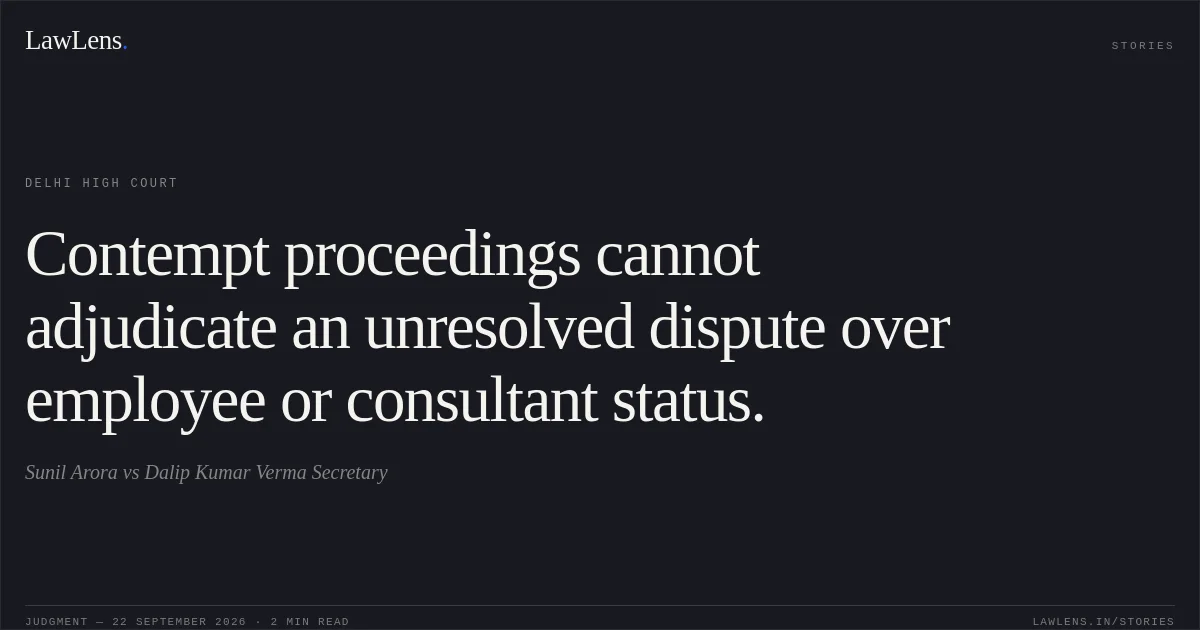
The petitioner initiated contempt proceedings alleging wilful disobedience of the Delhi High Court’s order dated 21 May 2026 in W.P.(C) 4987/2026.
Source reference: p.1, para. 1The respondent submitted that the direction had been complied with and produced certificates issued to the petitioner, namely Form 16AA and Form 16 Part A and Part B.
Source reference: p.2, paras. 2–3The petitioner disputed compliance, contending that he had served as a Consultant and Advisor (Law) and was therefore entitled to Form 16A, applicable to consultants, rather than Form 16, applicable to salaried employees.
Source reference: p.2, paras. 4–5The respondent maintained that the petitioner was a salaried employee and not a consultant.
Source reference: p.2, para. 6The same classification dispute had been raised before the Writ Court in CM APPL. 44491/2026, which was disposed of by order dated 6 August 2026; the petitioner’s subsequent recall application, CM APPL. 57703/2026, was dismissed on 25 August 2026.
Source reference: p.2, para. 7; p.3, paras. 8–10Issues
1. Whether the respondent had wilfully disobeyed the order dated 21 May 2026 by issuing Form 16/Form 16AA instead of the Form 16A allegedly applicable to the petitioner.
Source reference: p.1, para. 1; p.2, paras. 2–62. Whether the contempt court could determine, in the absence of a merits adjudication by the Writ Court, whether the petitioner was an employee entitled to Form 16 or a consultant entitled to Form 16A.
Source reference: p.5, paras. 11–12Law Applied
The Court applied the principle that contempt jurisdiction is confined to examining compliance with an existing, clear and enforceable court direction and cannot be used to adjudicate an underlying dispute that has not been decided on merits.
Source reference: p.5, paras. 11–12Where the alleged non-compliance depends upon determining the petitioner’s disputed legal status as an employee or consultant, the contempt court cannot issue substantive directions without a prior adjudication of that issue.
Source reference: p.5, para. 12No specific statutory provision or judicial precedent was cited in the judgment.
Source reference: no citationReasoning
The Court noted that the respondent had produced documents evidencing issuance of the relevant tax certificates, while the petitioner’s objection depended on his contention that he was a consultant rather than a salaried employee.
Source reference: p.2, paras. 2–6Since the Writ Court had expressly stated in its earlier orders that the petitioner’s claim had not been examined on merits, the question of his status remained unresolved.
Source reference: p.5, para. 11Determining whether Form 16 or Form 16A was legally appropriate would therefore require adjudication of that disputed status, which was beyond the permissible scope of the present contempt proceedings.
Source reference: p.5, paras. 11–12Holding
The Court declined to find contempt or issue further directions because the alleged non-compliance could not be determined without deciding whether the petitioner was an employee or a consultant.
The petitioner was granted liberty to pursue appropriate remedies in accordance with law to establish his status and challenge the form issued by the respondent.
Source reference: p.5, para. 13The contempt petition and the pending application were accordingly disposed of.
Source reference: p.6, para. 14Original Court PDF
Sunil AroravsDalip Kumar Verma Secretary
Click to open original judgment
Original judgment, available to read, download and summarize on LawLens.in