Facts
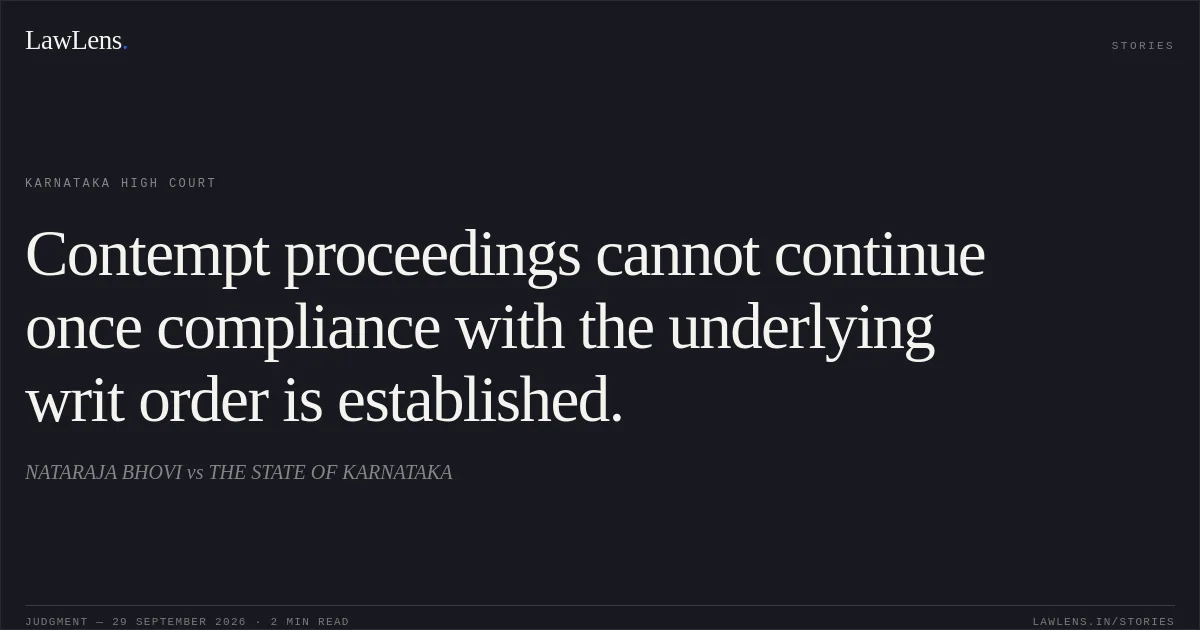
The complainant initiated contempt proceedings under Sections 11 and 12 of the Contempt of Courts Act, 1971, alleging non-compliance with the order dated 12 July 2024 in W.P. No. 28156 of 2023.
Source reference: p. 2That order directed the Tahsildar to determine and communicate the fair price for the land and provided for its payment by the complainant.
Source reference: pp. 2, 6–7In an earlier compliance affidavit, the then Tahsildar stated that the fair price had been paid and a saguvali chit for 2 acres and 33 guntas in Survey No. 33 had been issued to the complainant.
Source reference: pp. 7–8A subsequently filed affidavit by the incumbent Tahsildar asserted that the land was recorded as State Forest/minor forest and that proceedings had been initiated before the Assistant Commissioner to cancel the grant.
Source reference: pp. 2–5The incumbent sought leave to withdraw the earlier compliance affidavit.
Source reference: pp. 2–5Issues
Whether the contempt petition could be sustained when the earlier compliance affidavit stated that the writ court’s direction had been complied with.
Source reference: pp. 7–9Whether the subsequent challenge to the land grant affected the disposal of the contempt petition.
Source reference: pp. 4–5, 9Law Applied
The Court considered Sections 11 and 12 of the Contempt of Courts Act, 1971, under which contempt proceedings had been brought.
Source reference: p. 2It treated the earlier compliance affidavit—recording payment of the fair price and issuance of the saguvali chit—as establishing compliance with the writ court’s order for the purpose of the contempt petition.
Source reference: pp. 7–9The Court also made clear that subsequent proceedings concerning the grant could be pursued in accordance with law, without expressing any view on their merits.
Source reference: p. 9Reasoning
The writ court had directed the Tahsildar to determine and communicate the fair price, and the earlier Tahsildar’s affidavit stated that the amount had been paid and the saguvali chit issued.
Source reference: pp. 6–8Although the incumbent Tahsildar disputed the propriety of the grant and sought to withdraw the earlier affidavit, the Court concluded that the compliance affidavit was already on record and that the writ order had attained finality for the purpose of the contempt proceeding.
Source reference: pp. 5, 8–9The asserted defects in the grant did not require determination in contempt; the authorities remained free to pursue lawful proceedings concerning it, and the Court expressed no view on the merits.
Source reference: p. 9Holding
The Court held that no cause remained to sustain the contempt petition in light of the compliance affidavit and consigned the petition.
It left open the accused’s ability to proceed in accordance with law regarding the alleged irregularities in the grant and clarified that it had made no merits determination.
Source reference: p. 9Acts & Sections Cited
2 provisions across 1 statute referred to in this judgment. Each provision opens on LawLens.
Contempt of Courts Act, 19712
Original Court PDF
NATARAJA BHOVIvsTHE STATE OF KARNATAKA
Click to open original judgment
Original judgment, available to read, download and summarize on LawLens.in