01Facts
The petitioner challenged the Central Administrative Tribunal’s order dated 26 May 2025 dismissing Contempt Petition No. 871/2024 in O.A. No. 1360/2015.
p. 1The underlying Tribunal order dated 6 October 2015 had directed the respondents to consider the applicants and similarly situated persons for regularisation and, if regularised from a particular date, to subsequently consider their promotion from the dates on which their juniors had been promoted.
p. 1Although the applicants were later regularised/promoted, the petitioner alleged that the respondents had failed to meaningfully consider their entitlement to promotion with effect from the dates their juniors were promoted, amounting to contempt.
p. 2The respondents contended that the applicants had been promoted as Executive Engineers from the date of assumption of charge and were not yet eligible for promotion as Superintending Engineers because the applicable rules required an eight-year residency period.
pp. 2–3The Tribunal found no wilful disobedience and dismissed the contempt petition.
pp. 3–402Issues
i.1. Whether the respondents had wilfully disobeyed the Tribunal’s order dated 6 October 2015 by failing to grant or meaningfully consider the applicants’ promotion with effect from the dates on which their juniors were promoted.
pp. 1–2, 3–4ii.2. Whether the petitioner could use contempt proceedings to adjudicate the underlying substantive entitlement to retrospective promotion and the computation of eligibility for promotion to higher grades.
p. 4iii.3. Whether the Tribunal’s dismissal of the contempt petition warranted interference under writ jurisdiction.
p. 403Law Applied
The Court applied the settled principle that contempt jurisdiction is concerned with determining whether there has been wilful disobedience of a clear and operative judicial direction; it is not ordinarily the forum for adjudicating disputed or substantive service entitlements that extend beyond the terms of the original order.
p. 4The Court further applied the principle that where the original order merely directs consideration of a claim, compliance is assessed by examining whether the authority considered the claim and passed an order, rather than by deciding in contempt proceedings whether the authority reached the legally correct conclusion on the claimant’s entitlement to promotion.
pp. 1–2, 404Reasoning
The original Tribunal order directed the respondents to consider the applicants’ cases for regularisation and, if the applicants were regularised from a particular date, to subsequently consider their promotion from the dates on which their juniors had been promoted.
p. 1The respondents relied on subsequent regular promotion orders, the review DPC proceedings, the applicants’ seniority positions, and the applicable eight-year residency requirement for promotion to Superintending Engineer.
pp. 2–3The High Court held that the petitioner’s contention—that regularisation entitled the applicants to have the intervening period counted for promotion eligibility—raised substantive questions concerning promotion and service benefits, rather than demonstrating wilful disobedience of the Tribunal’s direction.
p. 4Those questions could not legitimately be resolved in contempt proceedings.
p. 4Since the Tribunal had found no case of wilful disobedience and had left the petitioner at liberty to pursue any surviving claim concerning non-consideration for promotion, the High Court found no ground for interference.
p. 405Holding
The High Court upheld the Tribunal’s dismissal of the contempt petition, holding that no wilful disobedience of the order dated 6 October 2015 had been established.
p. 4The petitioner was left at liberty to agitate any surviving substantive grievance regarding consideration for promotion to higher grades in appropriate proceedings.
p. 4The writ petition was consequently dismissed.
p. 4Original Court PDF
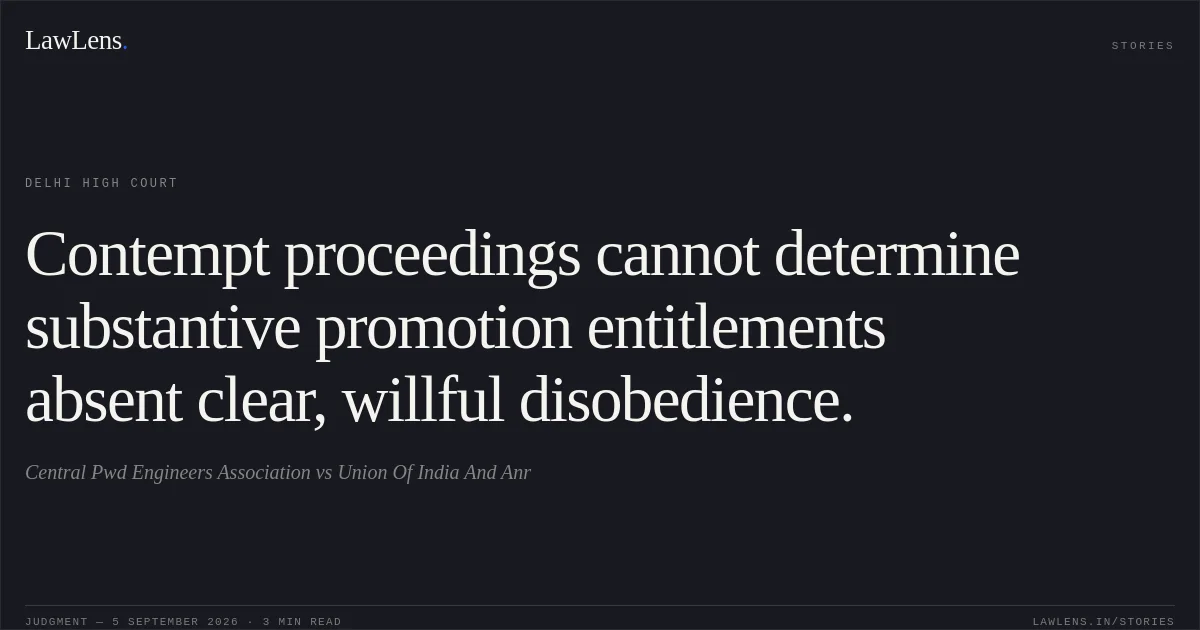
Central Pwd Engineers AssociationvsUnion Of India And Anr
Click to open original judgment
Original judgment, available to read, download and summarize on LawLens.in