Facts
The petitioner sought implementation of a common judgment dated 30 January 2018 allowing two writ petitions. The judgment quashed a seniority list insofar as it placed the private respondent above the petitioner and directed that the petitioner be placed first in Category-D (Legal Assistant), with promotional benefits to follow in accordance with the revised seniority.
Source reference: para. 1The respondents reported that they had refixed the petitioner’s seniority and revised her promotion and regularisation dates; they also stated that arrears had been paid and her pension revised.
Source reference: para. 2The petitioner contended that the respondents had not implemented her separate claim in SWP No. 1042/2014 for consideration for promotion to Additional Secretary from 2011–2012, particularly from 29 April 2011, when her junior was promoted.
Source reference: paras. 3, 5She asserted that the resulting delay also affected her subsequent promotions.
Source reference: para. 3The contempt petition concerned whether that omission breached the 2018 judgment.
Source reference: paras. 7–10Issues
Whether the 2018 judgment directed the respondents to consider or promote the petitioner to Additional Secretary from 2011–2012, such that failure to do so could constitute contempt.
Source reference: paras. 7–9Whether the respondents’ actions amounted to a wilful default in implementing the directions actually made by the writ court.
Source reference: para. 10Law Applied
A person may be proceeded against for contempt only where a wilful default in implementing the court’s judgment is established.
Source reference: para. 10If a direction is capable of more than one plausible interpretation and the authority adopts a possible and plausible interpretation in the circumstances, that conduct does not amount to wilful disobedience.
Source reference: para. 10The court also applied the principle that contempt proceedings enforce the directions actually contained in the judgment; a claim on which the writ court gave no specific direction cannot, by itself, establish breach of that judgment.
Source reference: paras. 8–10Reasoning
The operative directions in the 2018 judgment quashed the seniority list, required the petitioner’s placement first in Category-D, and directed promotional benefits in accordance with the refixed seniority.
Source reference: paras. 1, 8Although the petitioner had sought consideration for promotion to Additional Secretary from 2011–2012 in SWP No. 1042/2014, the writ court did not discuss or determine that claim, focusing instead on the seniority dispute between the petitioner and the private respondent.
Source reference: paras. 5, 7–8The court further observed that the officer promoted to Additional Secretary in 2011 was not a party to the writ petitions, which could reasonably have contributed to the respondents’ understanding of the judgment’s scope.
Source reference: para. 9Because no specific direction required promotion to Additional Secretary from 2011, and the respondents had refixed seniority and given retrospective effect to promotions in accordance with the judgment, the court found no wilful disobedience.
Source reference: paras. 9–10Holding
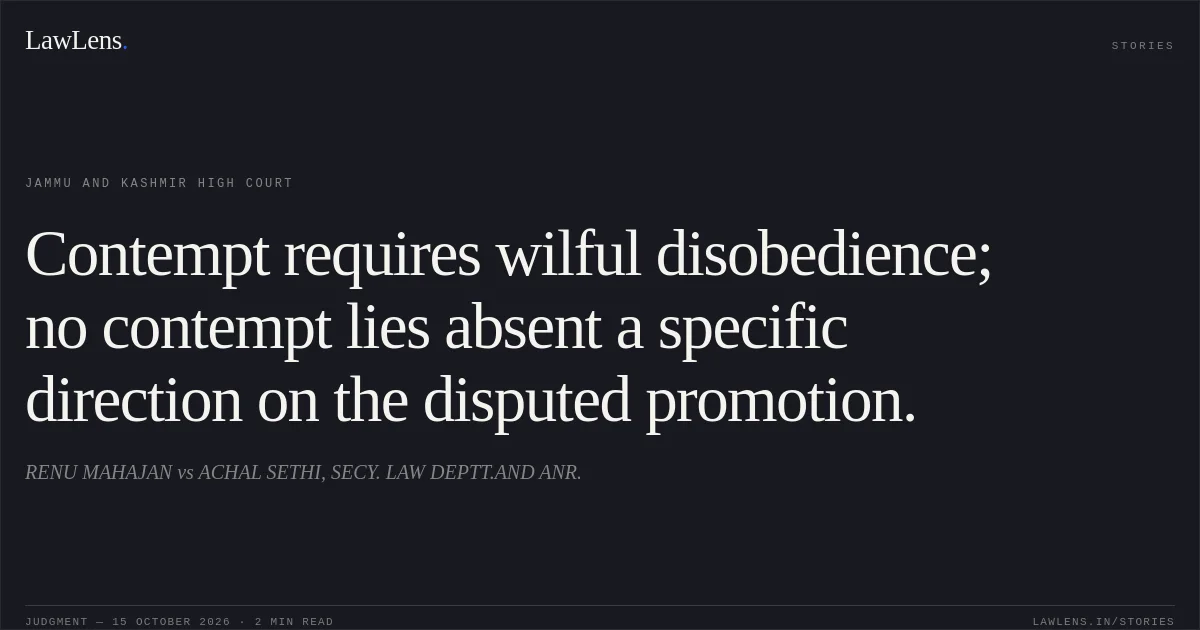
The court held that the respondents had not committed contempt of the 2018 judgment.
It found that they had complied with its directions by refixing the petitioner’s seniority and giving retrospective effect to her promotions, while the judgment contained no specific direction concerning promotion to Additional Secretary from 2011.
Source reference: para. 10The contempt proceedings were closed.
Source reference: para. 11Original Court PDF
RENU MAHAJANvsACHAL SETHI, SECY. LAW DEPTT.AND ANR.
Click to open original judgment
Original judgment, available to read, download and summarize on LawLens.in
![The competent authority must decide the appeal by a reasoned, speaking order within four weeks.. DR NISHANT GOYAL vs HEALTH. CAT - ['Delhi']. LawLens](/stories/thumbnails/the-competent-authority-must-decide-the-appeal-by-a-reasoned-speaking-order-within-four-we-51ef3c532385466483f4156703e7e0bc.webp)
![Competent authority must decide the pending representation by a reasoned order within four weeks.. AJAY YADAV vs MUNICIPAL CORPORATION OF DELHI (GNCTD). CAT - ['Delhi']. LawLens](/stories/thumbnails/competent-authority-must-decide-the-pending-representation-by-a-reasoned-order-within-four-1bec6310839148709c127f0a0c64e2b5.webp)
