01Facts
The claimant, a teacher earning a fixed salary of ₹4,500 per month, sustained injuries in a road accident and was assessed as having 12% functional disability.
pp. 1–2The Tribunal attributed 90% negligence to the truck driver and 10% to the Hero Honda driver.
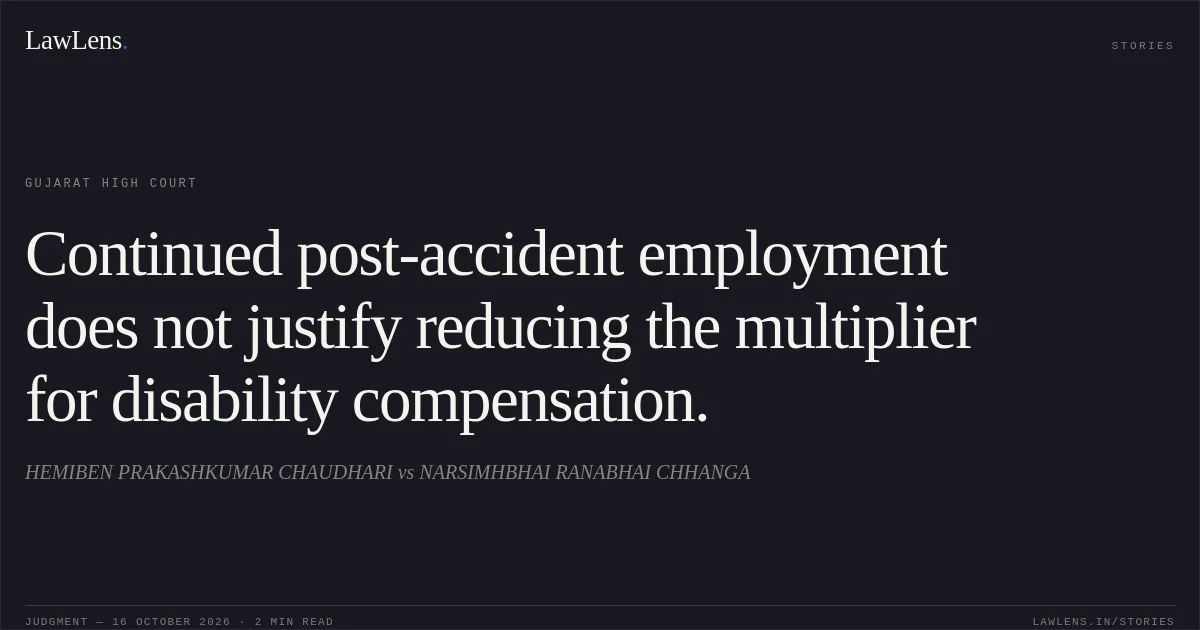
pp. 1–2Although the claimant continued working after the accident, the Tribunal applied a multiplier of 5 and awarded ₹88,400.
pp. 1–2The claimant appealed under Section 173 of the Motor Vehicles Act, 1988, challenging the compensation assessment.
pp. 1–202Issues
i.1. Whether the Tribunal was justified in applying a multiplier of 5 because the claimant continued working after the accident.
pp. 1–2ii.2. Whether the compensation of ₹88,400 should be enhanced in light of the claimant’s injuries and functional disability.
pp. 2–303Law Applied
Section 173 of the Motor Vehicles Act, 1988 provides for an appeal against an award of the Motor Accident Claims Tribunal.
p. 1The Court relied on National Insurance Company Ltd. v. Pranay Sethi, (2017) 16 SCC 680, in discussing the principles governing just, fair and equitable compensation.
p. 2It also applied the principle stated in Reliance General Insurance Company Limited v. Priyanka Das & Ors., 2026 INSC 950, that the regular multiplier should be used even where the victim continues in regular employment after the accident.
p. 2It also noted the same view in Rakeshkumar Navnitlal Shah v. Hirenkumar Kiritkumar Shah, First Appeal No. 636 of 2012.
p. 2Provisions in the judgment · 1 · Linked ones open on LawLens
Motor Vehicles Act, 1988 Section 173
04Reasoning
The Court held that the Tribunal had no reason to reduce the multiplier to 5 merely because the claimant continued working after the accident; that approach was inconsistent with the cited authorities and the requirement of just compensation.
p. 2However, having considered the disability certificate, which recorded restricted leg movement and a fracture of the fibula, the Court considered the case suitable for global compensation.
pp. 2–3It accordingly increased the award without altering the negligence ratio.
p. 305Holding
The appeal was partly allowed.
p. 3The compensation was increased from ₹88,400 to ₹1,60,000, an enhancement of ₹71,600, carrying interest at 7.5% per annum from the date of the petition until realization.
p. 3The existing inter se negligence ratio was maintained, and both insurance companies were directed to deposit their respective shares of the enhanced compensation and accrued interest within eight weeks.
p. 3The Tribunal was directed to disburse the amount, subject to verification, due procedure and applicable court fees.
p. 3Original Court PDF
HEMIBEN PRAKASHKUMAR CHAUDHARIvsNARSIMHBHAI RANABHAI CHHANGA
Click to open original judgment
Original judgment, available to read, download and summarize on LawLens.in