Facts
Arti Devi married appellant Vishal Ravidas on 16 April 2019 and died an unnatural death at her matrimonial home on 29 May 2020, within fourteen months of marriage.
Source reference: paras. 16(i), 26The appellant initially informed the deceased’s parental family that she had died of electrocution while ironing clothes. Her body was subsequently subjected to post-mortem examination and cremated.
Source reference: paras. 16(ii)–(iii), 19.1The informant, the deceased’s father, later alleged that the appellant and his family members had demanded ₹50,000 and a motorcycle, subjected the deceased to cruelty, and strangulated her when the motorcycle demand remained unfulfilled.
Source reference: paras. 15, 19, 28.1–28.2The post-mortem examination found multiple abrasions and bruises, and the medical officer opined that the cause of death was asphyxia due to constriction of the neck by pressure, namely strangulation.
Source reference: para. 21After the informant was allegedly assaulted when he questioned the appellant regarding the death, his fardbeyan was recorded on 31 May 2020; the formal FIR was registered on 10 July 2020.
Source reference: paras. 5, 16(v)The appellant and his father were charged under Sections 302/34, 304B/34, 341/34, 504/34 and 323/34 IPC.
Source reference: para. 8The trial court convicted them under Sections 304B/34 and 323/34 IPC and sentenced the appellant to ten years’ rigorous imprisonment under Section 304B/34 IPC and one year’s simple imprisonment with fine under Section 323/34 IPC.
Source reference: para. 3During the appeal, the appellant’s father died and the appeal against him abated.
Source reference: para. 2Issues
Whether the prosecution established that the deceased died a dowry death within the meaning of Section 304B IPC, including death otherwise than under normal circumstances within seven years of marriage and cruelty or harassment for, or in connection with, a dowry demand soon before death?
Source reference: paras. 26–28.2Whether the medical evidence and surrounding circumstances established that the deceased was strangulated, and whether the appellant’s defence of death by electrocution created a reasonable doubt?
Source reference: paras. 21, 27–27.1Whether the alleged omission of the dowry demand from the informant’s fardbeyan and the delayed registration of the formal FIR undermined the prosecution case?
Source reference: paras. 23, 28Whether the appellant rebutted the statutory presumption of dowry death under Section 113B of the Indian Evidence Act?
Source reference: para. 28.2Law Applied
The court applied Section 304B IPC, under which a death is a dowry death when a woman dies from burns, bodily injury, or otherwise than under normal circumstances within seven years of marriage and it is shown that soon before her death she was subjected to cruelty or harassment by her husband or his relatives in connection with a dowry demand.
Source reference: paras. 26–28.2Section 113B of the Indian Evidence Act requires the court to presume that a person caused the dowry death where the foundational facts of dowry-related cruelty or harassment soon before death are established.
Source reference: para. 28.2The court also considered Section 323/34 IPC concerning voluntarily causing hurt in furtherance of common intention, and Section 428 Cr.P.C. concerning set-off of the period undergone in custody.
Source reference: paras. 3, 29The court recognised that an FIR need not contain every detail of the prosecution case and that the testimony of close parental relatives may be relied upon in dowry-death cases, particularly where the alleged cruelty occurs within the matrimonial home and independent witnesses are ordinarily unavailable.
Source reference: paras. 22, 28–28.1The judgments in Karan Singh v. State of Haryana and Nagendra Sah v. State of Bihar were relied upon by the appellant in argument, but the appeal was decided principally on the statutory requirements of Sections 304B IPC and 113B of the Evidence Act.
Source reference: paras. 23.1–23.2Reasoning
The court held that the requirement concerning the timing of death was satisfied because the deceased died within fourteen months of marriage.
Source reference: para. 26The post-mortem findings of abrasions and bruises, together with the medical opinion attributing death to strangulation, contradicted the appellant’s claim of electrocution.
Source reference: paras. 21, 27The appellant’s alternative suggestion that the injuries could have resulted from a fall after electrocution was treated as inconsistent with his principal defence, and there was no evidence of electrocution at the place of occurrence or in the post-mortem findings.
Source reference: para. 27Since the deceased was last present in the appellant’s house and the injuries were matters particularly within his knowledge, his failure to provide a plausible explanation further supported the prosecution case.
Source reference: para. 27.1Although the informant’s fardbeyan did not mention the demand for ₹50,000 and a motorcycle, the court found that this omission was not fatal because the fardbeyan was recorded after the death of the informant’s daughter and after he had allegedly been assaulted when questioning the accused.
Source reference: para. 28The evidence of PW-2, PW-3 and PW-4 consistently indicated that the demand began shortly after marriage, that the cash demand was fulfilled, and that the demand for a motorcycle remained unfulfilled.
Source reference: paras. 19–20, 28.1The court inferred continuity of the harassment because there was no evidence that the demand ceased or that cordial relations were restored before the death.
Source reference: paras. 28.1–28.2These circumstances established dowry-related cruelty soon before death, thereby attracting the presumption under Section 113B of the Evidence Act. The appellant failed to rebut that presumption through credible evidence.
Source reference: para. 28.2The same evidence also supported the conviction under Section 323/34 IPC for assaulting the informant.
Source reference: para. 29Holding
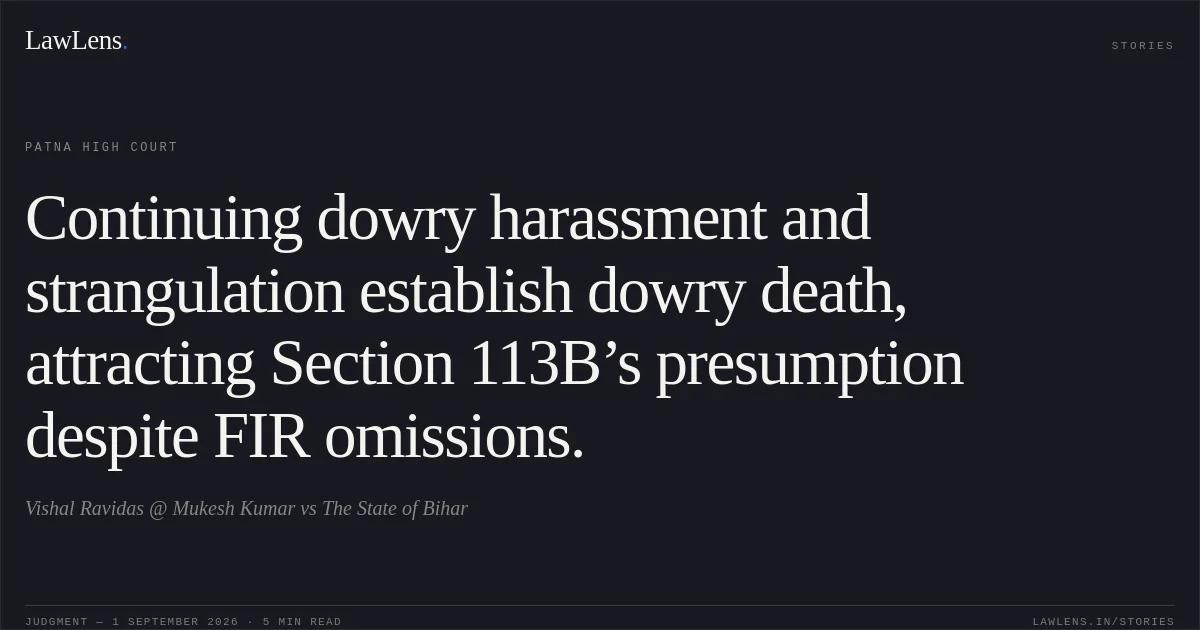
The Patna High Court held that the prosecution proved all essential ingredients of dowry death under Section 304B IPC: the deceased died otherwise than under normal circumstances within fourteen months of marriage, was subjected to cruelty and harassment connected with a dowry demand, and was strangulated when the motorcycle demand remained unfulfilled.
The appellant failed to establish the defence of electrocution or rebut the presumption under Section 113B of the Indian Evidence Act.
Source reference: paras. 27.1, 28.2The conviction under Sections 304B/34 and 323/34 IPC and the sentences imposed by the trial court were affirmed.
Source reference: para. 29.1The appeal was dismissed as devoid of merit, and the trial court records were directed to be transmitted for compliance.
Source reference: paras. 29.1–30Acts & Sections Cited
8 provisions across 3 statutes referred to in this judgment. Each provision opens on LawLens.
Indian Penal Code, 18605
Code of Criminal Procedure, 19732
Bharatiya Nagarik Suraksha Sanhita, 20231
Original Court PDF
Vishal Ravidas @ Mukesh KumarvsThe State of Bihar
Click to open original judgment
Original judgment, available to read, download and summarize on LawLens.in