Facts
The respondent was appointed as a Hamal (part-time loader/porter) against a vacant sanctioned post in 1992
Source reference: p. 1Under a Government Circular dated 26.12.1980, part-time employees were entitled to absorption after three years of service; however, in 1995, the State kept this circular in abeyance, preventing the respondent’s regularization
Source reference: p. 1-2Over the next decade, the respondent’s working hours fluctuated between three, four, and six hours by various administrative orders
Source reference: p. 2-3In 2007, a new Government Resolution (G.R. dated 01.05.2007) allowed for one-time regularization provided the employee had 10 years of service and worked at least 6 hours daily as of 10.02.2006
Source reference: p. 4The State rejected the respondent’s claim, citing technical non-compliance with the 6-hour daily work requirement
Source reference: p. 4-5The learned Single Judge quashed this rejection and ordered regularization, leading to this appeal by the State
Source reference: p. 4Issues
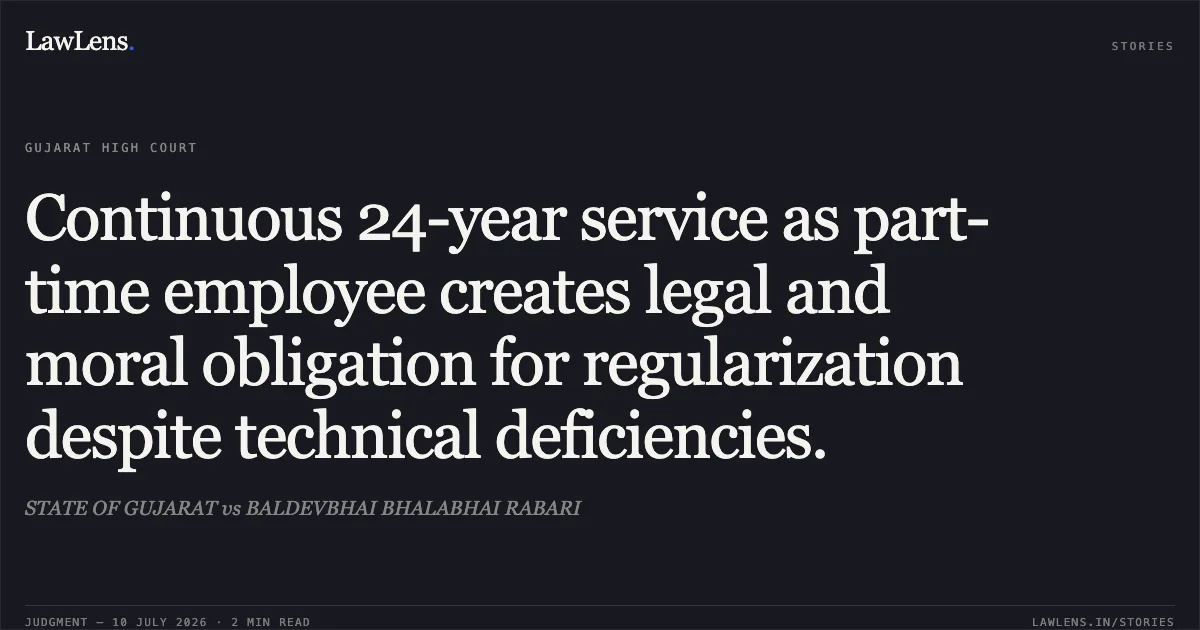
1. Whether the State is legally and morally obligated to regularize the services of a part-time employee who has completed 24 years of continuous service despite technical shortfalls in daily working hours specified in Government Resolutions
Source reference: p. 5-62. Whether the suspension of a beneficial circular (G.R. dated 26.12.1980) can indefinitely deprive an employee of the right to be considered for regularization when they met the initial criteria during their tenure
Source reference: p. 6-7Law Applied
The court's reasoning was grounded in the principles of legitimate expectation and the State's obligations as a model employer.
Source reference: no citationThe Government Resolution dated 26.12.1980 regarding the absorption of part-time employees after three years
Source reference: p. 1Government Resolution dated 01.05.2007, which established criteria for one-time regularization after 10 years of service
Source reference: p. 4the principle that the State has both a legal and moral obligation to regularize long-standing employees to prevent the extraction of labor for nearly a quarter of a century without permanent status
Source reference: p. 5Reasoning
The court observed that the respondent had served for 24 years—nearly a quarter of a century—as a Hamal
Source reference: p. 5It noted that the respondent initially had a right to regularization under the 1980 Circular upon completing three years in 1995, but this was frustrated by the State's decision to keep the circular in abeyance
Source reference: p. 6The Court rejected the State's technical arguments regarding the failure to meet the 6-hour daily work requirement under the 2007 G.R., characterizing them as "technical in nature"
Source reference: p. 6The Bench reasoned that extracting work for over two decades creates an inescapable moral and legal duty for the State to provide security of tenure
Source reference: p. 5The Court emphasized that an employee spends their entire life serving the State with the "fond hope" of eventual regularization, and such long-standing service overrides minor administrative or technical deficiencies in the application of subsequent policy resolutions
Source reference: p. 7Holding
The High Court dismissed the State's appeal, affirming the Single Judge's order for regularization
The Court held that 24 years of continuous service per se entitles an employee to regularization, and the State cannot rely on technicalities to defeat such a claim
Source reference: p. 7The Court directed the State to compute all consequential benefits the respondent is entitled to and make payment within six weeks
Source reference: p. 7Original Court PDF
STATE OF GUJARATvsBALDEVBHAI BHALABHAI RABARI
Click to open original judgment
Original judgment, available to read, download and summarize on LawLens.in