Facts
The applicant, a Tech-II in the Electrical Department, was declared surplus and redeployed to the Mechanical Department at Bhadrak via an order dated 10.12.2018
Source reference: p. 2He challenged this transfer in OA 122/2019, where an interim order was passed on 24.07.2019 directing the respondents not to take coercive action regarding the transfer
Source reference: p. 2Despite this, the applicant remained absent from duty starting 11.12.2018, citing private medical certificates
Source reference: p. 6, 9On 27.01.2023, the applicant submitted a representation requesting either a transfer modification or, alternatively, voluntary retirement (VRS)
Source reference: p. 4The respondents issued a show-cause notice on 06.08.2024 for unauthorized absence exceeding five years
Source reference: p. 4On 17/18.10.2024 and 26.11.2024, the respondents issued orders treating the applicant as "deemed to have resigned" from service effective immediately, citing his continuous absence since 2018
Source reference: p. 7The applicant filed this OA to quash those orders and compel the acceptance of his VRS application.
Source reference: no citationIssues
1. Whether the applicant’s request dated 27.01.2023 constitutes a valid, unconditional application for Voluntary Retirement (VRS)
Source reference: p. 112. Whether the respondents’ action in treating the applicant as "deemed resigned" under Rule 510(2) of the IREC Vol. I due to five years of continuous absence is legally sustainable
Source reference: p. 11Law Applied
Rule 510(2) of the Indian Railway Establishment Code (IREC) Vol. I, as circulated under RBE No. 186/2019
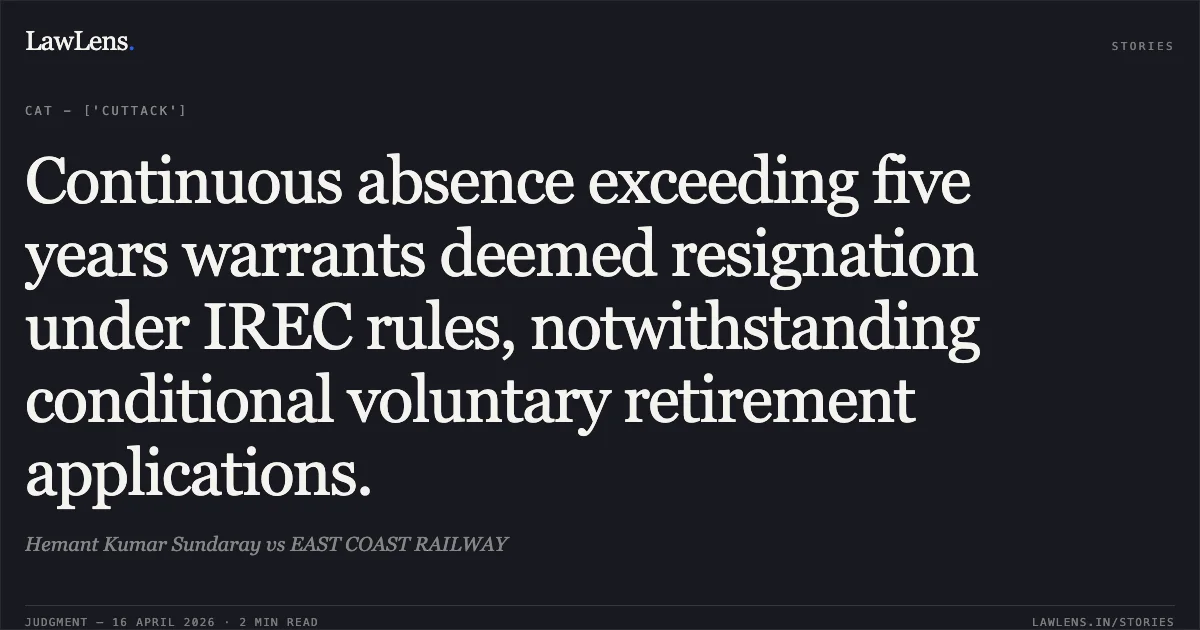
Source reference: p. 6This rule stipulates that no Railway servant shall be granted leave of any kind for a continuous period exceeding five years and that any servant absent for a continuous period exceeding five years (other than on foreign service), with or without leave, shall be deemed to have resigned from Railway service
Source reference: p. 14Reasoning
The Tribunal observed that the applicant’s letter dated 27.01.2023 was conditional, stating he would be "compelled to submit" his VRS only if his transfer was not modified
Source reference: p. 11Such a conditional request cannot be construed as a valid notice for voluntary retirement
Source reference: p. 11Regarding the unauthorized absence, the Tribunal found that the interim order in the previous litigation (OA 122/2019) protected the applicant only from coercive action regarding the transfer order but did not grant him a right to remain absent from duty for an indefinite period
Source reference: p. 13Furthermore, the applicant failed to report to the Railway Hospital for medical evaluation as directed and could not justify his five-year absence through the COVID-19 pandemic, which was limited in duration
Source reference: p. 12Since the applicant failed to prove his leave was sanctioned and the absence exceeded the five-year threshold, the statutory "deemed resignation" under Rule 510(2) was triggered automatically
Source reference: p. 14Holding
The Tribunal dismissed the Original Application, holding that the applicant's letter was not a valid VRS application and that the respondents correctly applied Rule 510(2) of the IREC Vol. I
The court upheld the orders dated 17/18.10.2024 and 26.11.2024, confirming that the applicant is deemed to have resigned from Railway service due to continuous absence exceeding five years
Source reference: p. 14All pending miscellaneous applications were also disposed of
Source reference: p. 14Acts & Sections Cited
1 provisions across 1 statute referred to in this judgment. Each provision opens on LawLens.
Indian Penal Code, 18601
Original Court PDF
Hemant Kumar SundarayvsEAST COAST RAILWAY
Click to open original judgment
Original judgment, available to read, download and summarize on LawLens.in