Facts
The appellant entered into an Agreement to Sell (ATS) dated 19th June 2008 for a property in Delhi for Rs. 55.5 Lacs, paying Rs. 20 Lacs (Rs. 10 Lacs earnest money, Rs. 10 Lacs part-payment).
Source reference: p. 3The sale was to be completed by 1st August 2008. While both parties appeared at the Sub-Registrar's office on the stipulated date, the sale deed was not executed.
Source reference: p. 4The appellant issued a legal notice on 2nd August 2008 and later filed a police complaint seeking a refund of money rather than execution.
Source reference: p. 4, 35The Trial Court dismissed the suit for specific performance, holding that the appellant failed to prove continuous readiness and willingness to pay the balance of Rs. 35.5 Lacs.
Source reference: p. 7The appellant appealed, also filing an application (CM 8298/2017) to produce additional bank statements as evidence.
Source reference: p. 2Issues
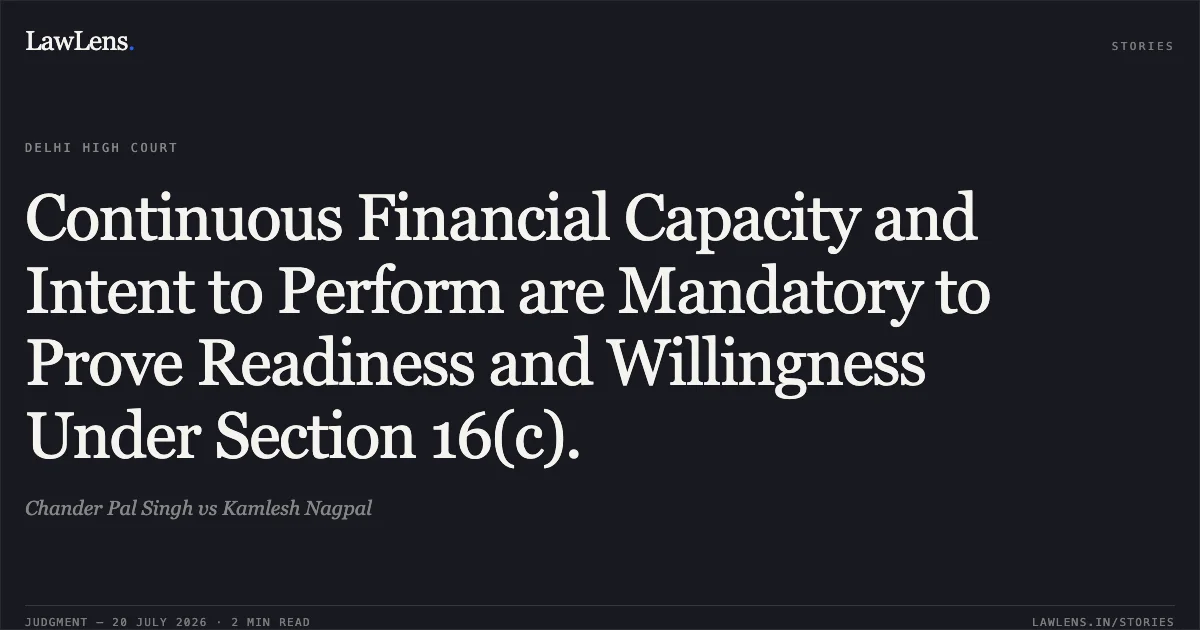
1. Whether the plaintiff/appellant was ready and willing at all times to perform his part of the obligations as per Section 16(c) of the Specific Relief Act.
Source reference: p. 6, para 6.162. Whether the appellant is entitled to a decree of specific performance or, in the alternative, a refund of earnest money.
Source reference: p. 1-23. Whether additional evidence regarding bank capacity can be admitted at the appellate stage under Order XLI Rule 27 of the CPC.
Source reference: p. 2, 33Law Applied
The court applied Section 16(c) of the Specific Relief Act, 1963 (pre-2018 amendment), which mandates that a plaintiff must "aver and prove" continuous readiness and willingness from the date of contract until the decree.
Source reference: p. 17-18The 2018 amendment is prospective and inapplicable to older transactions as established in Pydi Ramana v. Davarasety Manmadha Rao.
Source reference: p. 17The court cited J.P. Builders v. A. Ramadas Rao and C.S. Venkatesh v. A.S.C. Murthy to distinguish "readiness" (financial capacity) from "willingness" (conduct).
Source reference: p. 19-22Regarding additional evidence, the court applied Order XLI Rule 27 of the CPC and the principles in Sanjay Kumar Singh v. State of Jharkhand, stating that additional evidence is only permissible if the court requires it to pronounce judgment or for substantial cause.
Source reference: p. 34-35Reasoning
The court found that while the appellant proved his presence at the Sub-Registrar's office, he failed to prove "continuous" financial readiness.
Source reference: p. 23, 26The cheques produced were third-party account-payee cheques, which carried no guarantee of encashment on the execution date and belonged to accounts that lacked sufficient funds during the cheques' validity periods.
Source reference: p. 24-27The court observed that willingness was absent because the appellant’s police complaint dated 29th August 2008 sought a "refund," which is inconsistent with an intent to perform the contract.
Source reference: p. 27-28The court determined that the proposed bank statements (from 2011) would not rectify the failure to show capacity in 2008 and were not necessary for the court to reach a decision.
Source reference: p. 36-37Holding
The court upheld the Trial Court’s refusal to grant specific performance, holding that the plaintiff failed the statutory requirement of showing continuous readiness and willingness.
The final order rejected the application for additional evidence (CM 8298/2017) and directed the respondent to refund the Rs. 10 Lacs earnest money to the appellant within four weeks, disposing of the appeal.
Source reference: p. 37, 32-33Acts & Sections Cited
2 provisions across 2 statutes referred to in this judgment. Linked provisions open on LawLens.
Code of Civil Procedure, 19081
Specific Relief Act, 19631
Original Court PDF
Chander Pal SinghvsKamlesh Nagpal
Click to open original judgment
Original judgment, available to read, download and summarize on LawLens.in